Household Robot Market 요약
주요 시장 동향 및 하이라이트
시장 규모 및 예측
| CAGR (2025 - 2035) | 13.36% |
주요 기업
iRobot (US), Samsung (KR), LG Electronics (KR), Ecovacs Robotics (CN), Neato Robotics (US), Roborock (CN), Dyson (GB), Amazon (US), Sony (JP)
| CAGR (2025 - 2035) | 13.36% |
The Household Robot Market is currently experiencing a notable transformation, driven by advancements in technology and changing consumer preferences. As automation becomes increasingly integrated into daily life, households are adopting robotic solutions for various tasks, ranging from cleaning to security. This shift appears to be influenced by a growing desire for convenience and efficiency, as well as a rising awareness of the benefits that robotic assistance can provide. Furthermore, the market seems to be expanding due to the increasing availability of affordable and user-friendly robotic devices, which cater to a diverse range of household needs. In addition to technological advancements, the Household Robot Market is also shaped by evolving demographics and lifestyle changes. Younger generations, who are more accustomed to technology, are likely to embrace robotic solutions more readily than previous generations. This trend suggests a potential for sustained growth in the sector, as these consumers prioritize smart home integration and seamless connectivity. Moreover, the ongoing development of artificial intelligence and machine learning capabilities may further enhance the functionality of household robots, making them more appealing to a broader audience. Overall, the market appears poised for continued evolution, with innovations likely to redefine the role of robots in everyday life.
The Household Robot Market is witnessing a surge in demand for devices that seamlessly integrate with existing smart home systems. Consumers are increasingly seeking robots that can communicate with other smart devices, enhancing overall home automation. This trend indicates a shift towards a more interconnected living environment, where household robots play a crucial role in managing various tasks.
There is a growing emphasis on creating household robots that are intuitive and easy to use. Manufacturers are prioritizing user experience, ensuring that devices can be operated with minimal technical knowledge. This trend suggests that as robots become more accessible, they are likely to attract a wider audience, including those who may have previously been hesitant to adopt such technology.
The Household Robot Market is increasingly influenced by consumer preferences for sustainability. Many manufacturers are exploring eco-friendly materials and energy-efficient designs in their products. This trend reflects a broader societal shift towards environmental consciousness, indicating that consumers are not only interested in functionality but also in the ecological impact of their household devices.
가정용 로봇의 이점에 대한 소비자 인식이 높아지고 있으며, 이는 가정용 로봇 시장에 긍정적인 기여를 하고 있습니다. 더 많은 사람들이 이러한 장치의 기능에 익숙해짐에 따라 수용률이 증가하고 있습니다. 교육 캠페인과 시연은 신화를 불식시키고 가정용 로봇의 실용적인 응용 프로그램을 보여주는 데 중요한 역할을 했습니다. 시장 조사 미래에 따르면 현재 약 60%의 소비자가 가정용 로봇 구매에 열려 있으며, 이는 이전 년도에 비해 상당한 증가입니다. 이러한 증가하는 수용은 판매를 촉진하고 제조업체가 더 혁신하도록 장려하여 가정용 로봇 시장을 확장할 가능성이 높습니다.
노인 인구는 가정용 로봇 시장에 독특한 기회를 제공합니다. 노인 인구가 증가함에 따라 일상적인 작업에 대한 지원의 필요성이 커지고 있습니다. 가정용 로봇은 청소부터 동반자 역할까지 다양한 방식으로 지원을 제공하여 노인의 삶의 질을 향상시킬 수 있습니다. 최근 통계에 따르면 2030년까지 인구의 거의 20%가 65세 이상이 될 것으로 예상되며, 이는 이 인구 집단을 위해 특별히 설계된 로봇에 대한 상당한 시장을 창출합니다. 이러한 추세는 가정용 로봇 시장이 노인들의 필요에 맞춘 제품 개발을 위한 투자와 혁신이 증가할 것으로 보입니다.
지속 가능성은 소비자에게 중요한 고려 사항이 되고 있으며, 이는 가정용 로봇 시장에서의 구매 결정에 영향을 미치고 있습니다. 많은 제조업체들이 이제 환경 영향을 최소화하는 에너지 효율적인 로봇을 만드는 데 집중하고 있습니다. 이러한 변화는 재생 가능 에너지원과 재활용 가능한 재료로 설계된 로봇의 개발에서 분명히 나타납니다. 최근 데이터에 따르면 친환경 가정용 로봇의 판매가 지난 1년 동안 25% 증가하며 주목받고 있습니다. 소비자들이 환경에 대한 인식이 높아짐에 따라 지속 가능한 제품에 대한 수요가 증가할 것으로 예상되며, 이는 가정용 로봇 시장을 더욱 촉진할 것입니다.
가정용 로봇 시장은 인공지능 및 기계 학습 분야에서 기술 발전이 급증하고 있습니다. 이러한 혁신은 로봇이 복잡한 작업을 더 효율적이고 정확하게 수행할 수 있게 합니다. 예를 들어, AI의 통합은 가정용 로봇이 환경에서 학습하고 사용자 선호에 맞게 조정하며 시간이 지남에 따라 성능을 최적화할 수 있게 합니다. 최근 데이터에 따르면 AI 기반 가정용 로봇 시장은 향후 5년 동안 연평균 20% 성장할 것으로 예상됩니다. 이러한 기술의 빠른 발전은 가정용 로봇의 기능을 향상시킬 뿐만 아니라 소비자의 관심을 증가시켜 가정용 로봇 시장의 수요를 촉진합니다.
많은 지역에서 상승하는 노동 비용과 증가하는 시간 제약은 소비자들이 가사 작업을 위한 자동화 솔루션을 찾도록 강요하고 있습니다. 가정용 로봇 시장은 이러한 추세로 혜택을 보고 있으며, 로봇은 전통적인 청소 및 유지 관리 서비스에 대한 실용적인 대안을 제공합니다. 지난 3년 동안 청소 서비스에 대한 평균 가정 지출이 약 15% 증가함에 따라 많은 소비자들이 비용 효율적인 솔루션으로 가정용 로봇을 선택하고 있습니다. 이러한 로봇은 시간을 절약할 뿐만 아니라 일관된 성능을 제공하여 바쁜 가정에 매력적입니다. 편리함에 대한 수요가 계속 증가함에 따라 가정용 로봇 시장은 상당히 확장될 가능성이 높습니다.
In the Household Robot Market, Vacuuming remains the largest application, capturing a significant share of the overall market. This is driven by widespread adoption of robotic vacuum cleaners among consumers seeking convenience and efficiency in maintaining cleanliness at home. Lawn Mowing robots have also gained traction, as more homeowners embrace automation for garden care, reflecting a growing trend towards high-tech solutions for household chores. The growth of the Lawn Mowing segment is propelled by advancements in technology and the increasing focus on smart home functionalities. Additionally, the demands of urbanization and busy lifestyles have created a fertile ground for these robotic tools. Meanwhile, Vacuuming continues to evolve with better features, but Lawn Mowing is projected to witness the fastest growth, driven by innovative capabilities that attract a broader consumer base.
In the Household Robot Market, the functionality segment is diverse, encompassing Cleaning, Monitoring, Assistance, and Entertainment. Cleaning robots dominate the market, making up a significant portion of the overall segment share. They are widely adopted for their efficiency in household tasks, contributing to their status as the largest category. In contrast, Monitoring robots, though currently smaller in share, are quickly gaining traction as consumers increasingly prioritize home security and remote monitoring solutions.
In the Household Robot Market, the end user segment is primarily divided into residential, commercial, and institutional categories. Currently, the residential sector dominates the market, accounting for a significant portion of overall demand. This can be attributed to the growing number of households adopting smart appliances and automated solutions, fostering a shift toward increased convenience and efficiency in everyday tasks. Meanwhile, the commercial segment is quickly gaining traction, presenting substantial growth opportunities as businesses recognize the advantages that household robots can bring to operational efficiency and customer service. The trends driving growth in these segments are multifaceted. Residential users are increasingly investing in robotic vacuum cleaners and lawn mowers, reflecting a consumer preference for automated solutions that save time and effort. Conversely, the commercial segment is witnessing rapid adoption of robots in retail and hospitality, where they provide services such as inventory management and customer assistance. These advancements are not only improving service delivery but also creating a more engaging customer experience, further propelling demand for household robots in commercial applications.
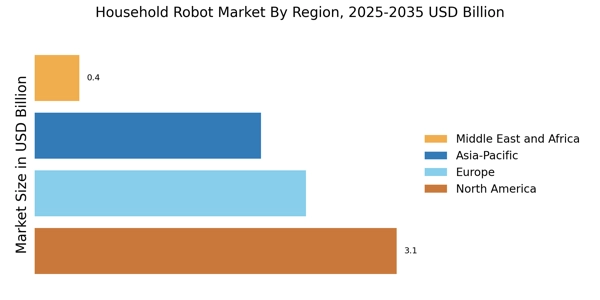
The Household Robot Market witnessed significant growth across various regions, reflecting a robust increase in market revenue. In 2024, North America held a dominant position valued at 3.0 USD billion, expected to grow to 12.1 USD billion by 2035, indicating its majority holding in the market.
Europe followed closely with a valuation of 2.5 USD billion in 2024 and is anticipated to reach 10.25 USD billion by 2035, showcasing its substantial contribution. Meanwhile, Asia Pacific was valued at 1.8 USD billion and is expected to increase to 7.4 USD billion, marking it as a significant player in the household robotics space.
South America, with a value of 0.8 USD billion in 2024, is anticipated to grow to 3.4 USD billion, while the Middle East and Africa started at 0.58 USD billion and are projected to reach 2.8 USD billion by 2035. The steady growth across these regions highlighted varying market dynamics, driven by the increasing adoption of automation and advanced technologies in household tasks.
The significance of North America and Europe within the Household Robot Market can be attributed to their high levels of disposable income, consumer readiness for smart home technologies, and ongoing advancements in robotics.
The Household Robot Market is characterized by rapid innovation and increasing adoption rates, driven by technological advancements and changing consumer preferences. The competitive landscape features a mix of well-established players and new entrants, all vying for market share by offering a variety of smart home solutions.Companies are leveraging advancements in artificial intelligence, machine learning, and automation to enhance their offerings, thus responding to a growing demand for convenience and efficiency in household chores.
This market is not only about robotics but also emphasizes connectivity, ease of use, and integration with other smart home devices, allowing for an ecosystem that promotes seamless living experiences. Understanding the dynamics of competition within this market, including the strengths, weaknesses, and strategies of key players, is crucial for stakeholders aiming to position themselves effectively.Sharp has made significant strides in the Household Robot Market, showcasing its commitment to developing innovative solutions tailored to consumer needs. The company has focused on integrating advanced technologies into its products, emphasizing efficiency and user-friendliness, which resonate well with tech-savvy consumers.Sharp has utilized its extensive experience in electronics to manufacture household robots that stand out for their quality and performance.
Its market presence is supported by a strong distribution network and strategic partnerships that enhance product accessibility in various global regions.The company leverages its strengths in technological expertise and research and development to continually improve its product offerings, positioning itself as a competitive player in this evolving market.Samsung has emerged as a formidable competitor in the Household Robot Market, leveraging its wide array of technological capabilities and brand recognition. The company offers a range of household robots, including robotic vacuum cleaners and smart appliances, which incorporate advanced features like artificial intelligence and smart home integration.
Samsung's strong market presence is backed by continuous investment in research and development, enabling constant product innovations tailored to meet consumer preferences. The company has also engaged in various strategic mergers and acquisitions to enhance its technological edge and extend its market reach.Samsung’s strengths lie in its diversified portfolio, solid brand loyalty, and ability to integrate its robotic solutions into a broader ecosystem of smart home devices, making it a key player that shapes the future landscape of household automation on a global scale.



Q3 2026: iRobot (US): iRobot unveiled Roomba Duo, its first dual-unit robot vacuum and mop, combining a floor-washing main robot, ultra-slim companion robot, mechanical deployment arm, shared home map, and autonomous mobile dock for household floor care.
Q3 2026: iRobot (US): iRobot introduced Roomba Max 875 Combo, its new flagship robot with SealForce vacuuming technology and a dual-action heated mopping system, expanding automated floor-cleaning capabilities within the household robotics market.
Q3 2026: Dyson (GB): Dyson announced Dyson Unveiled 2026 would showcase new machines and concepts spanning floorcare and robotics, providing a company-confirmed platform for new household robotics developments during its September 2026 product showcase.
가정용 로봇 시장은 2025년부터 2035년까지 13.36%의 연평균 성장률(CAGR)로 성장할 것으로 예상되며, 이는 기술 발전, 증가하는 소비자 수요 및 향상된 자동화 기능에 의해 촉진됩니다.
2035년까지 가정용 로봇 시장은 강력할 것으로 예상되며, 상당한 성장과 혁신을 반영할 것입니다.
| MARKET SIZE 2024 | 7.68(USD Billion) |
| MARKET SIZE 2025 | 8.706(USD Billion) |
| MARKET SIZE 2035 | 30.51(USD Billion) |
| COMPOUND ANNUAL GROWTH RATE (CAGR) | 13.36% (2025 - 2035) |
| REPORT COVERAGE | Revenue Forecast, Competitive Landscape, Growth Factors, and Trends |
| BASE YEAR | 2024 |
| Market Forecast Period | 2025 - 2035 |
| Historical Data | 2019 - 2024 |
| Market Forecast Units | USD Billion |
| Key Companies Profiled | iRobot (US), Samsung (KR), LG Electronics (KR), Ecovacs Robotics (CN), Neato Robotics (US), Roborock (CN), Dyson (GB), Amazon (US), Sony (JP) |
| Segments Covered | Application, Robot Type, Functionality, End User, Regional |
| Key Market Opportunities | Integration of artificial intelligence enhances functionality and consumer appeal in the Household Robot Market. |
| Key Market Dynamics | Rising consumer demand for automation drives innovation and competition in the household robot market. |
| Countries Covered | North America, Europe, APAC, South America, MEA |
가정용 로봇 시장은 2024년에 76.8억 달러로 평가되었습니다.
시장은 2035년까지 305.1억 달러에 이를 것으로 예상됩니다.
2025년부터 2035년까지 가정용 로봇 시장의 예상 CAGR은 13.36%입니다.
주요 기업으로는 iRobot, 삼성, LG 전자, 에코백스 로보틱스, 네이토 로보틱스, 로보락, 다이슨, 아마존, 소니가 있습니다.
주요 응용 분야로는 청소(105억 달러), 잔디 깎기(55억 달러), 노인 지원(80억 달러)가 있으며, 2035년까지 예상됩니다.
2035년까지 기능은 청소(105억 달러), 지원(80억 달러), 오락(55.1억 달러)을 포함할 것으로 예상됩니다.
2035년까지 주거용 로봇은 152.4억 달러에 이를 것으로 예상되며, 상업용 로봇은 92억 달러에 이를 수 있습니다.
종류로는 자율 로봇(105억 달러), 원격 조작 로봇(65억 달러), 협동 로봇(85.1억 달러)이 있으며, 2035년까지 예상됩니다.
노인 지원 로봇은 2035년까지 80억 달러로 성장할 것으로 예상되며, 상당한 성장 잠재력을 나타냅니다.
가정용 로봇 시장의 성장은 특히 청소 및 지원 기능에서 강력해 보이며, 2035년까지 지배할 것으로 예상됩니다.
 Ankit Gupta

이 보고서의 무료 샘플을 받으려면 아래 양식을 작성하십시오


“This is really good guys. Excellent work on a tight deadline. I will continue to use you going forward and recommend you to others. Nice job”
 Noah Malgeri
Co-Founder

“Thanks for sending the report it gives us a good global view of the Betaïne market.”
 Peter Groot koerkamp
Account and Business Manager

“We found the report very insightful! we found your research firm very helpful. I'm sending this email to secure our future business.”
 Younghwan Choi
Senior Retail Manager

“I am very pleased with how market segments have been defined in a relevant way for my purposes (such as "Portable Freezers & refrigerators" and "last-mile"). In general the report is well structured. Thanks very much for your efforts.”
 Mark Irwin
Management Consultant

“We got the report in time, we really thank you for your support in this process. I also thank to all of your team as they did a great job.”
 Akif Moroglu
Strategy & Business Development Director

“The Automotive 48V ECU Components Procurement Intelligence Study” was a complex project, but the Market Research Future (MRFR) team handled it with quality, agility, and customer-centricity. They delivered all requested data on time and within the agreed scope. The team, including Shubhendra Anand and Rahul Gotadki, was always readily available to clarify questions and swiftly implement necessary adjustments, driving the project to a successful conclusion within a very demanding timeframe.
I would also like to specifically commend Akshay Agarwal for his responsiveness and support at every stage—from our initial inquiry on May 6th through to final delivery on June 18th. His dedication made the entire process seamless.”
 Guilherme Gomes Martins
Product Management Director

“Thanks. It’s been a pleasure working with you, please use me as reference with any other Intel employees.”
 Joseph Aguayo
Sales Operations & Pricing Manager

“Thank you, this will be very helpful for OQS.”
 La Terria Dodd
Program Support Specialist

“I have been reading the first document or the study, ,the Global HVAC and FP market report 2021 till 2026. Must say, good info! I have not gone in depth at all parts, but got a good indication of the data inside!”
 Rob Kooiker
Group Product Manager HVAC & Fire Protection GMA



