고속도로 주행 보조 시장 요약
주요 시장 동향 및 하이라이트
시장 규모 및 예측
| CAGR (2025 - 2035) | 12.84% |
| CAGR (2025 - 2035) | 12.84% |
The Highway Driving Assist Market is currently experiencing a transformative phase, driven by advancements in technology and increasing consumer demand for enhanced safety features. As vehicles become more integrated with sophisticated systems, the focus on automation and driver assistance is intensifying. This shift is not merely a trend but appears to be a fundamental change in how individuals perceive driving. The integration of artificial intelligence and machine learning into highway driving systems suggests a future where vehicles can communicate with each other and their surroundings, potentially reducing accidents and improving traffic flow. Furthermore, regulatory bodies are increasingly emphasizing the need for safety standards, which may further propel the adoption of these technologies. In addition to technological advancements, consumer preferences are evolving. There is a growing awareness of the benefits associated with highway driving assist features, such as reduced driver fatigue and enhanced comfort during long journeys. This awareness is likely to drive demand, as more individuals seek vehicles equipped with these capabilities. Moreover, the competitive landscape is becoming more dynamic, with various automotive manufacturers investing heavily in research and development to capture market share. As a result, the Highway Driving Assist Market is poised for substantial growth, with innovations that could redefine the driving experience in the coming years.
The Highway Driving Assist Market is witnessing a surge in the integration of advanced technologies. Innovations such as artificial intelligence and machine learning are becoming commonplace, enhancing the capabilities of driving assist systems. This trend indicates a shift towards more autonomous features, which may lead to safer and more efficient driving experiences.
There is a noticeable increase in consumer awareness regarding the advantages of highway driving assist technologies. As individuals recognize the potential for improved safety and comfort, demand for vehicles equipped with these features is likely to rise. This growing interest suggests a shift in consumer preferences towards more technologically advanced automobiles.
Regulatory bodies are playing a crucial role in shaping the Highway Driving Assist Market. With an emphasis on safety standards and guidelines, these regulations may drive manufacturers to enhance their offerings. This trend indicates that compliance with safety regulations could become a significant factor influencing market dynamics.
The Highway Driving Assist Market is experiencing a surge in technological advancements, particularly in artificial intelligence and sensor technologies. These innovations enhance vehicle capabilities, allowing for improved lane-keeping, adaptive cruise control, and obstacle detection. As of 2025, the market is projected to grow at a compound annual growth rate of approximately 15%, driven by the integration of advanced driver-assistance systems (ADAS). The proliferation of high-resolution cameras, radar, and LiDAR systems is enabling vehicles to interpret their surroundings more accurately. This technological evolution not only enhances safety but also contributes to a more seamless driving experience. Consequently, manufacturers are increasingly investing in research and development to stay competitive in the Highway Driving Assist Market.
In the Highway Driving Assist Market, Passenger Cars dominate the segment with a significant market share, primarily due to their widespread adoption and integration of advanced driving technologies. This segment benefits from robust demand driven by consumer preferences for safety and convenience features, along with supportive regulations promoting automated driving solutions. On the other hand, Heavy Commercial Vehicles, though currently a smaller segment, are experiencing rapid growth as fleet operators increasingly embrace highway driving assist technologies to enhance safety and efficiency in logistics and transportation operations.
In the Highway Driving Assist Market, the segment values of Personal Use, Fleet Management, and Ride-Sharing Services showcase a diverse landscape. Personal Use constitutes the largest share, driven by individual consumers seeking greater safety and convenience on the road. Meanwhile, Fleet Management is rapidly gaining traction, reflecting the growing importance of technology in optimizing logistics and improving operational efficiency for businesses. Ride-Sharing Services, while significant, represent a smaller fraction of the overall market share compared to the other two segments. Growth trends highlight the increasing adoption of highway driving assist technologies across various user segments. Personal Use remains stable as consumers demand more advanced safety features in their vehicles. However, Fleet Management is emerging as the fastest-growing segment, spurred by advancements in AI and telematics, leading to smarter vehicle management solutions. The rise of eco-friendly initiatives and regulations also boosts the demand for such technologies in fleet operations, making it a key area of growth for the market.
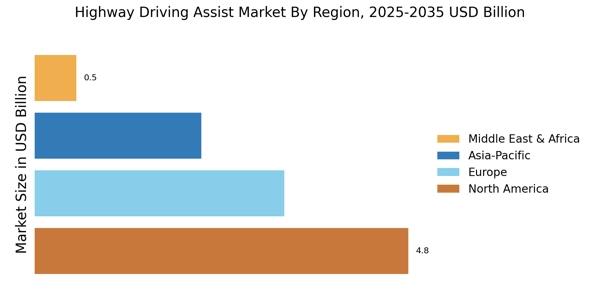
North America is the largest market for Highway Driving Assist Market, holding approximately 45% of the global share. The region's growth is driven by rapid technological advancements, increasing consumer demand for safety features, and supportive regulatory frameworks. The U.S. government has been proactive in establishing guidelines for autonomous vehicle testing, which further fuels market expansion. Key players like Tesla, Waymo, and General Motors dominate the landscape, leveraging their technological expertise and extensive R&D investments. The competitive environment is characterized by continuous innovation, with companies racing to enhance their offerings. The presence of established automotive giants and tech firms positions North America as a leader in the Highway Driving Assist Market.
Europe is the second-largest market for Highway Driving Assist Market, accounting for around 30% of the global market share. The region's growth is propelled by stringent safety regulations and a strong push towards sustainable transportation solutions. The European Union has implemented various initiatives to promote the adoption of advanced driver-assistance systems, which are crucial for market growth. Leading countries such as Germany, France, and the UK are at the forefront of this market, with major automotive manufacturers like BMW, Mercedes-Benz, and Audi investing heavily in R&D. The competitive landscape is marked by collaborations between automotive and technology firms, enhancing the development of innovative solutions. The focus on safety and efficiency continues to drive demand for Highway Driving Assist Market technologies.
Asia-Pacific is witnessing rapid growth in the Highway Driving Assist Market, holding approximately 20% of the global share. The region's expansion is driven by increasing urbanization, rising disposable incomes, and a growing focus on vehicle safety. Countries like Japan and China are leading the charge, with government initiatives aimed at promoting smart transportation solutions. Japan's automotive giants, including Nissan and Toyota, are heavily investing in autonomous driving technologies, while China's aggressive push for electric vehicles is creating a fertile ground for Highway Driving Assist Market systems. The competitive landscape is evolving, with both local and international players vying for market share, making Asia-Pacific a dynamic region for future growth.
The Middle East and Africa region is gradually emerging in the Highway Driving Assist Market, currently holding about 5% of the global share. The growth is primarily driven by increasing investments in infrastructure and a rising awareness of road safety. Governments in countries like the UAE and South Africa are beginning to implement regulations that support the adoption of advanced driving technologies. The competitive landscape is still developing, with a mix of local and international players entering the market. Key players are focusing on partnerships and collaborations to enhance their technological capabilities. As the region continues to invest in smart city initiatives, the demand for Highway Driving Assist Market systems is expected to rise significantly in the coming years.
The Highway Driving Assist Market is currently characterized by a dynamic competitive landscape, driven by rapid technological advancements and increasing consumer demand for enhanced safety features. Major players such as Tesla (US), Waymo (US), and General Motors (US) are at the forefront, each adopting distinct strategies to solidify their market positions. Tesla (US) continues to innovate with its Autopilot system, focusing on software updates that enhance user experience and safety. Meanwhile, Waymo (US) emphasizes its leadership in autonomous driving technology, leveraging extensive data from its testing programs to refine its offerings. General Motors (US) is strategically investing in electric vehicle (EV) technology, integrating advanced driving assistance systems into its EV lineup, thereby appealing to environmentally conscious consumers. Collectively, these strategies not only enhance individual company profiles but also intensify competition within the market, as firms vie for technological supremacy and consumer trust.In terms of business tactics, companies are increasingly localizing manufacturing to reduce costs and improve supply chain efficiency. This approach is particularly evident in the Highway Driving Assist Market, which appears to be moderately fragmented, with several key players exerting significant influence. The collective actions of these companies suggest a trend towards consolidation, as firms seek to enhance their competitive edge through strategic partnerships and collaborations.
In August Tesla (US) announced a partnership with a leading AI firm to enhance its vehicle's autonomous capabilities. This collaboration is poised to bolster Tesla's position in the market by integrating cutting-edge AI technologies into its driving systems, potentially improving safety and user experience. The strategic importance of this move lies in Tesla's commitment to maintaining its technological lead, which is crucial in a market where consumer expectations are rapidly evolving.
In September Waymo (US) expanded its autonomous ride-hailing service to additional cities, marking a significant step in its operational strategy. This expansion not only increases Waymo's market presence but also allows the company to gather more data on urban driving conditions, which is essential for refining its technology. The strategic implications of this move suggest a focus on scalability and adaptability, key factors in the competitive landscape of highway driving assistance.
In October General Motors (US) unveiled a new suite of advanced driver-assistance features in its latest EV models, showcasing its commitment to innovation. This launch is particularly noteworthy as it aligns with the growing consumer demand for sustainable transportation solutions. By integrating these features, General Motors aims to differentiate itself in a crowded market, emphasizing safety and environmental responsibility as core values.
As of October the Highway Driving Assist Market is witnessing trends that emphasize digitalization, sustainability, and the integration of artificial intelligence. Strategic alliances are increasingly shaping the competitive landscape, as companies recognize the value of collaboration in driving innovation. Looking ahead, it appears that competitive differentiation will evolve from traditional price-based strategies to a focus on technological innovation, reliability in supply chains, and the ability to meet consumer demands for safety and sustainability.





The Highway Driving Assist Market has recently experienced significant developments, particularly with major automotive companies investing in advanced technologies. Toyota continues to enhance its driver-assist capabilities, focusing on safety and automation as part of its ongoing commitment to innovation. General Motors and Ford are also ramping up efforts to integrate sophisticated highway assist features into their new models, reflecting a broader industry trend towards autonomous driving. Meanwhile, Volkswagen and Audi are collaborating on software advancements to refine their driving assist systems, leveraging synergies in technology.
In a noteworthy merger, FCA and PSA Group have finalized their union, which is expected to bolster their collective research into highway driving assist technologies. Hyundai is making strides in deploying its Highway Driving Assist Market system across several models aimed at increasing market penetration. Daimler and BMW have also been collaborating on a joint venture to develop next-generation driving technologies. Recent valuations indicate a growing market, with key players observing significant investment incentives to enhance their assistive technologies, highlighting the competitive landscape's dynamic nature.
This growth reflects a substantial interest in increasing vehicle automation and consumer demand for enhanced safety features in highway driving.
고속도로 주행 보조 시장은 2025년부터 2035년까지 12.84% CAGR로 성장할 것으로 예상되며, 이는 AI의 발전, 안전 규제의 증가, 자동화에 대한 소비자 수요에 의해 추진됩니다.
새로운 기회는 다음에 있습니다:
2035년까지 고속도로 주행 보조 시장은 상당한 성장과 혁신을 반영하며 강력할 것으로 예상됩니다.
| Parameter | Details |
|---|---|
| Market Scope | Global Highway Driving Assist Market covering technology, vehicle type, component, end-use, and region |
| Study Period | 2021–2035 (Historical: 2021–2024; Base Year: 2025; Forecast: 2026–2035) |
| CAGR | 12.94% (2026–2035) |
| Market Size checkpoints | USD 8.34 Billion (2025); USD 9.49 Billion (2026); USD 28.37 Billion (2035) |
| Fastest Growing Segments | Automated Lane Change; Medium and Heavy Commercial Vehicle; Software; Ride-Sharing Service |
| Companies Profiled | Robert Bosch, Continental/AUMOVIO, Mobileye, ZF, Denso, Aptiv, Valeo, Magna, Hyundai Mobis, NVIDIA |
| Valuation Currency | USD Billion |
| CAGR Driver Disclaimer | Driver and restraint impacts are directional and overlapping; they are not additive components of the headline CAGR |
고속도로 주행 보조 시장은 2035년까지 405.4억 달러의 가치를 가질 것으로 예상됩니다.
2024년 고속도로 주행 보조 시장은 107.3억 달러로 평가되었습니다.
2025년부터 2035년까지의 예측 기간 동안 고속도로 주행 보조 시장의 예상 CAGR은 12.84%입니다.
충돌 회피 기술 세그먼트는 2035년까지 182억 달러에 이를 것으로 예상됩니다.
승용차는 2035년까지 200억 달러의 가치를 가질 것으로 예상되며 시장을 지배할 것으로 보입니다.
카메라 시스템은 2035년까지 102.5억 달러로 성장할 것으로 예상됩니다.
고속도로 주행 보조 시장의 주요 플레이어로는 테슬라, 웨이모, 제너럴 모터스, 포드가 있습니다.
차량 관리는 2035년까지 120억 달러의 가치를 가질 것으로 예상됩니다.
자동화된 차선 변경 기술 세그먼트는 2035년까지 40.5억 달러로 성장할 것으로 예상됩니다.
레이더 시스템은 2035년까지 60.3억 달러의 가치를 가질 것으로 예상됩니다.
 Shubham Munde

 Sejal Akre
이 보고서의 무료 샘플을 받으려면 아래 양식을 작성하십시오


“This is really good guys. Excellent work on a tight deadline. I will continue to use you going forward and recommend you to others. Nice job”
 Noah Malgeri
Co-Founder

“Thanks for sending the report it gives us a good global view of the Betaïne market.”
 Peter Groot koerkamp
Account and Business Manager

“We found the report very insightful! we found your research firm very helpful. I'm sending this email to secure our future business.”
 Younghwan Choi
Senior Retail Manager

“I am very pleased with how market segments have been defined in a relevant way for my purposes (such as "Portable Freezers & refrigerators" and "last-mile"). In general the report is well structured. Thanks very much for your efforts.”
 Mark Irwin
Management Consultant

“We got the report in time, we really thank you for your support in this process. I also thank to all of your team as they did a great job.”
 Akif Moroglu
Strategy & Business Development Director

“The Automotive 48V ECU Components Procurement Intelligence Study” was a complex project, but the Market Research Future (MRFR) team handled it with quality, agility, and customer-centricity. They delivered all requested data on time and within the agreed scope. The team, including Shubhendra Anand and Rahul Gotadki, was always readily available to clarify questions and swiftly implement necessary adjustments, driving the project to a successful conclusion within a very demanding timeframe.
I would also like to specifically commend Akshay Agarwal for his responsiveness and support at every stage—from our initial inquiry on May 6th through to final delivery on June 18th. His dedication made the entire process seamless.”
 Guilherme Gomes Martins
Product Management Director

“Thanks. It’s been a pleasure working with you, please use me as reference with any other Intel employees.”
 Joseph Aguayo
Sales Operations & Pricing Manager

“Thank you, this will be very helpful for OQS.”
 La Terria Dodd
Program Support Specialist

“I have been reading the first document or the study, ,the Global HVAC and FP market report 2021 till 2026. Must say, good info! I have not gone in depth at all parts, but got a good indication of the data inside!”
 Rob Kooiker
Group Product Manager HVAC & Fire Protection GMA



