Agriculture Robots Market

농업 로봇 시장 규모, 점유율 및 유형별 연구 보고서 (단일 기능 농업 로봇 {잡초 제거, 파종, 분무, 수확, 기타}, 기타 - 단일 기능 농업 로봇 유형 {경작, 경운, 경작, 비료 살포, 기타}), 다기능 농업 로봇 {파종-잡초 제거-비료, 파종-급수-비료-잡초 제거-모니터링, 현장 분석-토양 평탄화-토양 수분 분석), 지역별(미국, 유럽, 호주, 한국) – 2035년까지 산업 전망
ID: MRFR/SEM/8669-CR 200 Pages Apoorva Priyadarshi, Aarti Dhapte Last Updated: September 24, 2026
Agriculture Robots Market
Market Size
Forecast Period2025 - 2035
CAGR (2025 - 2035)15.81%
2024 Market Size$ 3,665.6 Million
2025 Market Size$ 4,245.21 Million
2035 Market Size$ 18,426.18 Million
Key Players
John Deere
AG Leader Technology
Trimble
CNH Industrial
Yamaha Motor Co
Harvest Automation
Opportunities
  • Labor Shortages
  • Rising Food Demand
  • Sustainability Initiatives

Agriculture Robots Market 요약

MRFR 분석에 따르면, 농업 로봇 시장 규모는 2024년에 3665.6 백만 달러로 추정되었습니다. 농업 로봇 산업은 2025년 4245.21 백만 달러에서 2035년까지 18426.18 백만 달러로 성장할 것으로 예상되며, 2025 - 2035년 예측 기간 동안 연평균 성장률(CAGR)은 15.81%에 이를 것으로 보입니다.

주요 시장 동향 및 하이라이트

농업 로봇 시장은 기술 발전과 지속 가능한 관행에 대한 수요 증가에 힘입어 강력한 성장을 경험하고 있습니다.

  • 이 시장은 특히 북미에서 정밀 농업의 채택이 증가하고 있으며, 북미는 여전히 가장 큰 시장입니다.
  • 인공지능의 통합이 운영을 변화시키고 있으며, 작물 모니터링 및 자율 트랙터의 효율성을 향상시키고 있습니다.
  • 지속 가능한 관행이 주목받고 있으며, 이는 산업 전반에 걸쳐 환경 관리에 대한 더 넓은 약속을 반영합니다.
  • 상승하는 인건비와 정부 지원 이니셔티브는 수확 및 드론 부문의 성장을 촉진하는 중요한 요인입니다.

시장 규모 및 예측

2024 시장 규모 3665.6 (백만 달러)
2035 시장 규모 18426.18 (백만 달러)
CAGR (2025 - 2035) 15.81%

주요 기업

존 디어(미국), AG 리더 테크놀로지(미국), 트림블(미국), CNH 인더스트리얼(영국), 야마하 모터(일본), 하베스트 오토메이션(미국), 블루 리버 테크놀로지(미국), 나이오 테크놀로지(프랑스), 옥티니온(벨기에)

Agriculture Robots Market Treiber

노동 부족

농업 부문의 노동 부족은 글로벌 농업 로봇 산업이 해결하고자 하는 긴급한 문제입니다. 많은 지역에서 농업 노동자의 수가 감소하고 있어 생산성과 작물 수확량에 지장을 줄 수 있습니다. 이에 따라 농부들은 점점 더 로봇 기술에 의존하여 이 격차를 메우고 있습니다. 예를 들어, 로봇 수확기는 작물을 효율적으로 수확할 수 있어 수작업에 대한 의존도를 줄입니다. 이 추세는 산업이 노동 부족 문제를 해결하고 농업 생산량을 유지하기 위한 혁신적인 솔루션의 필요성에 의해 2035년까지 184억 달러에 도달할 것으로 예상됨에 따라 가속화될 가능성이 높습니다.

식량 수요 증가

글로벌 농업 로봇 산업은 인구 증가와 변화하는 식단 선호에 의해 촉발된 전 세계 식량 수요 증가의 영향을 크게 받고 있습니다. 세계 인구가 2050년까지 약 97억에 이를 것으로 예상됨에 따라, 더 많은 식량을 생산해야 하는 농업 시스템에 대한 압력이 증가하고 있습니다. 로봇 기술은 생산성과 효율성을 향상시켜 농부들이 이러한 수요를 충족할 수 있도록 합니다. 예를 들어, 자동화된 파종 및 수확 시스템은 노동 비용을 줄이면서 작물 수확량을 증가시킬 수 있습니다. 이러한 식량 생산 증가의 필요성은 시장을 앞으로 나아가게 할 가능성이 높으며, 이해관계자들은 식량 안보를 보장하기 위한 혁신적인 솔루션을 찾고 있습니다.

지속 가능성 이니셔티브

지속 가능성 이니셔티브는 글로벌 농업 로봇 산업 내에서 중심적인 초점이 되고 있으며, 소비자와 정부 모두 더 환경 친화적인 관행을 요구하고 있습니다. 농업 로봇은 자원 사용 최적화, 화학 물질 투입 감소 및 토양 교란 최소화를 통해 지속 가능한 농업에 기여할 수 있습니다. 예를 들어, 정밀 농업 기술은 비료와 농약의 표적 적용을 가능하게 하여 환경 영향을 줄일 수 있습니다. 지속 가능성이 점점 더 우선시됨에 따라, 시장은 2025년부터 2035년까지 15.81%의 CAGR로 성장할 것으로 예상되며, 이는 산업의 친환경 농업 관행에 대한 헌신을 반영합니다.

기술 발전

글로벌 농업 로봇 시장 산업은 효율성과 생산성을 향상시키는 빠른 기술 발전을 경험하고 있습니다. 로봇 공학, 인공지능 및 기계 학습의 혁신은 다양한 작업을 수행할 수 있는 정교한 농업 로봇의 개발을 가능하게 하고 있습니다. 예를 들어, GPS 기술이 장착된 자율 트랙터는 최소한의 인간 개입으로 작동할 수 있어 자원 사용을 최적화합니다. 이러한 기술이 발전함에 따라 시장 성장에 기여할 것으로 예상되며, 산업은 2024년까지 36.7억 달러에 이를 것으로 예상되며, 이는 고급 농업 솔루션에 대한 강한 수요를 나타냅니다.

정부 지원 및 자금 지원

정부 지원 및 자금 지원은 글로벌 농업 로봇 산업의 발전에 중요한 역할을 합니다. 많은 정부가 농업 로봇 기술이 식량 생산과 지속 가능성을 향상시킬 수 있는 잠재력을 인식하고 있습니다. 보조금, 지원금 및 연구 자금과 같은 이니셔티브가 이 분야의 혁신을 장려하기 위해 시행되고 있습니다. 예를 들어, 여러 국가는 고급 농업 기술 개발을 목표로 하는 연구 프로그램에 투자하고 있습니다. 이러한 지원은 농업 관행에서 로봇 기술과 자동화의 채택을 장려함에 따라 산업 내 성장을 촉진할 가능성이 높습니다.

시장 세그먼트 통찰력

Agriculture Robots Market에 대한 더 자세한 통찰력 얻기

지역 통찰력

북미: 혁신과 리더십 허브

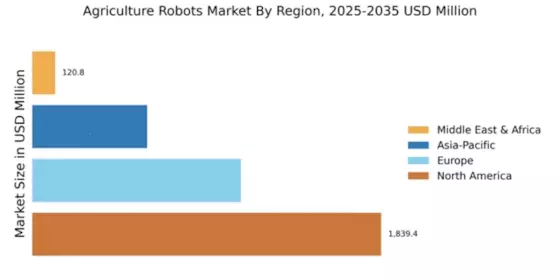
북미는 2024년에 1839.36M의 점유율로 농업 로봇 시장을 선도하고 있으며, 기술 발전과 농업 자동화에 대한 수요 증가에 의해 주도되고 있습니다. 이 지역은 연구개발에 대한 강력한 투자, 유리한 정부 정책, 지속 가능한 관행에 대한 증가하는 집중으로 혜택을 보고 있습니다. 정밀 농업 및 환경 지속 가능성에 대한 규제 지원은 시장 성장을 촉진하여 글로벌 환경에서 중요한 플레이어로 자리매김하고 있습니다. 미국은 존 디어, AG 리더 테크놀로지, 트림블과 같은 주요 기업들이 있는 가장 큰 시장으로 두드러집니다. 이들 기업은 혁신의 최전선에 있으며 생산성과 효율성을 높이는 최첨단 솔루션을 개발하고 있습니다. 경쟁 환경은 제품 제공 및 시장 도달 범위를 확장하기 위한 전략적 파트너십과 협력으로 특징지어집니다. 이는 농업 로봇 부문에서 북미의 지배력을 보장합니다.

유럽: 신기술 채택

유럽의 농업 로봇 시장은 1099.68M으로 평가되며, 노동 비용 증가와 자동화로의 전환에 의해 강력한 성장 궤적을 반영하고 있습니다. 이 지역은 지속 가능한 농업 관행을 촉진하는 EU 규정에 의해 지원되는 정밀 농업 기술에 대한 수요가 급증하고 있습니다. 환경 영향을 줄이고 식량 안전성을 향상시키기 위한 이니셔티브는 시장 확장의 주요 동력이며, 유럽을 글로벌 무대에서 중요한 플레이어로 자리매김하게 하고 있습니다. 독일, 프랑스, 네덜란드와 같은 주요 국가들이 이 변혁의 최전선에 있으며, CNH 인더스트리얼 및 나이오 테크놀로지와 같은 주요 기업들이 강력한 존재감을 보이고 있습니다. 경쟁 환경은 혁신과 협력으로 특징지어지며, 기업들은 농부들의 변화하는 요구를 충족하기 위해 노력하고 있습니다. AI 및 IoT 기술의 통합은 운영 효율성을 더욱 향상시키고 있으며, 유럽을 농업 로봇 혁신의 중심지로 만들고 있습니다.

아시아-태평양: 빠른 성장과 채택

아시아-태평양 농업 로봇 시장은 605.76M으로 평가되며, 농업 생산성 요구 증가와 노동 부족으로 인해 빠르게 확장하고 있습니다. 일본과 호주와 같은 국가들이 기술 발전과 농업 현대화를 목표로 하는 정부 이니셔티브에 의해 주도하고 있습니다. 이 지역은 식량 안전성과 지속 가능성을 향상시키기 위한 집중이 농업에서 로봇의 채택을 촉진하고 있으며, 향후 몇 년 동안 성장의 주요 영역이 되고 있습니다. 경쟁 환경은 야마하 모터와 하베스트 오토메이션과 같은 주요 기업들이 지역의 고유한 도전에 대응하기 위해 혁신하고 있습니다. 기술 기업과 농업 이해관계자 간의 협력은 농업 로봇을 위한 활기찬 생태계를 조성하고 있습니다. 시장이 성숙함에 따라 스마트 기술의 통합은 아시아-태평양 농업의 미래를 형성하는 데 중요한 역할을 할 것입니다.

중동 및 아프리카: 미개척 잠재력과 성장

중동 및 아프리카 농업 로봇 시장은 120.8M으로 평가되며, 초기 단계에 있지만 성장 가능성이 큽니다. 식량 수요 증가, 물 부족, 효율적인 농업 관행의 필요성이 농업 자동화에 대한 관심을 불러일으키고 있습니다. 이 지역의 정부들은 농업에서 기술의 중요성을 인식하기 시작하고 있으며, 생산성과 지속 가능성을 향상시키기 위한 지원 정책과 투자를 이끌고 있습니다. 남아프리카와 UAE와 같은 국가들은 농업 로봇 채택의 선두주자로 부상하고 있으며, 지역적 도전에 맞춘 혁신적인 솔루션에 집중하고 있습니다. 주요 기업들의 존재가 점차 증가하고 있으며, 혁신을 촉진하는 경쟁 환경을 조성하고 있습니다. 자동화의 이점에 대한 인식이 높아짐에 따라 중동 및 아프리카는 농업 로봇 분야에서 중요한 플레이어가 될 준비가 되어 있습니다.

Agriculture Robots Market Regional Image

Agriculture Robots Market 시장의 주요 기업은 다음과 같습니다

Recent Industry Developments

  • Q3 2026: CNH Industrial (GB): New Holland presented its R4 autonomous robots at Motor Valley Fest 2026, demonstrating app-based agricultural automation using GPS, LiDAR, and vision cameras for vineyards, orchards, and specialty crops.
  • Q3 2026: Yamaha Motor Co (JP): Yamaha Motor opened a dedicated Robotics Business Support Division in Gurugram, India, strengthening sales and service infrastructure for its robotics portfolio and supporting expansion of the company’s robotics business in the growing Indian market.
  • Q2 2024: Agtonomy raises $22.5M Series A to scale autonomous farm equipment Agtonomy, a California-based startup developing autonomous and remote-operated farm machinery, secured $22.5 million in Series A funding to accelerate product development and expand commercial deployments.
  • Q2 2024: John Deere Unveils New Autonomous Sprayer at 2024 World Ag Expo John Deere launched its latest autonomous sprayer, designed to reduce chemical use and labor requirements, at the 2024 World Ag Expo, marking a significant product expansion in its agricultural robotics portfolio.
  • Q2 2024: Naïo Technologies secures €32 million to expand agricultural robot fleet French agri-robotics company Naïo Technologies raised €32 million in a new funding round to scale up production and accelerate international growth of its autonomous weeding and harvesting robots.
  • Q2 2024: CNH Industrial acquires Augmenta to boost precision agriculture automation CNH Industrial announced the acquisition of Augmenta, a provider of real-time precision farming solutions, to enhance its automation and robotics capabilities in the agricultural sector.
  • Q3 2024: Blue River Technology appoints new CEO to drive next phase of ag robotics growth Blue River Technology, a subsidiary of John Deere specializing in AI-powered agricultural robots, named a new CEO to lead the company’s expansion and product innovation strategy.
  • Q3 2024: Ecorobotix raises $48 million in Series C funding for AI-powered weeding robots Swiss agtech firm Ecorobotix closed a $48 million Series C round to accelerate the commercialization of its AI-driven weeding robots, which aim to reduce herbicide use and improve crop yields.
  • Q3 2024: Yanmar launches new strawberry-picking robot for Japanese market Yanmar, a Japanese machinery manufacturer, introduced a new autonomous robot designed specifically for strawberry harvesting, targeting labor shortages in Japan’s fruit farming sector.
  • Q4 2024: FarmWise partners with Driscoll’s to deploy autonomous weeding robots in berry fields FarmWise, a U.S.-based ag robotics company, announced a partnership with Driscoll’s to deploy its autonomous weeding robots across Driscoll’s berry farms, aiming to improve efficiency and sustainability.
  • Q4 2024: AGCO opens new robotics R&D center in Germany AGCO Corporation inaugurated a new research and development center in Germany focused on advancing agricultural robotics and automation technologies for European markets.
  • Q1 2025: John Deere acquires SmartAg for autonomous tractor technology John Deere completed the acquisition of SmartAg, a developer of autonomous tractor solutions, to strengthen its leadership in farm automation and robotics.
  • Q1 2025: Small Robot Company secures £15 million to scale commercial robot farming UK-based Small Robot Company raised £15 million in new funding to expand the deployment of its autonomous robots for precision weeding and crop monitoring on commercial farms.
  • Q2 2025: Kubota and Tevel partner to commercialize fruit-picking drones in Europe Kubota, a leading agricultural machinery manufacturer, announced a partnership with Israeli startup Tevel to bring autonomous fruit-picking drones to European orchards, addressing labor shortages and boosting productivity.

향후 전망

Agriculture Robots Market 향후 전망

농업 로봇 시장은 2025년부터 2035년까지 15.81%의 CAGR로 성장할 것으로 예상되며, 이는 기술 발전, 노동 부족 및 지속 가능한 농업 관행에 대한 수요 증가에 의해 추진됩니다.

2035년까지 농업 로봇 시장은 현대 농업의 초석이 되어 생산성과 지속 가능성을 향상시킬 것으로 예상됩니다.

시장 세분화

농업 로봇 시장 유형 전망

  • 자율 트랙터
  • 드론
  • 로봇 수확기
  • 잡초 제거 로봇
  • 식재 로봇

농업 로봇 시장 최종 용도 전망

  • 농업
  • 원예
  • 수산 양식
  • 임업
  • 온실

농업 로봇 시장 기술 전망

  • 인공지능
  • 기계 학습
  • 컴퓨터 비전
  • GPS 기술
  • 원격 감지

농업 로봇 시장 응용 전망

  • 작물 모니터링
  • 토양 분석
  • 수확
  • 식재
  • 잡초 관리

보고서 범위

2024년 시장 규모 3665.6(백만 달러)
2025년 시장 규모 4245.21(백만 달러)
2035년 시장 규모 18426.18(백만 달러)
연평균 성장률(CAGR) 15.81% (2025 - 2035)
보고서 범위 수익 예측, 경쟁 환경, 성장 요인 및 트렌드
기준 연도 2024
시장 예측 기간 2025 - 2035
역사적 데이터 2019 - 2024
시장 예측 단위 백만 달러
주요 기업 프로필 존 디어(미국), AG 리더 테크놀로지(미국), 트림블(미국), CNH 인더스트리얼(영국), 야마하 모터(일본), 하베스트 오토메이션(미국), 블루 리버 테크놀로지(미국), 나이오 테크놀로지(프랑스), 옥티니온(벨기에)
다루는 세그먼트 응용 프로그램, 유형, 기술, 최종 사용
주요 시장 기회 인공지능의 통합은 농업 로봇 시장에서 효율성과 정밀성을 향상시킵니다.
주요 시장 역학 기술 발전은 경쟁력을 강화하고 다양한 농업 관행에서 농업 로봇의 채택을 촉진합니다.
다루는 국가 북미, 유럽, 아시아 태평양, 남미, 중동 및 아프리카

Frequently Asked Questions

2024년 농업 로봇 시장의 현재 가치는 얼마인가요?

농업 로봇 시장은 2024년에 약 3665.6 백만 달러로 평가되었습니다.

2035년 농업 로봇 시장의 예상 시장 규모는 얼마인가요?

이 시장은 2035년까지 약 18426.18 백만 달러의 가치를 가질 것으로 예상됩니다.

2025년부터 2035년까지 농업 로봇 시장의 예상 CAGR은 얼마인가요?

농업 로봇 시장은 2025년부터 2035년까지 15.81%의 CAGR로 성장할 것으로 예상됩니다.

2024년에 가장 높은 가치를 가진 응용 분야는 무엇인가요?

2024년에는 수확 응용 분야가 920.0 백만 달러의 가치로 선두를 차지했습니다.

현재 시장을 지배하고 있는 주요 농업 로봇 유형은 무엇인가요?

현재 시장은 2024년에 900.0 백만 달러의 가치가 있는 로봇 수확기와 같은 유형이 지배하고 있습니다.

2024년 자율 트랙터의 가치는 드론과 어떻게 비교되나요?
2024년 자율 트랙터는 800.0 백만 달러로 평가되었고, 드론은 600.0 백만 달러의 가치를 가졌습니다.
2024년 농업 로봇 시장에서 가장 큰 점유율을 차지한 최종 사용 분야는 무엇인가요?
농장은 2024년에 1099.68 백만 달러의 가치로 가장 큰 최종 사용 분야를 차지했습니다.
농업 로봇 시장에서 주요 기업으로 인정받는 곳은 어디인가요?
존 디어는 농업 로봇 시장에서 주요 기업으로 인정받으며, 시장 성장에 크게 기여하고 있습니다.
2024년 잡초 관리 응용 분야의 가치는 얼마인가요?
잡초 관리 응용 분야는 2024년에 845.6 백만 달러로 평가되었습니다.
2024년 식재 로봇 시장은 제초 로봇 시장과 어떻게 비교되나요?
2024년 식재 로봇은 765.6 백만 달러로 평가되었고, 제초 로봇은 600.0 백만 달러의 가치를 가졌습니다.
저자
Author Author Profile Apoorva Priyadarshi LinkedIn Research Analyst
With 4+ years of experience in Market Intelligence and Strategic Research, Apoorv specializes in ICT, Semiconductor, and BFSI markets. Combining strong analytical capabilities with a deep understanding of technology-driven industries, he focuses on delivering data-driven insights that support strategic decision-making. With a background in technology and business research, Apoorv has contributed to numerous global market studies, competitive landscape analyses, and opportunity assessments across sectors such as semiconductors, digital banking, cybersecurity, and telecommunications.
Co-Author Co-Author Profile Aarti Dhapte LinkedIn AVP - Research
A consulting professional focused on helping businesses navigate complex markets through structured research and strategic insights. I partner with clients to solve high-impact business problems across market entry strategy, competitive intelligence, and opportunity assessment. Over the course of my experience, I have led and contributed to 100+ market research and consulting engagements, delivering insights across multiple industries and geographies, and supporting strategic decisions linked to $500M+ market opportunities. My core expertise lies in building robust market sizing, forecasting, and commercial models (top-down and bottom-up), alongside deep-dive competitive and industry analysis. I have played a key role in shaping go-to-market strategies, investment cases, and growth roadmaps, enabling clients to make confident, data-backed decisions in dynamic markets.

Research Approach


Secondary Research

The secondary research process involved comprehensive analysis of regulatory databases, peer-reviewed agricultural engineering journals, robotics publications, and authoritative agricultural organizations. Key sources included the US Department of Agriculture (USDA), European Commission Agriculture and Rural Development (DG AGRI), Food and Agriculture Organization of the United Nations (FAO), International Federation of Robotics (IFR), American Society of Agricultural and Biological Engineers (ASABE), PrecisionAg Institute, USDA National Agricultural Statistics Service (NASS), EUROSTAT Agricultural Statistics, Organisation for Economic Co-operation and Development (OECD) Agricultural Statistics, National Institute of Food and Agriculture (NIFA), Agricultural Robotics and Automation Technical Committee (IEEE Robotics & Automation Society), and national agricultural machinery associations from key markets (Germany's VDMA, Japan's JAMA, China's CAAMM). These sources were used to collect agricultural automation adoption rates, regulatory approval data for autonomous farm equipment, robotics safety standards, demographic trends in farm labor, and market landscape analysis for milking robots, harvesting robots, unmanned aerial vehicles (UAVs/drones), driverless tractors, and material management robots.


Primary Research

To gather both qualitative and quantitative insights, supply-side and demand-side stakeholders were interviewed during the primary research phase. Commercial directors from agricultural robot manufacturers, autonomous tractor OEMs, and precision agriculture technology suppliers were among the supply-side sources, as were CEOs, CTOs of Robotics Engineering, VPs of Agricultural Solutions, and regulatory affairs heads for autonomous machinery certification. Farm operators, agricultural cooperative managers, vineyard managers, dairy farm owners, precision agriculture consultants, and procurement leads from large-scale agribusinesses, family farms, agricultural service providers, and government agricultural extension offices were among the demand-side sources. Primary research confirmed product pipeline timelines for next-generation autonomous systems, validated market segmentation across hardware (UAVs, milking robots, driverless tractors, harvesting robots, material management systems) and software (data analytics, AI/ML platforms, fleet management), and collected information on pricing models (RaaS vs. CapEx), subsidy/reimbursement dynamics, and barriers to technology adoption.

Primary Respondent Breakdown:

Table

Copy

Category Segment Percentage

By Company Tier Tier 1 (>$5B revenue) 38%

Tier 2 ($500M-$5B revenue) 31%

By Designation C-level Primaries 28%

Director Level 32%

Others (Managers, Engineers, Farm Operators) 40%

By Region North America 32%

Europe 29%

Asia-Pacific 31%

Rest of World (Latin America, Middle East & Africa) 8%
 

Market Size Estimation

Global market valuation was derived through revenue mapping and unit shipment analysis. The methodology included:

Identification of 50+ key manufacturers across North America, Europe, Asia-Pacific, and Latin America specializing in agricultural robotics

Product mapping across UAVs/drones, milking robots, driverless tractors, harvesting robots, and material management systems (automated guided vehicles, robotic weeders)

Analysis of reported and modeled annual revenues specific to agricultural robotics portfolios, including precision agriculture software subscriptions

Coverage of manufacturers representing 65-70% of global market share in 2024

Extrapolation using bottom-up (unit shipments × ASP by region/crop type) and top-down (manufacturer revenue validation, venture capital investment tracking) approaches to derive segment-specific valuations

Adjustment for agricultural commodity price cycles and seasonal purchasing patterns affecting robotics adoption

Integration of government subsidy programs (EU CAP subsidies for precision ag, USDA NRCS conservation innovation grants) impacting effective market pricing

Data Triangulation

무료 샘플 다운로드

이 보고서의 무료 샘플을 받으려면 아래 양식을 작성하십시오

Download PDF ×

We do not share your information with anyone. However, we may send you emails based on your report interest from time to time. You may contact us at any time to opt-out.