고급 전투 헬멧 시장 요약
주요 시장 동향 및 하이라이트
시장 규모 및 예측
| CAGR (2025 - 2035) | 4.95% |
| CAGR (2025 - 2035) | 4.95% |
The Advanced Combat Helmet Market is currently experiencing a notable evolution, driven by advancements in materials and technology. Manufacturers are increasingly focusing on enhancing the protective capabilities of helmets while ensuring comfort and usability for military personnel. This shift appears to be influenced by the growing demand for lightweight yet durable headgear that can withstand various combat scenarios. Additionally, the integration of communication systems and other high-tech features into helmet designs is becoming more prevalent, suggesting a trend towards multifunctional equipment that meets the diverse needs of modern warfare. Moreover, the market landscape is characterized by a heightened emphasis on customization and personalization. As military forces seek to optimize their operational effectiveness, the ability to tailor helmets to specific missions and environments is gaining traction. This trend may reflect a broader movement towards individualized gear that enhances soldier performance and safety. Furthermore, collaborations between defense contractors and technology firms are likely to foster innovation, potentially leading to the development of next-generation helmets that incorporate smart technologies and advanced materials. Overall, the Advanced Combat Helmet Market is poised for continued growth, driven by these dynamic trends and the evolving requirements of armed forces worldwide.
The Advanced Combat Helmet Market is witnessing a surge in the incorporation of advanced technologies. This trend includes the integration of communication systems, night vision devices, and heads-up displays, which enhance situational awareness for soldiers. As military operations become increasingly complex, the demand for helmets that support these technologies is likely to grow.
There is a growing trend towards customization within the Advanced Combat Helmet Market. Military forces are increasingly seeking helmets that can be tailored to specific missions and individual soldier needs. This shift suggests a move towards personalized gear that enhances both comfort and operational effectiveness.
The emphasis on lightweight materials is becoming more pronounced in the Advanced Combat Helmet Market. Manufacturers are exploring innovative materials that provide high levels of protection without adding excessive weight. This trend indicates a commitment to improving soldier mobility and comfort during extended missions.
The Advanced combat helmet Market is experiencing a surge in demand due to rapid technological advancements. Innovations in materials science and engineering have led to the development of helmets that offer enhanced protection while maintaining comfort and usability. For instance, the integration of smart technologies, such as communication systems and heads-up displays, is becoming increasingly prevalent. These advancements not only improve situational awareness for soldiers but also contribute to overall mission success. The market is projected to grow at a compound annual growth rate (CAGR) of approximately 5.2% over the next few years, driven by these technological enhancements.
In the Advanced Combat Helmet Market, the distribution of market share among materials reveals that Kevlar holds the largest segment due to its well-established reputation for providing excellent durability and ballistic protection. Polycarbonate and Aramid materials also maintain significant shares due to their lightweight properties and sufficient protection levels, catering to a variety of military and law enforcement applications. Fiberglass remains a niche player, often chosen for specific applications requiring lightweight solutions, while Carbon Fiber is emerging rapidly as an innovative choice for premium helmets, attracting a growing customer base. The growth trends in the material segment of the Advanced Combat Helmet Market indicate a shift towards advanced composites, particularly Carbon Fiber, which is gaining traction for its strength-to-weight ratio and innovative applications. The increasing importance of lightweight and comfortable headgear for extended use in tactical situations is driving this shift. Additionally, advancements in manufacturing techniques are enhancing the performance of existing materials like Kevlar and Fiberglass, ensuring they continue to meet the evolving requirements in military operations and personal safety standards.
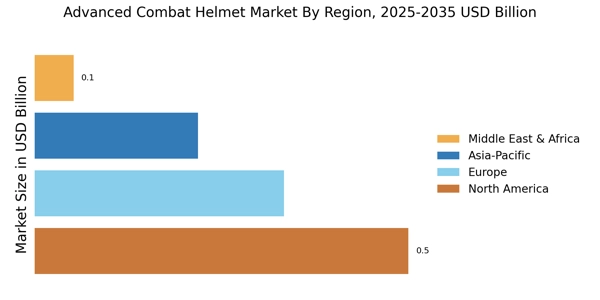
North America is the largest market for advanced combat helmets, accounting for approximately 45% of the global share. The region's growth is driven by increasing defense budgets, technological advancements, and a focus on soldier safety. Regulatory support from government agencies, including the Department of Defense, further catalyzes market expansion. The demand for lightweight, durable helmets is rising, influenced by ongoing military operations and modernization programs. The United States and Canada are the leading countries in this market, with major players like Gentex Corporation, Honeywell International, and Revision Military dominating the landscape. The competitive environment is characterized by continuous innovation and partnerships between defense contractors and government entities. The presence of established manufacturers ensures a robust supply chain, meeting the evolving needs of military personnel.
Europe is witnessing significant growth in the advanced combat helmet market, holding approximately 30% of the global share. The increase in defense spending by NATO countries and the rising focus on soldier protection are key drivers. Regulatory frameworks, such as the European Defense Fund, are facilitating investments in advanced military technologies, including personal protective equipment. The demand for helmets that integrate communication systems and enhanced ballistic protection is on the rise. Leading countries in this region include the United Kingdom, Germany, and France, where companies like Bae Systems and United Shield International are prominent. The competitive landscape is evolving, with a mix of established firms and new entrants focusing on innovation. Collaborations between governments and private sectors are fostering advancements in helmet technology, ensuring that European forces are equipped with state-of-the-art protective gear.
Asia-Pacific is rapidly emerging as a significant player in the advanced combat helmet market, accounting for about 20% of the global share. The region's growth is fueled by increasing military expenditures, modernization initiatives, and geopolitical tensions. Countries like India and Australia are investing heavily in defense capabilities, leading to a surge in demand for advanced protective gear. Regulatory support and government initiatives are further driving market expansion, focusing on enhancing soldier safety and operational effectiveness. Key players in this region include Elbit Systems and local manufacturers, which are increasingly collaborating with international firms to enhance their product offerings. The competitive landscape is marked by innovation and a focus on integrating advanced technologies, such as augmented reality and communication systems, into helmet designs. This trend is expected to continue as nations prioritize the safety and effectiveness of their armed forces.
The Middle East and Africa region is witnessing a gradual increase in the advanced combat helmet market, holding approximately 5% of the global share. The growth is driven by rising security concerns, ongoing conflicts, and military modernization efforts. Countries in this region are increasingly recognizing the importance of equipping their armed forces with advanced protective gear, supported by government initiatives aimed at enhancing defense capabilities. Regulatory frameworks are evolving to facilitate procurement processes for military equipment. Leading countries include the United Arab Emirates and South Africa, where local manufacturers are beginning to emerge alongside established global players. The competitive landscape is characterized by a mix of domestic and international firms, focusing on providing tailored solutions to meet specific regional needs. As defense budgets increase, the demand for advanced combat helmets is expected to rise, reflecting the region's commitment to enhancing military readiness.
The Advanced Combat Helmet Market is characterized by a dynamic competitive landscape, driven by the increasing demand for enhanced soldier protection and technological advancements. Key players such as Gentex Corporation (US), Honeywell International Inc. (US), and Revision Military (CA) are at the forefront, each adopting distinct strategies to solidify their market positions. Gentex Corporation (US) focuses on innovation, particularly in developing lightweight materials that enhance comfort without compromising safety. Meanwhile, Honeywell International Inc. (US) emphasizes regional expansion, targeting emerging markets to broaden its customer base. Revision Military (CA) is noted for its partnerships with defense agencies, which facilitate the integration of cutting-edge technologies into their helmet designs. Collectively, these strategies contribute to a competitive environment that is increasingly centered on technological differentiation and strategic collaborations.In terms of business tactics, companies are increasingly localizing manufacturing to reduce lead times and optimize supply chains. This approach appears to be a response to the moderately fragmented market structure, where multiple players vie for market share. The collective influence of these key players is significant, as they not only drive innovation but also set industry standards that smaller competitors must follow.
In August Gentex Corporation (US) announced the launch of its new line of advanced combat helmets featuring integrated communication systems. This strategic move is likely to enhance operational efficiency for military personnel, as it allows for seamless communication in the field. The introduction of such technology underscores Gentex's commitment to innovation and positions the company as a leader in the integration of advanced features into traditional helmet designs.
In July Honeywell International Inc. (US) expanded its manufacturing capabilities in Southeast Asia, aiming to meet the growing demand for advanced protective gear in the region. This expansion is strategically important as it not only increases production capacity but also allows Honeywell to respond more swiftly to regional market needs. By establishing a stronger foothold in this emerging market, Honeywell is likely to enhance its competitive edge against other global players.
In September Revision Military (CA) secured a multi-year contract with a NATO member country to supply advanced combat helmets. This contract is indicative of Revision's strong reputation in the defense sector and highlights the importance of strategic partnerships in securing long-term business opportunities. Such contracts not only provide financial stability but also enhance the company's credibility and visibility in the global market.
As of October current competitive trends in the Advanced Combat Helmet Market include a pronounced focus on digitalization, sustainability, and the integration of artificial intelligence. Strategic alliances are increasingly shaping the landscape, as companies collaborate to leverage each other's strengths. Looking ahead, it is anticipated that competitive differentiation will evolve, shifting from price-based competition to a focus on innovation, technological advancements, and supply chain reliability. This transition suggests that companies that prioritize research and development, alongside sustainable practices, will likely emerge as leaders in this evolving market.

May–June 2026
March 2026
On March 9, 2026, the U.S. Army awarded Elbit Systems of America a $120.5 million Other Transaction Authority contract to develop the Soldier Borne Mission Command (SBMC) system — a helmet-mounted mission command system fusing multiple battlefield sensors into a single visual feed for dismounted soldiers, allowing real-time sharing of visual intelligence and threat data across a unit, even in denied or degraded environments. Elbit America is partnering with Booz Allen Hamilton to build SBMC's software backbone, including extended-reality solutions and AI-enabled insights. Notably, per Future Warfare Magazine, SBMC is effectively superseding IVAS in the FY2026 budget, with the planned procurement of 3,162 IVAS 1.2 sets eliminated and funds redirected to SBMC development.
February 2026
At the Enforce Tac trade fair in Nuremberg (Feb 23–25), Rheinmetall unveiled a new combat helmet made from High Performance Polyethylene composite material, described as significantly lighter than earlier versions while maintaining existing ballistic protection standards. The helmet comes in high-cut and full-cut shapes, with a redesigned strap system, improved padding, and removal of the internal hairnet for better compatibility with other gear. Rheinmetall noted it has delivered roughly 310,000 combat helmets to the German Bundeswehr, positioning it as one of NATO's largest helmet suppliers.
January 2026
On January 12, 2026, Team Wendy Ceradyne and Theon International announced a strategic partnership under a U.S. Army Combat Capabilities Development Command (DEVCOM) Soldier Center-funded initiative to jointly develop the Integrated Multi-Threat Headborne System (IMHS) — a next-generation system designed to enhance soldier protection, situational awareness, and lethality across multi-domain operations. The prototype combines Team Wendy Ceradyne's ballistic helmet with Theon's electronic systems and is due for evaluation at the DEVCOM Soldier Center in Q4 of fiscal year 2026.
고급 전투 헬멧 시장은 2024년부터 2035년까지 4.95%의 연평균 성장률(CAGR)로 성장할 것으로 예상되며, 이는 기술 발전, 방위 예산 증가, 병사 보호에 대한 수요 증가에 의해 촉진될 것입니다.
새로운 기회는 다음에 있습니다:
2035년까지 시장은 강력한 성장을 이룰 것으로 예상되며, 방위 기술 분야에서의 입지를 확고히 할 것입니다.
| MARKET SIZE 2024 | 1.064(USD Billion) |
| MARKET SIZE 2025 | 1.116(USD Billion) |
| MARKET SIZE 2035 | 1.81(USD Billion) |
| COMPOUND ANNUAL GROWTH RATE (CAGR) | 4.95% (2025 - 2035) |
| REPORT COVERAGE | Revenue Forecast, Competitive Landscape, Growth Factors, and Trends |
| BASE YEAR | 2024 |
| Market Forecast Period | 2025 - 2035 |
| Historical Data | 2019 - 2024 |
| Market Forecast Units | USD Billion |
| Key Companies Profiled | Gentex Corporation (US), Honeywell International Inc. (US), 3M Company (US), Revision Military (CA), MSA Safety Incorporated (US), Safariland Group (US), United Shield International (GB), Bae Systems (GB), Elbit Systems (IL) |
| Segments Covered | Material, Application, Sales Channel, Design Type, Regional |
| Key Market Opportunities | Integration of advanced materials and smart technologies enhances performance in the Advanced Combat Helmet Market. |
| Key Market Dynamics | Technological advancements and regulatory changes drive innovation and competition in the Advanced Combat Helmet Market. |
| Countries Covered | North America, Europe, APAC, South America, MEA |
 Triveni Bhoyar

 Sejal Akre
The secondary research process involved comprehensive analysis of defense procurement databases, military standards publications, peer-reviewed defense journals, and authoritative security organizations. Key sources included the US Department of Defense (DoD), Defense Logistics Agency (DLA), National Institute of Justice (NIJ), US Army Natick Soldier Research, Development and Engineering Center (NSRDEC), UK Ministry of Defence (MoD), NATO Standardization Office (NSO), European Defence Agency (EDA), Defence Research and Development Organisation (DRDO) - India, China North Industries Corporation (NORINCO) procurement reports, Australian Defence Force (ADF), Israeli Ministry of Defense (IMOD), US Government Accountability Office (GAO) defense reports, Federal Business Opportunities (SAM.gov), US Bureau of Industry and Security, Stockholm International Peace Research Institute (SIPRI) Arms Transfers Database, International Institute for Strategic Studies (IISS) Military Balance, Jane's Defence Industry & Markets, Army Technology & Defense News outlets, and national defense ministry procurement reports from key markets. These sources were used to collect military procurement statistics, ballistic protection standards, operational requirement specifications, defense budget allocations, soldier modernization program data, and competitive landscape analysis for ballistic helmets, advanced combat helmets, modular integrated communications helmets, and next-generation head protection systems.
In order to gather both qualitative and quantitative insights, supply-side and demand-side stakeholders were interviewed during the primary research process. CEOs, VPs of Defense Programs, heads of Military Business Units, and government sales directors from helmet manufacturers, defense contractors, and ballistic protection OEMs were examples of supply-side sources. Military procurement officers, program managers from troop upgrading programs, defense acquisition specialists, and logistics chiefs from the army, marines, special forces, and law enforcement were examples of demand-side sources. In addition to gathering information on operational fielding patterns, defense procurement strategies, and military specification compliance requirements, primary research verified military contract award timings and validated market segmentation.
Primary Respondent Breakdown:
By Designation: C-level Primaries (32%), Director Level (30%), Others (38%)
By Region: North America (32%), Europe (30%), Asia-Pacific (28%), Rest of World (10%)
Global market valuation was derived through defense contract mapping and military procurement volume analysis. The methodology included:
Identification of 40+ key defense contractors and helmet manufacturers across North America, Europe, Asia-Pacific, Middle East, and Latin America
Product mapping across advanced combat helmets, ballistic helmets, modular integrated communications helmets (MICH), enhanced combat helmets (ECH), and next-generation head protection systems
Analysis of reported and modeled defense contract values specific to soldier protection and headgear portfolios
Coverage of manufacturers representing 65-70% of global defense helmet market share in 2024
Extrapolation using bottom-up (military procurement volume × contract value by country/branch) and top-down (defense contractor revenue validation) approaches to derive segment-specific valuations
이 보고서의 무료 샘플을 받으려면 아래 양식을 작성하십시오

“This is really good guys. Excellent work on a tight deadline. I will continue to use you going forward and recommend you to others. Nice job”
 Noah Malgeri
Co-Founder

“Thanks for sending the report it gives us a good global view of the Betaïne market.”
 Peter Groot koerkamp
Account and Business Manager

“We found the report very insightful! we found your research firm very helpful. I'm sending this email to secure our future business.”
 Younghwan Choi
Senior Retail Manager

“I am very pleased with how market segments have been defined in a relevant way for my purposes (such as "Portable Freezers & refrigerators" and "last-mile"). In general the report is well structured. Thanks very much for your efforts.”
 Mark Irwin
Management Consultant

“We got the report in time, we really thank you for your support in this process. I also thank to all of your team as they did a great job.”
 Akif Moroglu
Strategy & Business Development Director

“The Automotive 48V ECU Components Procurement Intelligence Study” was a complex project, but the Market Research Future (MRFR) team handled it with quality, agility, and customer-centricity. They delivered all requested data on time and within the agreed scope. The team, including Shubhendra Anand and Rahul Gotadki, was always readily available to clarify questions and swiftly implement necessary adjustments, driving the project to a successful conclusion within a very demanding timeframe.
I would also like to specifically commend Akshay Agarwal for his responsiveness and support at every stage—from our initial inquiry on May 6th through to final delivery on June 18th. His dedication made the entire process seamless.”
 Guilherme Gomes Martins
Product Management Director

“Thanks. It’s been a pleasure working with you, please use me as reference with any other Intel employees.”
 Joseph Aguayo
Sales Operations & Pricing Manager

“Thank you, this will be very helpful for OQS.”
 La Terria Dodd
Program Support Specialist

“I have been reading the first document or the study, ,the Global HVAC and FP market report 2021 till 2026. Must say, good info! I have not gone in depth at all parts, but got a good indication of the data inside!”
 Rob Kooiker
Group Product Manager HVAC & Fire Protection GMA



