Marché des pastilles pour la gorge (2026 - 2035)

Rapport de recherche sur le marché des pastilles pour la gorge : Informations par type (pastilles en bonbon dur, pastilles molles et pastilles comprimées), par ingrédient (menthol, menthe, huile d'eucalyptus, huile de menthe poivrée, miel et gingembre, citron et autres), par indication (mal de gorge, toux et rhume, et maladies de la gorge), et par région (Amérique du Nord, Europe, Asie-Pacifique et reste du monde) – Prévisions du marché jusqu'en 2035
ID: MRFR/Pharma/0705-CR 123 Pages Nidhi Mandole, Rahul Gotadki Last Updated: November 11, 2026
Throat Lozenges Market
Market Size
Forecast Period2026-2035
CAGR (2026-2035)6.2%
2025 Market SizeUSD 5.63 Billion
2035 Market SizeUSD 10.26 Billion
Key Players
Reckitt Benckiser Group plc
Mondelēz International
Ricola AG
Lofthouse of Fleetwood Ltd.
Prestige Consumer Healthcare Inc.
Combe Incorporated
Opportunities
  • Affordable Formats for Rural India and ASEAN
  • Subscription Replenishment and First-Party Data
  • Probiotic and Immunity-Positioned Lozenges

Marché des pastilles pour la gorge Résumé du marché

Le marché mondial des pastilles pour la gorge était évalué à 5,63 milliards USD en 2025 et devrait atteindre 5,97 milliards USD en 2026, puis s'étendre à un TCAC de 6,2 % pour atteindre 10,26 milliards USD d'ici 2035. Deux catalyseurs ancrent cette perspective. La proposition de la FDA américaine de novembre 2024 visant à retirer la phényléphrine orale du monographe OTC pousse les personnes souffrant de rhumes vers des formats de soulagement symptomatique. Parallèlement, les programmes de gestion des antibiotiques orientent les patients souffrant de maux de gorge viraux loin des prescriptions et vers l'autosoins [4].

La formulation, et non le volume, définit la transformation en cours. Les gouttes de menthol à base de sucre héritées cèdent la place à des matrices sans sucre à base de polyols, à des actifs anti-inflammatoires dosés cliniquement tels que le flurbiprofène, et à des mélanges botaniques ou probiotiques positionnés pour l'immunité quotidienne. La pression est autant métabolique que thérapeutique : la Fédération internationale du Diabète compte 537 millions d'adultes vivant avec le diabète, un total qui devrait atteindre 783 millions d'ici 2045. Les marques qui vendaient autrefois des pastilles pour soulager les maux de gorge comme des achats d'impulsion saisonniers construisent désormais des portefeuilles basés sur des preuves, disponibles toute l'année.

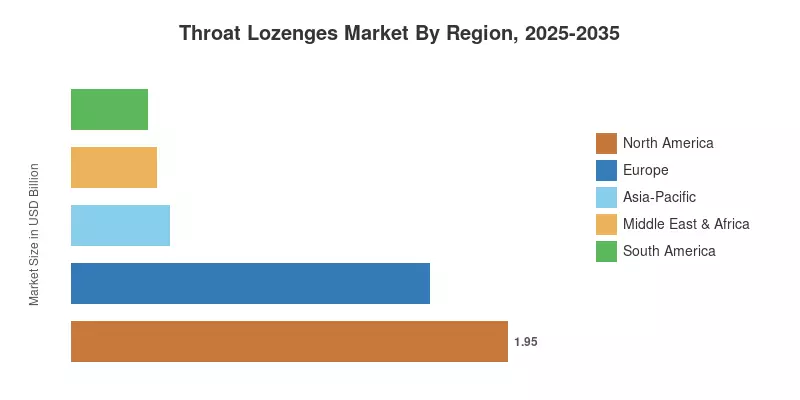
Régionalement, l'Amérique du Nord est en tête avec une part de 34,6 % en 2025, soutenue par des réseaux de pharmacies denses et des dépenses OTC par habitant élevées. La région Asie-Pacifique est celle qui connaît la croissance la plus rapide avec un TCAC de 7,9 %, propulsée par l'Inde, la Chine et le commerce électronique de l'ASEAN. L'Europe se classe au deuxième rang, générant 1,60 milliard USD grâce à sa culture de recommandation par les pharmaciens. Au cours de la prochaine décennie, le marché des pastilles pour la gorge récompensera les fournisseurs qui associent crédibilité clinique à des formats sans sucre, distribués numériquement.

Principaux enseignements du rapport

• Par catégorie de produit

  • Les pastilles médicamenteuses détenaient une part de 57,4 % du marché des pastilles pour la gorge en 2025, reflétant une confiance durable dans les actifs cliniquement prouvés.
  • Les pastilles non médicamenteuses/fonctionnelles sont la catégorie à la croissance la plus rapide avec un TCAC de 9,1 % jusqu'en 2035.

• Par type d'ingrédient

  • Le menthol et l'eucalyptus dominent avec une part de 29,4 % sur des signaux familiers de refroidissement et d'expectoration.
  • Les actifs à base de plantes se développent à un TCAC de 10,3 %, le plus rapide de tous les types d'ingrédients sur le marché des pastilles pour la gorge.

• Par teneur en sucre

  • Les formulations sans sucre commandent une part de 56,1 % alors que les acheteurs diabétiques et soucieux de leur poids échangent vers le haut.
  • Les pastilles à base de sucre croissent à un TCAC de 4,3 %, soutenues par des niveaux de valeur et des préférences de goût traditionnelles.

• Par canal de distribution

  • Les pharmacies et les drogueries capturent une part de 41,8 % grâce à l'approbation des pharmaciens.
  • Le commerce de détail en ligne affiche un TCAC de 10,5 %, le plus rapide de tous les canaux.

• Par région

  • L'Amérique du Nord domine avec une part de 34,6 %.
  • L'Asie-Pacifique connaît la croissance la plus rapide avec un TCAC de 7,9 %.
  • L'Europe génère 1,60 milliard USD en 2025.

Taille du marché et prévisions (2021–2035)

Market Research Future a construit la base de référence du marché des pastilles pour la gorge à partir des rapports annuels des fabricants, des audits de vente au détail de pharmacies et d'épiceries, des données commerciales et douanières, et de plus de 350 entretiens primaires avec des responsables de marque, des pharmaciens, des distributeurs et des fournisseurs d'ingrédients. Les valeurs historiques ont été réconciliées de bas en haut par produit, ingrédient et canal, puis validées de haut en bas contre les divulgations de segments d'entreprise et la surveillance de la santé publique sur l'incidence des maladies respiratoires.
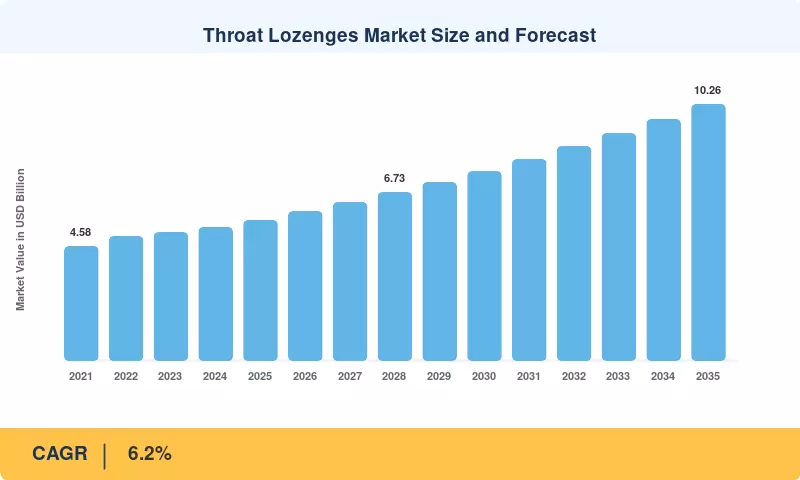
Taille et prévisions du marché des pastilles pour la gorge
Our Impact

Enabled $4.3B Revenue Impact for Fortune 500 and Leading Multinationals

Partnering with 2000+ Global Organizations Each Year

30K+ Citations by Top-Tier Firms in the Industry

Driver Impact Analysis

Driver ~% Impact on CAGR Geographic Relevance Impact Timeline
High incidence of upper respiratory infections ~+1.4% Global Short-term (≤2 yr)
Shift toward OTC self-care and antibiotic stewardship ~+1.1% North America, Europe, Japan Medium-term (2–4 yr)
Sugar-free reformulation for metabolic health ~+0.9% Global Medium-term (2–4 yr)
Adoption of herbal and botanical actives ~+0.8% Asia-Pacific, Europe Long-term (≥4 yr)
Online retail and quick-commerce expansion ~+0.7% Asia-Pacific, North America Short-term (≤2 yr)
Air pollution and voice-strain exposure ~+0.5% Asia-Pacific, Middle East & Africa Long-term (≥4 yr)

High Incidence of Upper Respiratory Infections

Respiratory infections remain the baseline of demand. WHO estimates roughly one billion cases of seasonal influenza worldwide each year [1], while CDC data show that adults catch an average of two to three colds annually [2]. Each episode creates a short, intense purchase window for throat relief, and post-pandemic immunity gaps have lengthened recent seasons. Manufacturers align promotional calendars and pharmacy stocking with these predictable cycles, converting recurring infections into dependable volume.

Shift Toward OTC Self-Care and Antibiotic Stewardship

Health systems are actively moving mild sore throat cases out of clinics. A JAMA study found that about 30% of U.S. outpatient antibiotic prescriptions were unnecessary, with respiratory conditions the leading cause [4]. Stewardship guidance now favors symptomatic relief for viral pharyngitis, and the 2020 CARES Act monograph reform gives FDA a faster route to update OTC ingredient rules . Japan's Self-Medication Taxation System adds a fiscal nudge by letting households deduct qualifying OTC purchases [24].

Sugar-Free Reformulation for Metabolic Health

Metabolic health concerns are rewriting recipes. Roughly one in ten adults globally lives with diabetes , and many more manage weight or dental health actively. Isomalt, erythritol, and stevia deliver non-cariogenic sweetness while preserving hard-candy texture, letting brands win placement in diabetic-care aisles. Market Research Future estimates that sugar-free variants retail at a 10–20% premium over sugar-based equivalents, so reformulation lifts both volume and value per pack.

Adoption of Herbal and Botanical Actives

Plant-derived remedies carry deep cultural credibility. WHO reports that 170 of its 194 member states acknowledge use of traditional and complementary medicine [6]. Licorice, ginger, tulsi, ivy leaf, and Alpine herb blends now appear in mainstream lozenges, and brands increasingly reference clinical data on the pack to separate evidence-backed botanicals from generic herbal claims. This driver strengthens through the forecast as regulators formalize traditional-use pathways.

Online Retail and Quick-Commerce Expansion

Search-driven purchasing at symptom onset favors digital channels. UNCTAD data show online retail's share of total retail sales in major economies rose from about 16% to 19% in 2020 alone [7], and that habit has persisted. Quick-commerce platforms in India and Southeast Asia now deliver within 10–30 minutes, effectively turning a pharmacy errand into an impulse purchase. Auto-replenishment programs extend this into recurring household demand.

Air Pollution and Voice-Strain Exposure

Environmental irritation creates non-infectious demand. WHO estimates that 99% of the global population breathes air exceeding its guideline limits [8], with the heaviest exposure across South Asia, China, and the Middle East. Dry, polluted air aggravates throat irritation year-round, while teachers, call-center agents, and performers face chronic voice strain. These users buy steadily rather than seasonally, smoothing demand curves for suppliers.

Restraints Impact Analysis

Restraint ~% Impact on CAGR Geographic Relevance Impact Timeline
Strict OTC claims and labeling regulation ~−0.6% Europe, North America Medium-term (2–4 yr)
Sugar and menthol raw-material price volatility ~−0.5% Global Short-term (≤2 yr)
Strong seasonality of demand ~−0.4% North America, Europe Short-term (≤2 yr)
Private-label price competition ~−0.4% North America, Europe Medium-term (2–4 yr)
Safety concerns over local anaesthetics in children ~−0.3% Global Long-term (≥4 yr)

Strict OTC Claims and Labeling Regulation

EU Regulation (EC) No 1924/2006 permits only authorized health claims on food-classified lozenges [9], and more than 2,000 botanical claims remain on hold, blocking functional brands from stating benefits plainly. In the UK, the MHRA Blue Guide constrains how medicated products are advertised [10]. Compliance reviews lengthen launch timelines and limit the marketing language that drives trial.

Sugar and Menthol Raw-Material Price Volatility

Input costs swing sharply. The FAO Sugar Price Index reached its highest level since 2011 during 2023 [11], squeezing margins on sugar-based lines. Natural menthol supply is concentrated in India's mint belt, so monsoon variability moves prices globally. Smaller manufacturers lack hedging scale and often absorb cost spikes rather than raise shelf prices.

Strong Seasonality of Demand

Sales cluster around respiratory seasons, which WHO surveillance shows peaking in winter months in temperate regions [1]. Market Research Future estimates that 55–60% of annual unit sales in Northern Hemisphere markets fall between October and March. This concentration complicates production planning, raises inventory-holding costs, and exposes suppliers to revenue shortfalls when a mild season arrives.

Private-Label Price Competition

In commoditized forms, retailer brands weaken pricing power. Pharmacy chains frequently offer own-label menthol and honey-lemon packs next to national brands at 20–30% reduced costs, and PLMA reported record U.S. store brand dollar sales exceeding USD 230 billion in 2023 [12]. Instead of relying solely on taste to protect share, branded players must use clinical distinctiveness.

Safety Concerns Over Local Anaesthetics in Children

Anesthetic forms are limited by pediatric safety monitoring. The FDA took action against newborn benzocaine teething products in 2018 and mandated more stringent warnings regarding methemoglobinemia on benzocaine oral health products . Therefore, the addressable population for this ingredient class is limited since benzocaine and hexylresorcinol lozenges have age limitations that exclude them from the family segment.

Marché des pastilles pour la gorge Opportunités

Cinq bassins d'opportunités se distinguent pour le marché des pastilles pour la gorge jusqu'en 2035, chacun lié à un changement de politique spécifique, une tendance technologique ou un écart géographique.

Formats abordables pour l'Inde rurale et l'ASEAN

Les marchés émergents offrent le plus grand potentiel de volume. L'interdiction en Inde en août 2024 de 156 médicaments à dose fixe [19] a libéré de l'espace sur les étagères pour les pastilles à actif unique et à base de plantes, tandis que la pénétration des pharmacies rurales continue d'augmenter. Les bandes à bas prix et les sachets à dose unique au prix d'un ou deux roupies par pastille ouvrent la voie aux acheteurs pour la première fois.

Réapprovisionnement par abonnement et données de première partie

Le réapprovisionnement automatique direct au consommateur transforme un achat épisodique en revenus récurrents. Les marques qui capturent les données de recherche et d'achat au début des symptômes peuvent vendre des placements ciblés via des réseaux de médias de détail et affiner le stockage régional, créant ainsi une couche de monétisation des données à travers le marché des pastilles pour la gorge. Les abonnements familiaux regroupant des pastilles avec d'autres articles de soins contre le rhume augmentent la taille du panier.

Pastilles probiotiques et positionnées pour l'immunité

Les pastilles passent d'un soulagement aigu à une prévention quotidienne grâce à l'utilisation de souches probiotiques orales et de formulations paraprobiotiques. Les pharmacies listent de plus en plus les pastilles pour l'immunité aux côtés des vitamines, et la recherche clinique sur l'utilisation pédiatrique a renforcé la confiance. Dans ce secteur pour les pastilles non médicamenteuses/fonctionnelles, les marques peuvent facturer un prix premium si elles obtiennent des preuves cliniques enregistrées.

Soins de la voix pour les utilisateurs professionnels

Les enseignants, les employés de centres d'appels, les artistes et les orateurs publics constituent un groupe d'utilisateurs constant et non saisonnier, aggravé par l'inconfort de la gorge causé par la pollution [8]. Les prix de vente moyens peuvent être augmentés par des canaux de vente au détail spécialisés et des lieux de travail offrant des produits de soins de la voix contenant de la glycérine, de l'orme glissant ou de la racine de guimauve.

Passages de l'ordonnance au sans ordonnance pour les actifs anti-inflammatoires

Les pastilles de flurbiprofène et de benzydamine se vendent déjà en vente libre dans certaines parties de l'Europe, mais de nombreux marchés asiatiques et latino-américains les restreignent encore. Les dépôts de changement dans ces géographies ouvriraient des segments cliniques à forte marge aux marques établies disposant de dossiers de sécurité existants.

Marché des pastilles pour la gorge Perspectives d'avenir

Four structural themes will shape the Throat Lozenges Market between 2026 and 2035, each shifting where value accrues along the chain.

Evidence-Backed Botanicals and Probiotics

Proof will become more and more necessary for herbal placement. Demand is guaranteed because traditional medicine is utilized in 170 WHO member states [6], but pharmacists and authorities will reward companies that provide trial evidence on certain extracts and strains. Anticipate consolidation as smaller, unsupported herbal labels are acquired by clinically supported botanical brands.

AI-Led Demand Forecasting and the Digital Shelf

In order to predict regional demand weeks in advance, manufacturers are implementing machine-learning algorithms that integrate search trends, weather, and pharmacy sell-out data. While digital shelf analytics optimize price and content across marketplaces, accurate forecasting minimizes seasonal stock-outs and write-offs. A disproportionate chunk of online growth will go to suppliers with better data capabilities.

Aging Populations and Metabolic Health

WHO projects that one in six people worldwide will be aged 60 or older by 2030 [20]. Older consumers experience more chronic dry throat, often linked to medications, and carry higher diabetes prevalence . This demographic shift favors sugar-free, saliva-stimulating, and gentle formulations sold year-round.

Sustainable Sourcing and ESG Disclosure

Europe's Corporate Sustainability Reporting Directive extends detailed ESG reporting to roughly 50,000 companies [25], pulling sugar, mint, and herb sourcing into supply-chain disclosure. Brands across the Throat Lozenges Market will need traceable menthol and certified sugar, and suppliers that document farm-level practices will gain preferred-vendor status with large manufacturers.

Regional Market Share Analysis

Region Key Metric (2025) Primary Investment Themes
North America 34.6% share Clinical actives, sugar-free premiumization, subscription retail
Europe USD 1.60 Billion Pharmacist recommendation, anti-inflammatory switches, recyclable packs
Asia-Pacific 7.9% CAGR Herbal actives, quick-commerce, rural pharmacy access
South America 6.1% share Pharmacy chain consolidation, affordable packs
Middle East & Africa 6.8% CAGR Local manufacturing, pollution-driven demand
Total USD 5.63 Billion —

North America remains the revenue anchor of the Throat Lozenges Market, while Asia-Pacific delivers the fastest growth as e-commerce, rising incomes, and herbal-remedy traditions converge. Europe's pharmacist-led model sustains a solid second position.

North America

Country Key Metric (2025) Key Driver
US 81.2% share of region Phenylephrine review and sugar-free premiumization
Canada 5.4% CAGR Natural Health Product licensing for botanicals
Mexico USD 0.17 Billion Rapid pharmacy-chain expansion

High per-capita OTC spending and mature drugstore chains sustain North American leadership. FDA's November 2024 proposal on oral phenylephrine is redirecting cold-care budgets toward symptomatic relief, benefiting lozenge brands from P&G, Mondelēz, and Prestige Consumer Healthcare [16]. Canada regulates many herbal lozenges as Natural Health Products, giving botanicals a defined pathway, while Mexico's pharmacy-chain expansion widens access.

Europe

Country Key Metric (2025) Key Driver
Germany 21.4% share of region Strong pharmacy recommendation culture
UK USD 0.27 Billion Established OTC anti-inflammatory lozenges
France 4.9% CAGR Pharmacy-exclusive OTC distribution
Italy 11.8% share of region Herbal and honey-based preferences
Spain USD 0.12 Billion Pharmacy-led antiseptic formats
Nordic Countries 5.6% CAGR High sugar-free adoption
Russia 7.3% share of region Value-tier and domestic brands
Rest of Europe USD 0.20 Billion Retail modernization in Central Europe

Pharmacist endorsement drives brand choice across Europe, particularly in Germany's Apotheke network and France's pharmacy-only OTC channel. The UK leads in anti-inflammatory formats following flurbiprofen's earlier OTC availability. EU claims rules [9] constrain functional brands, pushing them toward clinical substantiation. The Nordic Countries favor sugar-free products, and Russia remains price-sensitive.

Asia-Pacific

Country Key Metric (2025) Key Driver
China 33.5% share of region Traditional herbal formulations and e-commerce
India 9.6% CAGR FDC ban and Ayurvedic lozenge demand
Japan USD 0.26 Billion Self-medication tax incentives, aging population
South Korea 6.4% share of region Pollution-driven throat care
ASEAN 8.8% CAGR Quick-commerce and modern trade expansion
Rest of Asia-Pacific USD 0.12 Billion Pharmacy access in Australia and Oceania

Herbal heritage and digital commerce power Asia-Pacific growth. India's 2024 fixed-dose combination ban [19] favors single-active and Ayurvedic lozenges, while China's traditional formulations, such as Golden Throat, compete alongside multinational brands. Japan's self-medication tax deduction [24] supports OTC uptake among older consumers. ASEAN growth rides on quick-commerce and expanding modern trade.

South America

Country Key Metric (2025) Key Driver
Brazil 54.8% share of region Pharmacy-chain consolidation and OTC access
Argentina 5.2% CAGR Value-tier and compact pack demand
Rest of South America USD 0.09 Billion Expanding modern retail in Colombia and Chile

Brazil dominates the region, where ANVISA classifies many lozenges as non-prescription medicines and large pharmacy chains drive shelf visibility. Argentina's inflation dampens premium uptake but supports value and private-label formats. Across the region, compact pack sizes help brands manage affordability without cutting unit margins.

Middle East & Africa

Country Key Metric (2025) Key Driver
Saudi Arabia USD 0.07 Billion Localization of OTC manufacturing
UAE 7.6% CAGR Premium pharmacy and travel retail
South Africa 18.9% share of region Established OTC pharmacy channel
Egypt 7.1% CAGR Urban pollution and local generics
Rest of MEA 30.2% share of region Gradual pharmacy network expansion

Gulf pharmacy chains and Saudi Arabia's push for local pharmaceutical manufacturing underpin growth, while dust and urban air pollution sustain year-round demand [8]. The UAE's premium retail mix favors imported heritage brands. South Africa and Egypt rely on affordable antiseptic and menthol formats, with local manufacturers active in both markets.

Throat Lozenges Market By Region, 2025-2035

Marché des pastilles pour la gorge Segmentation du marché

By Product Category

The Throat Lozenges Market splits into Medicated Lozenges and Non-medicated/Functional Lozenges, with clinical trust and wellness positioning defining each side.

Segment Key Metric Primary Demand Driver
Medicated Lozenges 57.4% share Clinically proven actives and pharmacist endorsement
Non-medicated/Functional Lozenges 9.1% CAGR Immunity positioning and everyday preventive use

Medicated Lozenges lead because consumers in acute discomfort want proven relief, and pharmacists recommend registered actives such as AMC/DCBA, flurbiprofen, and benzocaine. Multinationals are upgrading delivery systems to improve local bioavailability. Non-medicated/Functional Lozenges grow fastest as honey, herbal, and probiotic products extend usage beyond illness episodes into daily throat care, and clinical data on botanicals gradually narrows the credibility gap between the two categories.

By Ingredient Type

Ingredient choices in the Throat Lozenges Market span classic cooling agents, antiseptics, anaesthetics, anti-inflammatories, and botanicals.

Segment Key Metric Primary Demand Driver
Menthol & Eucalyptus 29.4% share Immediate cooling and expectorant familiarity
Honey & Lemon 18.6% share Natural soothing and family appeal
Antiseptic USD 0.74 Billion Pharmacist-recommended AMC/DCBA blends
Local Anaesthetic 5.1% CAGR Targeted pain relief for severe sore throat
Anti-Inflammatory 6.9% CAGR Flurbiprofen and benzydamine efficacy
Herbal Actives 10.3% CAGR Shift toward plant-derived therapeutics
Others 6.2% share Zinc, vitamin C, and specialty actives

Menthol & Eucalyptus hold the lead on instant cooling perception and decades of familiarity. Herbal Actives grow fastest as shoppers seek plant-derived remedies with transparent labelling. Honey & Lemon serves family and gentle-relief needs, while antiseptic throat pastilles built on AMC/DCBA remain a pharmacy staple. Local Anaesthetic options such as benzocaine and hexylresorcinol occupy specialist pain-relief roles, and Anti-Inflammatory actives gain traction for post-procedure discomfort.

By Sugar Content

Sugar content has become a primary purchase filter in the Throat Lozenges Market, splitting demand between Sugar-Based and Sugar-Free formulations.

Segment Key Metric Primary Demand Driver
Sugar-Based 4.3% CAGR Value pricing and traditional taste cues
Sugar-Free 56.1% share Diabetic, dental, and weight-management needs

Sugar-Free leads and also grows fastest, outpacing the overall category as isomalt, erythritol, and stevia deliver non-cariogenic sweetness with familiar mouthfeel. These products earn placement in diabetic-care aisles and support premium price tiers. Sugar-Based lozenges remain relevant in value segments and cultures that favor traditional flavor, and hybrid recipes blending reduced cane sugar with polyols help ease legacy consumers toward lower-calorie options.

By Distribution Channel

Distribution in the Throat Lozenges Market runs through Pharmacies & Drug Stores, Supermarkets & Hypermarkets, Convenience Stores, Online Retail, and Others.

Segment Key Metric Primary Demand Driver
Pharmacies & Drug Stores 41.8% share Pharmacist endorsement and clinical credibility
Supermarkets & Hypermarkets USD 1.39 Billion Bundled family cold-care baskets
Convenience Stores 13.5% share Commuter grab-and-go purchases
Online Retail 10.5% CAGR Symptom-onset search and quick delivery
Others 4.4% CAGR Travel retail and specialty outlets

Pharmacies & Drug Stores lead because pharmacist advice converts symptom-driven shoppers toward medicated brands. Online Retail grows fastest as direct-to-consumer platforms capture search traffic at onset and quick-commerce partners deliver within minutes. Supermarkets & Hypermarkets retain relevance for family baskets, Convenience Stores serve commuters, and travel retail within Others favors premium heritage brands, requiring consistent pricing and packaging across every touchpoint.

Competitive Benchmarking

The Throat Lozenges Market shows medium concentration. Market Research Future estimates that the top five suppliers control roughly 48–54% of global revenue, consistent with an HHI in the 800–1,000 range. Global brands from Reckitt, P&G, and Mondelēz dominate pharmacy and grocery shelves [15][16][17], while regional herbal specialists, private labels, and traditional-medicine producers keep the long tail fragmented, particularly in Asia-Pacific.

Company Est. Revenue Share Range Key Offerings for Throat Lozenges Market Strategic Positioning
Reckitt Benckiser Group plc ~14–17% Strepsils, Strefen Clinical leadership in antiseptic and anti-inflammatory lozenges
The Procter & Gamble Company ~10–13% Vicks lozenges and drops Cold-care ecosystem with broad mass retail reach
Mondelēz International ~9–12% Halls Mass-market menthol and sugar-free confectionery-health hybrid
Ricola AG ~6–8% Swiss herb drops, sugar-free range Heritage herbal positioning with premium pricing
Lofthouse of Fleetwood Ltd. ~4–6% Fisherman's Friend Strong-menthol niche with global distribution
Prestige Consumer Healthcare Inc. ~3–5% Chloraseptic, Luden's Anaesthetic sprays and lozenges in U.S. drugstores
Combe Incorporated ~2–4% Cepacol Pharmacist-recommended anaesthetic relief
Perrigo Company plc ~2–4% Store-brand lozenges Private-label supplier to major retailers
Opella ~2–3% Throat-care brands in Europe Standalone OTC company focused on consumer health
Himalaya Wellness Company ~1–2% Koflet lozenges Ayurvedic herbal lozenges in India and emerging markets

Recent News & Developments

Recent regulatory and corporate moves are reshaping portfolio priorities across the Throat Lozenges Market.

  • FDA Nonprescription Drugs Advisory Committee (September 2023): Concluded unanimously that oral phenylephrine is ineffective as a nasal decongestant, prompting retailers to review cold-care assortments and lifting interest in symptomatic relief formats.
  • Mondelēz International (October 2023): Completed the sale of its developed-market gum business to Perfetti Van Melle while retaining Halls, sharpening focus on its lozenge franchise. [22]
  • Reckitt (July 2024): Announced plans to exit its Essential Home portfolio and concentrate on Powerbrands, including Strepsils, directing more investment toward throat care. [15]
  • Government of India (August 2024): Prohibited 156 fixed-dose combination drugs, including several cough and cold combinations, favoring single-active and herbal lozenges. [19]
  • Sanofi (October 2024): Entered exclusive negotiations to sell a controlling stake in Opella to Clayton, Dubilier & Rice; completion in 2025 created a standalone consumer health company with European throat-care brands. [18]
  • U.S. FDA (November 2024): Proposed removing oral phenylephrine from the OTC monograph, a step expected to redirect cold-care spending toward lozenges and other symptomatic products.

Marché des pastilles pour la gorge Portée du rapport de marché

Parameter Details
Market Scope Medicated and non-medicated/functional throat lozenges across ingredient types and sugar contents, sold through pharmacies, supermarkets, convenience stores, and online channels for sore throat, cough, and voice-care use.
Study Period 2021–2035
Base Year 2025
Historical Data 2021–2024
Forecast Period 2026–2035
Market Size in 2025 USD 5.63 Billion
Market Size in 2035 USD 10.26 Billion
CAGR (2026–2035) 6.2%
Fastest Growing Segments Online Retail (10.5% CAGR); Herbal Actives (10.3% CAGR); Non-medicated/Functional Lozenges (9.1% CAGR)
Regions Covered North America, Europe, South America, Asia Pacific, Middle East and Africa and ROW
Companies Profiled Reckitt Benckiser Group plc, The Procter & Gamble Company, Mondelēz International, Ricola AG, Lofthouse of Fleetwood Ltd., Prestige Consumer Healthcare Inc., Combe Incorporated, Perrigo Company plc, Opella, Himalaya Wellness Company
Valuation Currency USD Billion
Methodology 350+ primary expert interviews; bottom-up market sizing; top-down validation; data triangulation; scenario-based forecasting; real-time project tracking

FAQ

Quelle est la valorisation actuelle du marché des pastilles pour la gorge ?

Le marché des pastilles pour la gorge était évalué à 4,93 milliards USD en 2024.

Quelle est la taille de marché projetée pour le marché des pastilles pour la gorge d'ici 2035 ?

Le marché devrait atteindre 8,362 milliards USD d'ici 2035.

Quel est le CAGR attendu pour le marché des pastilles pour la gorge pendant la période de prévision ?

Le CAGR attendu pour le marché des pastilles pour la gorge de 2025 à 2035 est de 4,92 %.

Quels types de pastilles pour la gorge sont en tête de la valorisation du marché ?

En 2024, les pastilles molles étaient évaluées à 1,8 milliard USD, tandis que les pastilles dures atteignaient 1,5 milliard USD.

Quels sont les ingrédients clés qui stimulent le marché des pastilles pour la gorge ?
Le menthol et le miel & le gingembre sont notables, avec des valorisations respectives de 0,8 milliard USD et 0,9 milliard USD en 2024.
Quelles indications sont les plus répandues sur le marché des pastilles pour la gorge ?

Les indications de toux et de rhume ont dominé le marché avec une valorisation de 2,5 milliards USD en 2024.

Qui sont les principaux acteurs du marché des pastilles pour la gorge ?
Les acteurs clés incluent Reckitt Benckiser, Procter & Gamble, et Pfizer, entre autres.
Comment les valorisations des différents types de pastilles se comparent-elles ?
En 2024, les pastilles molles devraient croître pour atteindre 3,0 milliards USD d'ici 2035, indiquant une forte demande.
Quelle est la tendance du marché pour l'huile d'eucalyptus dans les pastilles pour la gorge ?
Les pastilles à l'huile d'eucalyptus étaient évaluées à 0,5 milliard USD en 2024, avec un potentiel de croissance à 0,9 milliard USD d'ici 2035.
Quel segment montre le plus grand potentiel de croissance sur le marché des pastilles pour la gorge ?
Le segment de la toux et du rhume semble montrer le plus grand potentiel de croissance, projeté pour atteindre 4,0 milliards USD d'ici 2035.
Auteur
Auteur Author Profile Nidhi Mandole LinkedIn Senior Research Analyst
She is an extremely curious individual currently working in Healthcare and Medical Devices Domain. Nidhi is comfortably versed in data centric research backed by healthcare educational background. She leverages extensive data mining and analytics tools such as Primary and Secondary Research, Statistical Analysis, Machine Learning, Data Modelling. Her key role also involves Technical Sales Support, Client Interaction and Project management within the Healthcare team. Lastly, she showcases extensive affinity towards learning new skills and remain fascinated in implementing them.
Co-auteur Co-Author Profile Rahul Gotadki LinkedIn Research Manager
He holds an experience of about 9+ years in Market Research and Business Consulting, working under the spectrum of Life Sciences and Healthcare domains. Rahul conceptualizes and implements a scalable business strategy and provides strategic leadership to the clients. His expertise lies in market estimation, competitive intelligence, pipeline analysis, customer assessment, etc.

Research Approach


Secondary Research

The secondary research process involved comprehensive analysis of regulatory databases, peer-reviewed pharmaceutical journals, clinical publications, and authoritative health organizations. Key sources included the US Food & Drug Administration (FDA), European Medicines Agency (EMA), World Health Organization (WHO) Global Health Observatory, Centers for Disease Control and Prevention (CDC), National Institutes of Health (NIH), National Center for Biotechnology Information (NCBI/PubMed), American Pharmacists Association (APhA), Consumer Healthcare Products Association (CHPA), European Self-Care Industry (AESGP), Pharmaceutical Research and Manufacturers of America (PhRMA), International Pharmaceutical Federation (FIP), EU Eurostat Health Database, Organisation for Economic Co-operation and Development (OECD) Health Statistics, IMS Health (IQVIA), MRFR Retail Measurement Services, MRFR, and national health ministry reports from key markets (US, Germany, UK, Japan, China, India). These sources were used to collect product registration data, OTC approval statistics, respiratory infection epidemiology, consumer purchasing trends, demographic patterns, and competitive landscape analysis for hard candy lozenges, soft lozenges, compressed lozenges, and ingredient categories including menthol, honey & ginger, eucalyptus oil, and herbal formulations.


Primary Research

Qualitative and quantitative insights were obtained by interviewing supply-side and demand-side stakeholders during the primary research process. From throat lozenge manufacturers, pharmaceutical companies, and contract manufacturing organizations (CMOs), supply-side sources included CEOs, VPs of Product Development, regulatory affairs chiefs, R&D directors, and commercial directors. Retail pharmacists, pharmacy buyers, category managers from drugstore chains, supermarket health product buyers, e-commerce platform managers, and procurement leads from hospital pharmacies and clinic dispensaries constituted demand-side sources. Primary research verified market segmentation based on type (hard candy, soft, compressed), ingredient (menthol, mint, eucalyptus, honey & ginger, lemon), and indication (sore throat, cough and cold, throat diseases), and confirmed product pipeline timelines. Additionally, it gathered insights on seasonal demand patterns, pricing strategies, distribution channel dynamics, and private label growth trends.

Primary Respondent Breakdown:

By Designation: C-level Primaries (32%), Director Level (31%), Others (37%)

By Region: North America (38%), Europe (29%), Asia-Pacific (26%), Rest of World (7%)


Market Size Estimation

Global market valuation was derived through revenue mapping and consumption volume analysis. The methodology included:

Identification of 50+ key manufacturers across North America, Europe, Asia-Pacific, and Latin America

Product mapping across hard candy lozenges, soft lozenges, compressed lozenges, and ingredient categories (menthol, mint, eucalyptus oil, peppermint oil, honey & ginger, lemon, and others)

Analysis of reported and modeled annual revenues specific to throat lozenge portfolios

Coverage of manufacturers representing 72-78% of global market share in 2024

Extrapolation using bottom-up (consumption volume × ASP by country/region) and top-down (manufacturer revenue validation) approaches to derive segment-specific valuations

Télécharger l'échantillon gratuit

Veuillez remplir le formulaire ci-dessous pour recevoir un échantillon gratuit de ce rapport

Download PDF ×

We do not share your information with anyone. However, we may send you emails based on your report interest from time to time. You may contact us at any time to opt-out.


















