Marché de l'aldéhyde téréphtalique Résumé
Principales tendances et faits saillants du marché
Taille du marché et prévisions
| CAGR (2025 - 2035) | 4.01% |
| CAGR (2025 - 2035) | 4.01% |
The Terephthalic Aldehyde Market is currently experiencing a phase of evolution, driven by various factors that influence its dynamics. The increasing demand for high-performance materials in industries such as textiles, plastics, and automotive is propelling the market forward. Additionally, the growing emphasis on sustainability and eco-friendly products is prompting manufacturers to explore innovative production methods. This shift towards greener alternatives may reshape the competitive landscape, as companies strive to meet consumer expectations while adhering to regulatory standards. Furthermore, advancements in technology are likely to enhance production efficiency, potentially reducing costs and improving product quality. In the present context, the Terephthalic Aldehyde Market appears to be on a trajectory of growth, with emerging applications in pharmaceuticals and agrochemicals. The diversification of end-use sectors is indicative of a broader acceptance of terephthalic aldehyde as a versatile chemical intermediate. As industries continue to evolve, the market may witness increased collaboration between stakeholders, fostering research and development initiatives aimed at unlocking new applications. Overall, the Terephthalic Aldehyde Market is poised for transformation, reflecting the interplay of innovation, sustainability, and market demand.
The Terephthalic Aldehyde Market is witnessing a notable shift towards sustainability. Manufacturers are increasingly adopting eco-friendly practices, driven by consumer preferences for greener products. This trend may lead to the development of bio-based alternatives, which could significantly impact production processes and supply chains.
Innovations in production technologies are reshaping the Terephthalic Aldehyde Market. Enhanced manufacturing techniques are likely to improve efficiency and reduce waste, thereby lowering operational costs. This evolution may also facilitate the introduction of higher-quality products, catering to diverse industry needs.
The applications of terephthalic aldehyde are expanding beyond traditional sectors. Emerging uses in pharmaceuticals and agrochemicals suggest a growing recognition of its versatility. This diversification may open new avenues for market growth, as industries seek innovative solutions to meet evolving demands.
The Terephthalic Aldehyde Market presents diverse application segments, with textiles leading in market share, driven by the demand for fibers and fabrics. Plastics follow closely, showcasing significant potential for growth. Pharmaceuticals, cosmetics, and adhesives also contribute, but their market presence is relatively smaller in comparison to the dominating textile segment.
Textiles are the dominant application for Terephthalic Aldehyde Market, attributed to its critical role in producing polyester fibers, which are widely used in clothing and home furnishings. The versatility and durability of these fibers make them a staple in the textile industry. On the other hand, plastics are emerging rapidly, propelled by increasing consumer demand for lightweight and robust materials in various sectors, including automotive and construction. This shift indicates a transition where the plastics sector is becoming a noteworthy competitor, leveraging innovations and sustainability initiatives to carve a larger market share.
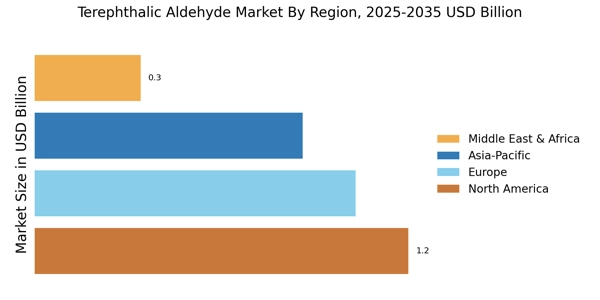
North America is witnessing significant growth in the Terephthalic Aldehyde Market, driven by increasing demand from the automotive and textile industries. The region holds approximately 35% of the global market share, making it the largest market. Regulatory support for sustainable chemical production is further catalyzing growth, with initiatives aimed at reducing carbon emissions and promoting eco-friendly practices. The United States and Canada are the leading countries in this region, with major players like Eastman Chemical Company and Huntsman Corporation dominating the landscape. The competitive environment is characterized by innovation and strategic partnerships, as companies invest in research and development to enhance product offerings and meet evolving consumer demands.
Europe is emerging as a key player in the Terephthalic Aldehyde Market, holding around 30% of the global share, making it the second-largest market. The region's growth is propelled by stringent environmental regulations and a strong emphasis on sustainability. The European Union's Green Deal and REACH regulations are pivotal in shaping market dynamics, encouraging the adoption of eco-friendly production methods and materials. Germany, France, and the UK are at the forefront of this market, with companies like BASF SE leading the charge. The competitive landscape is marked by innovation, with firms investing heavily in sustainable technologies. The presence of established chemical manufacturers and a robust regulatory framework further enhance the region's attractiveness for Terephthalic Aldehyde Market production.
Asia-Pacific is rapidly becoming a powerhouse in the Terephthalic Aldehyde Market, driven by increasing industrialization and urbanization. The region holds approximately 25% of the global market share, with countries like China and India leading the charge. The demand for Terephthalic Aldehyde Market is primarily fueled by the growing textile and automotive sectors, alongside supportive government policies aimed at boosting manufacturing capabilities. China is the largest market in this region, with companies like Yongxing Special Materials Technology and Shandong Hualu-Hengsheng Chemical playing significant roles. The competitive landscape is characterized by a mix of local and international players, with a focus on innovation and cost-effective production methods. As the region continues to develop, the Terephthalic Aldehyde Market is expected to see substantial growth in the coming years.
The Middle East and Africa (MEA) region is witnessing gradual growth in the Terephthalic Aldehyde Market, driven by increasing industrial activities and resource availability. The region holds about 10% of the global market share, with potential for expansion as local industries develop. Countries like Saudi Arabia and South Africa are focusing on enhancing their chemical production capabilities, supported by government initiatives aimed at diversifying economies away from oil dependency. Saudi Arabia is a key player in this market, with companies like SABIC leading the way. The competitive landscape is evolving, with both local and international firms vying for market share. As infrastructure improves and investment in chemical manufacturing increases, the MEA region is poised for growth in the Terephthalic Aldehyde Market sector.
The Terephthalic Aldehyde Market has recently experienced several significant developments. Mitsubishi Gas Chemical Company is expanding its production capabilities to enhance its market presence, responding to rising global demand for this chemical. Anhui Guofeng has also announced plans to invest in new technologies aimed at improving production efficiency, which is expected to positively influence their market share. Bayer AG and Huntsman Corporation have been actively pursuing strategic partnerships to strengthen their product lines and mitigate supply chain disruptions.
Furthermore, a noteworthy acquisition occurred when Celanese Corporation acquired a smaller competitor to bolster its position in this sector, reflecting a trend toward consolidation among industry players. BASF and Toray Industries are focusing on sustainability, adapting their processes to align with environmental regulations, thereby attracting a more eco-conscious clientele. As LyondellBasell Industries and Kraton Corporation invest in innovation and research, they are likely to enhance their product offerings and competitiveness. Meanwhile, PetroChina and Mitsui Chemicals are exploring collaborative ventures that may impact their operational efficiency.
Royal Dutch Shell, SABIC, and Eastman Chemical Company are also actively navigating market fluctuations to optimize their strategies in this evolving landscape.
Le marché de l'aldéhyde téréphtalique devrait croître à un taux de croissance annuel composé (CAGR) de 4,01 % de 2024 à 2035, soutenu par une demande croissante dans diverses applications industrielles et des méthodes de production durables.
De nouvelles opportunités résident dans :
En 2035, le marché de l'aldéhyde téréphtalique devrait consolider sa position en tant que composant vital dans diverses industries.
| MARKET SIZE 2024 | 3.421(USD Billion) |
| MARKET SIZE 2025 | 3.558(USD Billion) |
| MARKET SIZE 2035 | 5.273(USD Billion) |
| COMPOUND ANNUAL GROWTH RATE (CAGR) | 4.01% (2025 - 2035) |
| REPORT COVERAGE | Revenue Forecast, Competitive Landscape, Growth Factors, and Trends |
| BASE YEAR | 2024 |
| Market Forecast Period | 2025 - 2035 |
| Historical Data | 2019 - 2024 |
| Market Forecast Units | USD Billion |
| Key Companies Profiled | BASF SE (DE), Eastman Chemical Company (US), Mitsubishi Gas Chemical Company, Inc. (JP), Huntsman Corporation (US), SABIC (SA), LG Chem Ltd. (KR), Yongxing Special Materials Technology Co., Ltd. (CN), Shandong Hualu-Hengsheng Chemical Co., Ltd. (CN) |
| Segments Covered | Application, End Use Industry, Form, Distribution Channel, Regional |
| Key Market Opportunities | Growing demand for sustainable chemicals enhances opportunities in the Terephthalic Aldehyde Market. |
| Key Market Dynamics | Rising demand for sustainable chemicals drives innovation and competition in the Terephthalic Aldehyde Market. |
| Countries Covered | North America, Europe, APAC, South America, MEA |
 Chitranshi Jaiswal

Veuillez remplir le formulaire ci-dessous pour recevoir un échantillon gratuit de ce rapport

“This is really good guys. Excellent work on a tight deadline. I will continue to use you going forward and recommend you to others. Nice job”
 Noah Malgeri
Co-Founder

“Thanks for sending the report it gives us a good global view of the Betaïne market.”
 Peter Groot koerkamp
Account and Business Manager

“We found the report very insightful! we found your research firm very helpful. I'm sending this email to secure our future business.”
 Younghwan Choi
Senior Retail Manager

“I am very pleased with how market segments have been defined in a relevant way for my purposes (such as "Portable Freezers & refrigerators" and "last-mile"). In general the report is well structured. Thanks very much for your efforts.”
 Mark Irwin
Management Consultant

“We got the report in time, we really thank you for your support in this process. I also thank to all of your team as they did a great job.”
 Akif Moroglu
Strategy & Business Development Director

“The Automotive 48V ECU Components Procurement Intelligence Study” was a complex project, but the Market Research Future (MRFR) team handled it with quality, agility, and customer-centricity. They delivered all requested data on time and within the agreed scope. The team, including Shubhendra Anand and Rahul Gotadki, was always readily available to clarify questions and swiftly implement necessary adjustments, driving the project to a successful conclusion within a very demanding timeframe.
I would also like to specifically commend Akshay Agarwal for his responsiveness and support at every stage—from our initial inquiry on May 6th through to final delivery on June 18th. His dedication made the entire process seamless.”
 Guilherme Gomes Martins
Product Management Director

“Thanks. It’s been a pleasure working with you, please use me as reference with any other Intel employees.”
 Joseph Aguayo
Sales Operations & Pricing Manager

“Thank you, this will be very helpful for OQS.”
 La Terria Dodd
Program Support Specialist

“I have been reading the first document or the study, ,the Global HVAC and FP market report 2021 till 2026. Must say, good info! I have not gone in depth at all parts, but got a good indication of the data inside!”
 Rob Kooiker
Group Product Manager HVAC & Fire Protection GMA