Marché MRO des turbines à vapeur Résumé
Principales tendances et faits saillants du marché
Taille du marché et prévisions
| CAGR (2025 - 2035) | 5.01% |
The Steam Turbine MRO Market is currently experiencing a dynamic evolution, driven by the increasing demand for energy efficiency and reliability in power generation. As industries strive to optimize their operations, the focus on maintenance, repair, and overhaul services has intensified. This trend is largely influenced by the need to extend the lifespan of existing assets while minimizing downtime. Furthermore, advancements in technology are facilitating more effective monitoring and predictive maintenance strategies, which are becoming integral to operational excellence. Companies are increasingly investing in innovative solutions that enhance performance and reduce operational costs, thereby reshaping the competitive landscape of the market. In addition, The Steam Turbine MRO Market. Stakeholders are exploring eco-friendly materials and processes, aligning with broader environmental goals. This shift not only addresses regulatory pressures but also caters to the growing consumer preference for sustainable practices. As the market continues to adapt, collaboration among manufacturers, service providers, and end-users is likely to foster a more resilient and responsive ecosystem, ensuring that the Steam Turbine MRO Market remains robust in the face of evolving challenges and opportunities.
The integration of advanced technologies such as IoT and AI is transforming maintenance practices within the Steam Turbine MRO Market. These innovations enable real-time monitoring and predictive analytics, allowing for proactive maintenance strategies that can significantly reduce unplanned outages.
There is a growing emphasis on sustainability within the Steam Turbine MRO Market, as companies seek to adopt environmentally friendly practices. This trend includes the use of sustainable materials and processes, reflecting a commitment to reducing the ecological footprint of operations.
Organizations are placing greater importance on asset management strategies in the Steam Turbine MRO Market. This trend is driven by the need to optimize asset performance and extend the lifecycle of equipment, ensuring operational efficiency and cost-effectiveness.
The Steam Turbine MRO Market is also impacted by the expansion of renewable energy sources. As the energy landscape evolves, there is a growing integration of steam turbines in renewable energy applications, such as biomass and geothermal energy. This shift necessitates specialized MRO services tailored to the unique requirements of these applications. The increasing investment in renewable energy infrastructure is projected to create new opportunities for MRO providers, as operators seek to maintain the efficiency and reliability of steam turbines used in these innovative energy solutions. This trend may lead to a diversification of service offerings within the MRO market.
The Steam Turbine MRO Market is witnessing a surge in technological innovations that enhance maintenance practices. Advanced diagnostic tools, predictive maintenance technologies, and data analytics are transforming how MRO services are delivered. These innovations allow for more accurate assessments of turbine conditions, enabling proactive maintenance strategies that can significantly reduce unplanned outages. The adoption of such technologies is expected to grow, as companies recognize the potential for cost savings and improved operational efficiency. This trend indicates a shift towards more sophisticated MRO solutions, which could reshape the competitive landscape of the industry.
The Power Generation segment is recognized as the dominant force within the Steam Turbine MRO Market, driven by the continued reliance on steam turbines for electricity generation across the globe. These turbines are integral to both traditional power plants and newer renewable energy projects, ensuring their sustained demand in MRO activities. In contrast, the Oil Gas segment, though emerging, is quickly gaining momentum. This growth is propelled by the need for enhanced efficiency and reduced operational costs in oil extraction, prompting companies to invest significantly in MRO services to maintain and optimize their equipment.
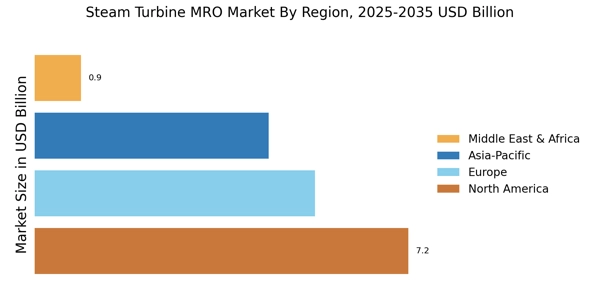
North America is the largest market for steam turbine MRO services, accounting for approximately 40% of the global market share. The region's growth is driven by the increasing demand for energy efficiency and the need for maintenance of aging infrastructure. Regulatory support for cleaner energy sources and investments in renewable energy projects are further catalyzing market expansion. The focus on reducing carbon emissions is also pushing industries to upgrade their existing turbine systems. The United States and Canada are the leading countries in this region, with significant investments from key players like General Electric and Siemens. The competitive landscape is characterized by a mix of established firms and emerging players, all vying for market share. The presence of advanced technology and skilled workforce enhances the region's capability to deliver high-quality MRO services, ensuring operational efficiency and reliability.
Europe is the second-largest market for steam turbine MRO, holding around 30% of the global market share. The region's growth is propelled by stringent environmental regulations and a strong push towards sustainable energy solutions. Countries are investing heavily in upgrading their energy infrastructure to meet EU directives on emissions and efficiency. The transition to renewable energy sources is also driving demand for MRO services, as older turbines require modernization to comply with new standards. Germany, France, and the UK are the leading countries in this market, with major players like Siemens and Alstom leading the charge. The competitive landscape is robust, with a mix of local and international firms providing innovative solutions. The presence of advanced research institutions and a skilled workforce further enhances the region's capabilities in delivering high-quality MRO services, ensuring compliance with evolving regulations.
Asia-Pacific is witnessing rapid growth in the steam turbine MRO market, accounting for approximately 25% of the global share. The region's expansion is driven by increasing industrialization, urbanization, and the rising demand for energy. Governments are investing in infrastructure development and modernization of power plants, which is creating a significant demand for MRO services. Regulatory frameworks are also evolving to support cleaner energy initiatives, further boosting market growth. Leading countries in this region include China, Japan, and India, with key players like Mitsubishi Heavy Industries and Bharat Heavy Electricals Limited making significant contributions. The competitive landscape is characterized by a mix of domestic and international firms, all striving to capture market share. The presence of a large manufacturing base and a growing focus on technological advancements are enhancing the region's capabilities in steam turbine MRO services.
The Middle East and Africa region is emerging as a significant player in the steam turbine MRO market, holding around 5% of the global market share. The growth is primarily driven by the region's rich natural resources and increasing investments in energy infrastructure. Governments are focusing on diversifying their energy sources and enhancing operational efficiency, which is creating a demand for MRO services. Regulatory initiatives aimed at improving energy efficiency are also contributing to market growth. Countries like Saudi Arabia and South Africa are leading the charge in this region, with investments from key players such as Doosan Heavy Industries and MAN Energy Solutions. The competitive landscape is evolving, with both local and international firms entering the market. The region's focus on technological advancements and partnerships is enhancing its capabilities in delivering effective MRO solutions, ensuring sustainability and reliability in energy production.
Major players in the Steam Turbine MRO Market industry are continuously developing advanced technologies to gain a competitive edge. Leading Steam Turbine MRO Market players are focusing on mergers and acquisitions to expand their global presence and strengthen their market position. The Steam Turbine MRO Market development is driven by increasing demand for efficient and reliable steam turbines in various industries such as power generation, oil and gas, and manufacturing. The competitive landscape of the Steam Turbine MRO Market is expected to remain fragmented, with several key players holding significant market shares. These leading companies are investing in research and development to introduce innovative solutions and enhance their product offerings. Partnerships and collaborations are also becoming increasingly common in Steam Turbine MRO Market industry as companies seek to combine their expertise and resources to develop comprehensive solutions for their customers. General Electric is a leading provider of steam turbines and related MRO services. The company offers a range of steam turbines, including heavy-duty, industrial, and aero-derivative turbines, for various applications. General Electric has a global presence and provides MRO services through its network of service centers and field engineers. The company focuses on providing customized solutions and leveraging its digital capabilities to enhance its service offerings. Siemens Energy is another major player in the Steam Turbine MRO Market. The company offers a comprehensive portfolio of steam turbines and related services, including maintenance, repairs, upgrades, and retrofits. Siemens Energy has a strong global presence and provides MRO services through its network of service centers and field engineers. The company emphasizes innovation and technology development to enhance the efficiency and reliability of its steam turbines.
The Steam Turbine MRO Market is witnessing significant growth, driven by rising demand for power generation, increased focus on maintenance and reliability, and technological advancements. Recent industry developments include:
Rising Adoption of Predictive Maintenance: Advanced technologies such as IoT sensors and data analytics are enabling predictive maintenance, reducing unplanned outages and improving operational efficiency.
Growing Focus on Sustainability: Steam turbines play a crucial role in reducing carbon emissions in power plants. As countries commit to net-zero targets, the demand for sustainable MRO services is increasing.
Expansion of Renewable Energy Sources: The integration of renewable energy sources, such as solar and wind, requires flexible and reliable steam turbines. This is driving demand for MRO services to ensure efficient operation and minimize downtime.
Emergence of New Market Players: The entry of new players, particularly in emerging markets, is intensifying competition and driving innovation in the Steam Turbine MRO Market sector.
Strategic Partnerships and Acquisitions: Industry leaders are forming partnerships and acquiring smaller players to expand their service offerings and geographic reach.
Le marché de la maintenance, de la réparation et de l'exploitation des turbines à vapeur devrait croître à un taux de croissance annuel composé (CAGR) de 5,01 % de 2024 à 2035, soutenu par les avancées technologiques, l'augmentation des demandes énergétiques et l'infrastructure vieillissante.
De nouvelles opportunités résident dans :
D'ici 2035, le marché devrait connaître une croissance robuste, soutenue par l'innovation et des investissements stratégiques.
| Parameter | Detail |
| Market Scope | Maintenance, repair, and overhaul services for steam turbines across power generation, oil and gas, and industrial applications |
| Study Period | 2021–2035 (Historical 2021–2024; Base Year 2025; Forecast 2026–2035) |
| CAGR | 4.6% (2026–2035) |
| Market Size Checkpoints | USD 24.14 Billion (2025); USD 25.31 Billion (2026); USD 37.94 Billion (2035) |
| Fastest Growing Segments | Above 600 MW capacity; Nuclear plant fuel; Repair service type; Asia-Pacific region |
| Companies Profiled | GE Vernova, Siemens Energy, Mitsubishi Power, Doosan Enerbility, Toshiba Energy Systems, Harbin Electric, BHEL, Ansaldo Energia, Sulzer, MD&A, Ethos Energy |
| Valuation Currency | USD Billion |
 Priya Nagrale

The secondary research process involved comprehensive analysis of regulatory databases, industry publications, technical standards, and authoritative energy sector organizations. Key sources included the US Department of Energy (DOE), Energy Information Administration (EIA), Federal Energy Regulatory Commission (FERC), International Energy Agency (IEA), International Electrotechnical Commission (IEC), American Society of Mechanical Engineers (ASME), National Association of Regulatory Utility Commissioners (NARUC), International Renewable Energy Agency (IRENA), World Energy Council (WEC), Nuclear Energy Institute (NEI), Power Engineering Society (IEEE), European Association of Energy Industries (EURELECTRIC), China Electricity Council (CEC), Japan Electrical Manufacturers' Association (JEMA), Central Electricity Authority (CEA) of India, International Labour Organization (ILO) industrial statistics, United Nations Industrial Development Organization (UNIDO), and national energy ministry reports from key markets. These sources were used to collect installed base data, capacity utilization statistics, maintenance expenditure patterns, regulatory compliance requirements, technological advancement trends, and market landscape analysis for steam turbine maintenance, repair, and overhaul services across power generation, oil & gas, petrochemical, and manufacturing end-use industries.
Qualitative and quantitative insights were obtained by interviewing supply-side and demand-side stakeholders during the primary research process. Sources from the supply side included CEOs, VPs of Service Operations, engineering directors, and business development leaders from steam turbine OEMs, independent service providers, and specialized MRO contractors. Among the demand-side sources were reliability engineers, procurement chiefs, maintenance directors, and plant managers from utility companies, independent power producers (IPPs), oil and gas refineries, petrochemical complexes, and heavy manufacturing facilities. Market segmentation was validated, service capacity expansion timelines were confirmed, and insights regarding outsourcing trends, predictive maintenance adoption, digital twin implementation, and long-term service agreement dynamics were gathered through primary research.
Primary Respondent Breakdown:
By Designation: C-level Primaries (28%), Director Level (33%), Others (39%)
By Region: North America (32%), Europe (29%), Asia-Pacific (28%), Rest of World (11%)
Global market valuation was derived through revenue mapping and installed base analysis. The methodology included:
Identification of 50+ key service providers across North America, Europe, Asia-Pacific, Latin America, and Middle East & Africa
Service mapping across repair, overhaul, and maintenance categories for blades, rotors, casings, valves, and bearings
Analysis of reported and modeled annual revenues specific to steam turbine MRO portfolios
Coverage of service providers representing 75-80% of global market share in 2024
Extrapolation using bottom-up (installed base × maintenance intensity × ASP by region) and top-down (service provider revenue validation) approaches to derive segment-specific valuations
Veuillez remplir le formulaire ci-dessous pour recevoir un échantillon gratuit de ce rapport

“This is really good guys. Excellent work on a tight deadline. I will continue to use you going forward and recommend you to others. Nice job”
 Noah Malgeri
Co-Founder

“Thanks for sending the report it gives us a good global view of the Betaïne market.”
 Peter Groot koerkamp
Account and Business Manager

“We found the report very insightful! we found your research firm very helpful. I'm sending this email to secure our future business.”
 Younghwan Choi
Senior Retail Manager

“I am very pleased with how market segments have been defined in a relevant way for my purposes (such as "Portable Freezers & refrigerators" and "last-mile"). In general the report is well structured. Thanks very much for your efforts.”
 Mark Irwin
Management Consultant

“We got the report in time, we really thank you for your support in this process. I also thank to all of your team as they did a great job.”
 Akif Moroglu
Strategy & Business Development Director

“The Automotive 48V ECU Components Procurement Intelligence Study” was a complex project, but the Market Research Future (MRFR) team handled it with quality, agility, and customer-centricity. They delivered all requested data on time and within the agreed scope. The team, including Shubhendra Anand and Rahul Gotadki, was always readily available to clarify questions and swiftly implement necessary adjustments, driving the project to a successful conclusion within a very demanding timeframe.
I would also like to specifically commend Akshay Agarwal for his responsiveness and support at every stage—from our initial inquiry on May 6th through to final delivery on June 18th. His dedication made the entire process seamless.”
 Guilherme Gomes Martins
Product Management Director

“Thanks. It’s been a pleasure working with you, please use me as reference with any other Intel employees.”
 Joseph Aguayo
Sales Operations & Pricing Manager

“Thank you, this will be very helpful for OQS.”
 La Terria Dodd
Program Support Specialist

“I have been reading the first document or the study, ,the Global HVAC and FP market report 2021 till 2026. Must say, good info! I have not gone in depth at all parts, but got a good indication of the data inside!”
 Rob Kooiker
Group Product Manager HVAC & Fire Protection GMA



