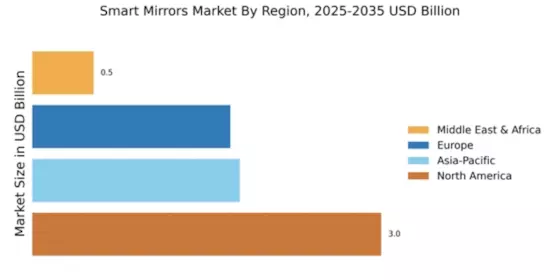
The Smart Mirrors Market is currently experiencing a notable evolution, driven by advancements in technology and changing consumer preferences. These mirrors, which integrate digital displays with reflective surfaces, are increasingly being adopted in various sectors, including retail, healthcare, and residential applications. The growing demand for personalized experiences and smart home integration appears to be propelling the market forward. This report presents a comprehensive smart mirror market analysis, covering market size, growth drivers, key applications, and regional outlook. Furthermore, the incorporation of artificial intelligence and augmented reality features into smart mirrors suggests a shift towards more interactive and engaging user interfaces. The smart mirror market is evolving rapidly as digital technologies reshape the traditional mirror market across residential and commercial environments. As consumers seek convenience and enhanced functionality, the Smart Mirrors Market is likely to expand, offering innovative solutions that cater to diverse needs. Overall, the smart mirror market is positioned for sustained growth, supported by expanding use cases and technological innovation.
In addition to technological advancements, the Smart Mirrors Market is influenced by the rising trend of health and wellness. Consumers are becoming more health-conscious, leading to an increased interest in mirrors that provide real-time health monitoring and beauty analysis. Key trends in the smart mirror market include increased personalization, AI-enabled interfaces, and integration with smart home ecosystems. This trend indicates a potential for smart mirrors to serve as tools for personal care and wellness management. These developments continue to transform the broader mirror market, accelerating adoption of intelligent mirror solutions. Moreover, the growing emphasis on sustainability and energy efficiency may drive manufacturers to develop eco-friendly smart mirror solutions. Overall, the Smart Mirrors Market is poised for growth, with various factors contributing to its dynamic landscape.
Integration of AI and AR Technologies
The Smart Mirrors Market is increasingly aligning with broader smart home ecosystems. This trend indicates a growing consumer preference for interconnected devices that enhance home automation. Smart mirrors are being designed to seamlessly integrate with other smart devices, allowing users to control lighting, security, and entertainment systems through a single interface. Such innovations represent a core component of the ongoing smart mirror market analysis, enhancing interactivity and user engagement.
Health and Wellness Focus
There is a growing emphasis on health and wellness within the Smart Mirrors Market. Consumers are increasingly interested in mirrors that offer health monitoring features, such as skin analysis and fitness tracking. Health-focused applications of smart mirror technology are expanding, particularly in personal care, fitness, and preventive healthcare. This trend suggests that smart mirrors could play a pivotal role in personal care and wellness management.
Sustainability and Eco-Friendly Solutions
The Smart Mirrors Market is also moving towards sustainability, with manufacturers exploring eco-friendly materials and energy-efficient designs. This trend reflects a broader consumer demand for environmentally responsible products, indicating that future smart mirrors may prioritize sustainability alongside functionality. Sustainability initiatives are increasingly influencing product development within the smart mirror market.







 Noah Malgeri
Co-Founder

 Peter Groot koerkamp
Account and Business Manager

 Younghwan Choi
Senior Retail Manager

 Mark Irwin
Management Consultant

 Akif Moroglu
Strategy & Business Development Director

 Guilherme Gomes Martins
Product Management Director

 Joseph Aguayo
Sales Operations & Pricing Manager

 La Terria Dodd
Program Support Specialist

 Rob Kooiker
Group Product Manager HVAC & Fire Protection GMA



