Marché des Poly Alpha Oléfines Résumé
Principales tendances et faits saillants du marché
Taille du marché et prévisions
| CAGR (2025 - 2035) | 8.95% |
| CAGR (2025 - 2035) | 8.95% |
The Poly Alpha Olefin Market is currently experiencing a dynamic evolution, driven by various factors that influence its growth trajectory. The increasing demand for high-performance lubricants and the rising adoption of poly alpha olefins in the automotive and industrial sectors appear to be pivotal in shaping market dynamics. Furthermore, the trend towards sustainability and the development of bio-based alternatives may also play a crucial role in the future landscape of this market. As industries seek to enhance efficiency and reduce environmental impact, poly alpha olefins are likely to gain traction due to their superior properties and versatility. In addition, the Poly Alpha Olefin Market seems to be benefiting from advancements in production technologies, which could lead to improved product quality and cost-effectiveness. The ongoing research and development efforts aimed at expanding applications in various sectors, including personal care and packaging, indicate a potential for market diversification. Overall, the Poly Alpha Olefin Market is poised for growth, with several factors suggesting a robust future as it adapts to changing consumer preferences and regulatory frameworks.
The emphasis on sustainable practices is becoming increasingly prominent within the Poly Alpha Olefin Market. Companies are exploring eco-friendly production methods and bio-based alternatives to meet consumer demand for greener products. This trend may lead to innovations that align with environmental regulations and consumer preferences.
Ongoing advancements in production technologies are likely to enhance the efficiency and quality of poly alpha olefins. These innovations could facilitate the development of new applications, thereby expanding the market's reach across various industries, including automotive and industrial sectors.
The versatility of poly alpha olefins is driving their adoption across a wide range of applications. From lubricants to personal care products, the potential for new uses appears to be growing, suggesting that the market may continue to diversify as industries seek high-performance solutions.
La durabilité devient une préoccupation centrale dans divers secteurs, y compris le marché des polyalphaoléfines. Les fabricants recherchent de plus en plus des alternatives écologiques aux matériaux traditionnels, et les polyalphaoléfines émergent comme une option viable en raison de leur potentiel de recyclabilité et de leur impact environnemental réduit. Le passage à des pratiques durables devrait stimuler l'innovation dans la production de polyalphaoléfines, avec un accent sur les matières premières d'origine biologique. Les tendances du marché indiquent que la demande de produits durables devrait croître de manière significative, avec des projections suggérant un taux de croissance annuel composé d'environ 7 % dans les années à venir. Cet accent sur la durabilité non seulement renforce l'attrait des polyalphaoléfines, mais les positionne également favorablement dans le contexte plus large de la responsabilité environnementale sur le marché des polyalphaoléfines.
Le secteur automobile connaît une augmentation notable de la demande pour des matériaux légers et économes en carburant, ce qui devrait stimuler le marché des polyalphaoléfines. Les polyalphaoléfines sont utilisées dans diverses applications automobiles, y compris les huiles moteur et les lubrifiants, en raison de leur stabilité thermique supérieure et de leur faible volatilité. Alors que les fabricants s'efforcent d'améliorer les performances des véhicules et de réduire les émissions, l'adoption des polyalphaoléfines devrait augmenter. Des données récentes indiquent que le segment des lubrifiants automobiles devrait croître à un taux de croissance annuel composé (CAGR) d'environ 4,5 % au cours des cinq prochaines années. Cette tendance suggère un marché robuste pour les polyalphaoléfines, car elles contribuent à améliorer l'efficacité énergétique et à réduire l'impact environnemental, renforçant ainsi leur importance sur le marché des polyalphaoléfines.
Les avancées technologiques dans la production de poly alpha oléfines devraient jouer un rôle crucial dans la structuration du marché des poly alpha oléfines. Des innovations telles que des procédés catalytiques améliorés et des techniques de polymérisation renforcées permettent aux fabricants de produire des poly alpha oléfines de haute qualité de manière plus efficace et rentable. Ces avancées devraient entraîner une réduction des coûts de production et une augmentation de la disponibilité de diverses qualités de poly alpha oléfines. L'analyse du marché suggère que l'introduction de nouvelles technologies pourrait entraîner un taux de croissance d'environ 5,5 % dans le segment des poly alpha oléfines au cours des prochaines années. Cette évolution technologique non seulement renforce la compétitivité des poly alpha oléfines, mais élargit également leur champ d'application, renforçant ainsi leur importance sur le marché des poly alpha oléfines.
L'industrie des soins personnels intègre de plus en plus des poly alpha oléfines dans les formulations de divers produits, y compris les soins de la peau, les soins capillaires et les cosmétiques. Ces composés sont appréciés pour leurs propriétés émollientes, qui améliorent la texture et la performance des produits. Le marché des poly alpha oléfines est prêt à croître alors que les préférences des consommateurs évoluent vers des produits de soins personnels de haute qualité et axés sur la performance. Les données récentes du marché suggèrent que le segment des soins personnels devrait croître à un taux d'environ 6 % au cours des prochaines années, soutenu par une sensibilisation croissante des consommateurs concernant les ingrédients et l'efficacité des produits. Cette tendance indique une opportunité prometteuse pour les poly alpha oléfines, car elles s'alignent sur l'accent mis par l'industrie sur l'innovation et la qualité, consolidant ainsi leur position sur le marché des poly alpha oléfines.
L'industrie pétrolière et gazière connaît une augmentation de l'utilisation des poly alpha oléfines, principalement en raison de leurs excellentes propriétés lubrifiantes et de leur haute performance dans des conditions extrêmes. Ces hydrocarbures synthétiques sont de plus en plus utilisés dans les fluides de forage, les fluides hydrauliques et d'autres applications où une haute stabilité thermique et de faibles points de congélation sont essentiels. Le marché des poly alpha oléfines devrait bénéficier de cette tendance, alors que la demande de lubrifiants efficaces et fiables continue d'escalader. L'analyse du marché indique que le segment pétrolier et gazier devrait représenter une part substantielle de la consommation globale de poly alpha oléfines, avec un taux de croissance projeté d'environ 5 % par an. Cette croissance souligne le rôle critique des poly alpha oléfines dans l'amélioration de l'efficacité opérationnelle et de la sécurité dans le secteur pétrolier et gazier.
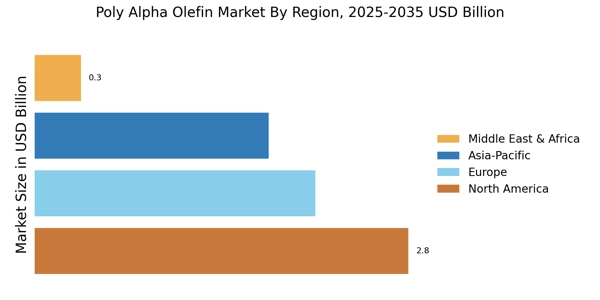
North America is the largest market for Poly Alpha Olefins, holding approximately 40% of the global share. The region's growth is driven by increasing demand in automotive and industrial applications, alongside stringent environmental regulations promoting the use of high-performance lubricants. The U.S. and Canada are the primary contributors, with a focus on sustainable production methods and innovations in polymer technology. The competitive landscape is dominated by key players such as ExxonMobil, Chevron, and LyondellBasell, who are investing heavily in R&D to enhance product offerings. The presence of advanced manufacturing facilities and a robust supply chain further strengthens the market position. Additionally, collaborations between companies and research institutions are fostering innovation, ensuring North America remains at the forefront of the Poly Alpha Olefin Market.
Europe is the second-largest market for Poly Alpha Olefins, accounting for around 30% of the global market share. The region's growth is propelled by increasing demand for eco-friendly products and stringent regulations aimed at reducing carbon emissions. Countries like Germany and France are leading the charge, with policies that encourage the adoption of sustainable materials in various industries, including automotive and packaging. The competitive landscape features major players such as Shell and INEOS, who are actively investing in sustainable production technologies. The European market is characterized by a strong emphasis on innovation, with companies focusing on developing high-performance products that meet regulatory standards. Collaborative efforts between industry and government are fostering advancements in the sector, ensuring Europe remains a key player in the Poly Alpha Olefin Market.
Asia-Pacific is witnessing rapid growth in the Poly Alpha Olefin Market, holding approximately 25% of the global share. The region's expansion is driven by increasing industrialization, urbanization, and rising demand for high-performance lubricants in automotive and manufacturing sectors. Countries like China and Japan are at the forefront, with significant investments in petrochemical production and infrastructure development. The competitive landscape is marked by the presence of key players such as Mitsubishi Chemical and Braskem, who are focusing on expanding their production capacities to meet the growing demand. The region is also seeing a rise in local manufacturers, enhancing competition and driving innovation. Government initiatives aimed at boosting the chemical industry further support market growth, positioning Asia-Pacific as a vital player in the Poly Alpha Olefin Market sector.
The Middle East and Africa region is emerging as a significant player in the Poly Alpha Olefin Market, holding about 5% of the global share. The growth is primarily driven by the availability of abundant natural resources and increasing investments in petrochemical infrastructure. Countries like Saudi Arabia and the UAE are leading the market, focusing on expanding their production capabilities to cater to both domestic and international demand. The competitive landscape is characterized by the presence of major players such as SABIC and TotalEnergies, who are leveraging their resource advantages to enhance production efficiency. Additionally, the region is witnessing a rise in local manufacturers, contributing to market diversification. Government initiatives aimed at promoting the chemical industry are further bolstering growth, positioning the Middle East and Africa as a promising market for Poly Alpha Olefins.
Major players in the Poly Alpha Olefin Market industry are constantly striving for Poly Alpha Olefin Market development by investing in research and development to create innovative products that cater to the evolving demands of consumers. Leading Poly Alpha Olefin Market players are also focusing on expanding their global presence through strategic partnerships, joint ventures, and acquisitions. The Poly Alpha Olefin Market Competitive Landscape is characterized by intense competition among established players and emerging entrants. To gain a competitive edge, companies are adopting various strategies such as product differentiation, cost optimization, and customer-centric approaches. Among the leading players in the Poly Alpha Olefin Market, The Dow Chemical Company has established itself as a prominent player with a strong market presence. The company's focus on innovation and sustainability has led to the development of advanced Poly Alpha Olefin Market products that cater to diverse applications. Dow's commitment to customer satisfaction and its extensive distribution network contribute to its strong position in the market. The company's continuous investments in research and development and its global reach position it well for future growth in the Poly Alpha Olefin Market. In contrast, ExxonMobil Corporation, another key player in the Poly Alpha Olefin Market, has gained recognition for its high-quality products and customer-centric approach. The company's extensive manufacturing capabilities and global supply chain enable it to meet the diverse needs of customers across various industries. ExxonMobil's emphasis on operational efficiency and its commitment to sustainable practices have contributed to its strong reputation in the market. The company's focus on innovation and its investments in research and development position it well to capitalize on emerging opportunities in the Poly Alpha Olefin Market.

August 2025: Chevron Phillips Chemical completed the expansion of its low-viscosity polyalphaolefin (LV PAO) production unit in Beringen, Belgium, doubling site capacity to 120,000 metric tons per year. The company described the facility as the largest decene-based LV PAO facility in Europe by volume. The upgraded unit also incorporates electrification technologies intended to reduce natural-gas use and improve energy efficiency.
Source: Chevron Phillips Chemical — Beringen LV PAO expansion.
August 2025: Chevron Phillips Chemical stated that the expanded Beringen facility would strengthen its ability to supply PAO for automotive and industrial lubricants, electric vehicles, wind turbines, and immersion-cooling applications. The expansion uses the site's existing processes while increasing production capacity to 120,000 MT annually.
Source: Chevron Phillips Chemical — LV PAO capacity expansion.
2026: INEOS Oligomers continued commercial production of its Durasyn® polyalphaolefin (PAO) range from production sites in La Porte and Chocolate Bayou, Texas, and Feluy, Belgium. The company markets Durasyn PAOs for automotive and industrial lubricants, including passenger-car motor oils, wind-turbine lubricants, transmission fluids, compressor oils, hydraulic oils, and gear oils.
Source: INEOS Oligomers — Durasyn® PAO portfolio.
January 2026: ExxonMobil reported USD 28.8 billion in full-year 2025 earnings and USD 52.0 billion in operating cash flow, while completing 10 of 10 key projects planned for the year. ExxonMobil is an MRFR-listed PAO producer, and its base-stock portfolio classifies PAOs as API Group IV fully synthetic base stocks used in high-performance lubricant formulations.
Le marché des polyalphaoléfines devrait croître à un taux de croissance annuel composé de 8,95 % de 2024 à 2035, soutenu par une demande croissante dans les applications automobiles et industrielles.
De nouvelles opportunités résident dans :
En 2035, le marché devrait consolider sa position de leader dans les produits chimiques spécialisés.
| MARKET SIZE 2024 | 7.023(USD Billion) |
| MARKET SIZE 2025 | 7.651(USD Billion) |
| MARKET SIZE 2035 | 18.03(USD Billion) |
| COMPOUND ANNUAL GROWTH RATE (CAGR) | 8.95% (2025 - 2035) |
| REPORT COVERAGE | Revenue Forecast, Competitive Landscape, Growth Factors, and Trends |
| BASE YEAR | 2024 |
| Market Forecast Period | 2025 - 2035 |
| Historical Data | 2019 - 2024 |
| Market Forecast Units | USD Billion |
| Key Companies Profiled | ExxonMobil (US), Shell (GB), Chevron (US), INEOS (GB), SABIC (SA), TotalEnergies (FR), LyondellBasell (US), Mitsubishi Chemical (JP), Braskem (BR) |
| Segments Covered | Application, Grade, Density, Molecular Weight, Regional |
| Key Market Opportunities | Growing demand for sustainable lubricants drives innovation in the Poly Alpha Olefin Market. |
| Key Market Dynamics | Rising demand for sustainable lubricants drives innovation and competition in the Poly Alpha Olefin market. |
| Countries Covered | North America, Europe, APAC, South America, MEA |
 Priya Nagrale

Veuillez remplir le formulaire ci-dessous pour recevoir un échantillon gratuit de ce rapport


“This is really good guys. Excellent work on a tight deadline. I will continue to use you going forward and recommend you to others. Nice job”
 Noah Malgeri
Co-Founder

“Thanks for sending the report it gives us a good global view of the Betaïne market.”
 Peter Groot koerkamp
Account and Business Manager

“We found the report very insightful! we found your research firm very helpful. I'm sending this email to secure our future business.”
 Younghwan Choi
Senior Retail Manager

“I am very pleased with how market segments have been defined in a relevant way for my purposes (such as "Portable Freezers & refrigerators" and "last-mile"). In general the report is well structured. Thanks very much for your efforts.”
 Mark Irwin
Management Consultant

“We got the report in time, we really thank you for your support in this process. I also thank to all of your team as they did a great job.”
 Akif Moroglu
Strategy & Business Development Director

“The Automotive 48V ECU Components Procurement Intelligence Study” was a complex project, but the Market Research Future (MRFR) team handled it with quality, agility, and customer-centricity. They delivered all requested data on time and within the agreed scope. The team, including Shubhendra Anand and Rahul Gotadki, was always readily available to clarify questions and swiftly implement necessary adjustments, driving the project to a successful conclusion within a very demanding timeframe.
I would also like to specifically commend Akshay Agarwal for his responsiveness and support at every stage—from our initial inquiry on May 6th through to final delivery on June 18th. His dedication made the entire process seamless.”
 Guilherme Gomes Martins
Product Management Director

“Thanks. It’s been a pleasure working with you, please use me as reference with any other Intel employees.”
 Joseph Aguayo
Sales Operations & Pricing Manager

“Thank you, this will be very helpful for OQS.”
 La Terria Dodd
Program Support Specialist

“I have been reading the first document or the study, ,the Global HVAC and FP market report 2021 till 2026. Must say, good info! I have not gone in depth at all parts, but got a good indication of the data inside!”
 Rob Kooiker
Group Product Manager HVAC & Fire Protection GMA