Marché de l'oxyde de magnésium

Taille du marché de l'oxyde de magnésium, part & rapport d'analyse de l'industrie par type : (magnésie brûlée à mort, magnésie calcinée caustique, magnésie fondue), par pureté : (faible, moyenne, élevée), par source : (naturelle, synthétique), par application : (alimentation animale, fabrication d'acier, verre & céramique, électronique, produits pharmaceutiques, autres), par secteur d'utilisation finale : (alimentation & boissons, construction, santé, autres), par région : (Amérique du Nord, Europe, Asie-Pacifique, Amérique du Sud, Moyen-Orient & Afrique) - Prévisions jusqu'en 2035.
ID: MRFR/CnM/1451-CR 111 Pages Chitranshi Jaiswal Last Updated: October 14, 2026
Magnesium Oxide Market
Market Size
Forecast Period2025 - 2035
CAGR (2025 - 2035)6.12%
2024 Market Size$ 5.5 Billion
2025 Market Size$ 5.8 Billion
2035 Market Size$ 10.6 Billion
Key Players
Magnezit Group
RHI Magnesita
Martin Marietta Magnesia Specialties
Grecian Magnesite
Ube Material Industries, Ltd.
KÜMAŞ A.Ş.
Opportunities
  • Rising Demand in Construction Sector
  • Advancements in Pharmaceutical Applications
  • Increased Focus on Renewable Energy Solutions

Marché de l'oxyde de magnésium Résumé

Selon l'analyse de MRFR, la taille du marché de l'oxyde de magnésium était estimée à 3,77 milliards USD en 2024. L'industrie de l'oxyde de magnésium devrait croître de 3,943 milliards USD en 2025 à 6,184 milliards USD d'ici 2035, affichant un taux de croissance annuel composé (CAGR) de 4,6 pendant la période de prévision 2025 - 2035.

Principales tendances et faits saillants du marché

Le marché de l'oxyde de magnésium est prêt à croître, soutenu par la durabilité et les avancées technologiques.

  • L'Amérique du Nord reste le plus grand marché pour l'oxyde de magnésium, soutenu par une demande robuste dans les applications de construction et industrielles.
  • L'Asie-Pacifique émerge comme la région à la croissance la plus rapide, avec des investissements croissants dans l'agriculture et les technologies environnementales.
  • La magnésie brûlée à mort détient la plus grande part de marché, tandis que la magnésie calcinée caustique connaît une croissance rapide en raison de ses diverses applications.
  • Les principaux moteurs du marché incluent la demande croissante dans le secteur de la construction et les avancées dans les applications agricoles, soulignant la polyvalence du matériau.

Taille du marché et prévisions

2024 Market Size k Taille du marché 2024 v 5.5(USD Milliards)
2035 Market Size k Taille du marché 2035 v 10.6(USD Milliards)
CAGR (2025 - 2035) k TCAC (2025 - 2035) v 6.12%

Principaux acteurs

Magnesia (US), Martin Marietta (US), Almatis (DE), Ube Industries (JP), Grecian Magnesite (GR), RHI Magnesita (AT), Kumas Magnesite Industry (TR), K+S AG (DE), KMG Chemicals (US)

Marché de l'oxyde de magnésium conducteurs

Rising Demand in Construction Sector

The construction sector is experiencing a notable increase in demand for magnesium oxide, primarily due to its application in fireproofing and insulation materials. As building codes become more stringent regarding fire safety, the Magnesium Oxide Market is likely to benefit from this trend. In 2023, the construction industry accounted for approximately 30% of the total magnesium oxide consumption, indicating a robust growth trajectory. Furthermore, the shift towards sustainable building materials is propelling the use of magnesium oxide as an eco-friendly alternative to traditional materials. This trend suggests that the Magnesium Oxide Market may continue to expand as more construction projects prioritize sustainability and safety.

Advancements in Pharmaceutical Applications

The pharmaceutical industry is increasingly utilizing magnesium oxide in various formulations, particularly as an antacid and a dietary supplement. The Magnesium Oxide Market is poised for growth as health-conscious consumers seek products that support digestive health and overall wellness. Recent data indicates that the demand for magnesium oxide in pharmaceuticals has risen by 10% annually, driven by a growing awareness of magnesium's health benefits. This trend suggests that the Magnesium Oxide Market may continue to expand as more companies develop innovative health products that incorporate magnesium oxide as a key ingredient.

Increased Focus on Renewable Energy Solutions

Growth in Agriculture and Fertilizer Applications

Emerging Applications in Environmental Technologies

Aperçu des segments de marché

In the Magnesium Oxide Market, the segment is notably dominated by Dead Burned Magnesia, which holds the largest share due to its extensive applications in refractory materials and steel manufacturing. Following closely is Caustic Calcined Magnesia, which, while smaller, has been gaining traction rapidly in agricultural and environmental applications. Fused Magnesia, though a vital player, remains more niche in its usage, primarily serving specialized industrial needs.

The application segment of the Magnesium Oxide Market is characterized by a diverse distribution across various industries. The refractory segment stands out as the largest, primarily driven by the demand for high-performance materials in steel production and non-ferrous metal industries. Agriculture follows, with its increasing adoption in soil conditioning and crop enhancement, though it holds a smaller market share when compared to refractories. Chemical intermediates and construction also play significant roles, though they are comparatively less dominant.

Obtenez des informations plus détaillées sur Marché de l'oxyde de magnésium

Aperçu régional

North America : Market Leader in Production

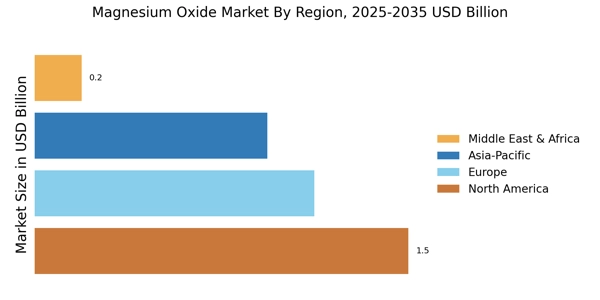
North America is the largest region, holding approximately 40% of the global Magnesium Oxide Market share. The region's growth is driven by increasing demand in industries such as construction, agriculture, and pharmaceuticals. Regulatory support for sustainable mining practices and environmental compliance further catalyzes market expansion. The U.S. is the primary contributor, with Canada following closely, benefiting from rich mineral resources and advanced manufacturing capabilities. The competitive landscape in North America features key players like Magnesia and Martin Marietta, which leverage advanced technologies to enhance production efficiency. The presence of established companies fosters innovation and drives market growth. Additionally, the region's focus on research and development ensures a steady supply of high-quality magnesium oxide products, catering to diverse industrial applications.

Europe : Emerging Market with Potential

Europe is witnessing a significant rise in magnesium oxide demand, accounting for approximately 30% of the global market share. The growth is fueled by increasing applications in the automotive and construction sectors, alongside stringent regulations promoting eco-friendly materials. Countries like Germany and the UK are leading this trend, supported by government initiatives aimed at enhancing industrial sustainability and reducing carbon footprints. The competitive landscape in Europe is characterized by key players such as Almatis and K+S AG, which are investing in innovative production techniques to meet rising demand. The region's focus on sustainability and regulatory compliance drives companies to adopt advanced technologies. Furthermore, the presence of a robust supply chain and strategic partnerships enhances market dynamics, positioning Europe as a vital player in the magnesium oxide sector.

Asia-Pacific : Rapid Growth and Industrialization

Asia-Pacific is rapidly emerging as a significant player in the global Magnesium Oxide Market, holding around 25% of the global share. The region's growth is primarily driven by industrialization, urbanization, and increasing demand from the construction and automotive sectors. Countries like China and Japan are at the forefront, supported by government policies that encourage infrastructure development and technological advancements in manufacturing processes. The competitive landscape in Asia-Pacific features major players such as Ube Industries and Grecian Magnesite, which are expanding their production capacities to meet the growing demand. The region's focus on innovation and cost-effective production methods enhances its competitive edge. Additionally, strategic collaborations and investments in research and development are expected to further boost market growth, making Asia-Pacific a key region for magnesium oxide production.

Middle East and Africa : Resource-Rich with Growth Potential

The Middle East and Africa region is gradually developing its magnesium oxide market, currently holding about 5% of the global share. The growth is driven by increasing investments in mining and mineral processing, alongside rising demand in construction and agriculture. Countries like South Africa and Turkey are leading the charge, supported by government initiatives aimed at enhancing resource extraction and processing capabilities. The competitive landscape in this region is characterized by emerging players such as Kumas Magnesite Industry, which are focusing on expanding their operational capacities. The presence of abundant natural resources provides a solid foundation for market growth. Furthermore, the region's strategic location offers access to international markets, enhancing its potential as a key player in the global magnesium oxide sector.
Marché de l'oxyde de magnésium Regional Image

Les principales entreprises du marché Marché de l'oxyde de magnésium incluent

Recent Industry Developments

Magnesia GmbH et RHI Magnesita se concentrent récemment sur l'expansion de leur capacité opérationnelle, en réponse à la demande croissante de l'oxyde de magnésium dans diverses applications industrielles. De plus, Ube Industries a annoncé des plans pour améliorer ses installations de production afin de soutenir davantage la consommation en hausse dans les secteurs de la construction et de l'agriculture. L'actualité met en évidence une croissance significative de la valorisation des entreprises impliquées dans le marché de l'oxyde de magnésium, alimentée par le passage en cours vers des matériaux durables et la reprise de l'industrie de la construction après la pandémie.

Notamment, en septembre 2023, Kaiser Aluminum a finalisé l'acquisition d'un acteur mineur du marché, renforçant ainsi sa chaîne d'approvisionnement et son offre de produits en alliages spéciaux. Cleveland Potash a également signalé une augmentation de ses exportations, en particulier dans le secteur agricole où l'oxyde de magnésium est recherché pour l'amélioration des sols. Au cours des dernières années, une tendance notable de consolidation parmi les acteurs plus petits a remodelé le paysage concurrentiel.

Des entreprises majeures comme Ferro Corporation et Sibelco investissent massivement dans des initiatives de recherche et développement pour innover leurs gammes de produits, s'assurant ainsi de rester compétitives sur le marché en évolution rapide.

Perspectives d'avenir

Marché de l'oxyde de magnésium Perspectives d'avenir

La taille du marché de l'oxyde de magnésium devrait croître à un TCAC de 4,6% de 2024 à 2035, soutenue par une demande croissante dans les secteurs de la construction, de l'agriculture et de la santé.

De nouvelles opportunités résident dans :

  • Expansion dans l'oxyde de magnésium de haute pureté pour des applications pharmaceutiques.
  • Développement de méthodes de production d'oxyde de magnésium écologiques.
  • Investissement dans des matériaux à base d'oxyde de magnésium pour des solutions de construction avancées.

D'ici 2035, la part du marché de l'oxyde de magnésium devrait connaître une croissance robuste, reflétant l'évolution des demandes de l'industrie.

Segmentation du marché

Perspectives du marché de l'oxyde de magnésium

  • Magnésie brûlée à mort
  • Magnésie calcinée caustique
  • Magnésie fondue

Perspectives d'application du marché de l'oxyde de magnésium

  • Réfractaire
  • Agriculture
  • Intermédiaires chimiques
  • Construction

Portée du rapport

TAILLE DU MARCHÉ 2024 3,77 (milliards USD)
TAILLE DU MARCHÉ 2025 3,943 (milliards USD)
TAILLE DU MARCHÉ 2035 6,184 (milliards USD)
TAUX DE CROISSANCE ANNUEL COMPOSÉ (CAGR) 4,6 % (2024 - 2035)
COUVERTURE DU RAPPORT Prévisions de revenus, paysage concurrentiel, facteurs de croissance et tendances
ANNÉE DE BASE 2024
Période de prévision du marché 2025 - 2035
Données historiques 2019 - 2024
Unités de prévision du marché milliards USD
Principales entreprises profilées Analyse de marché en cours
Segments couverts Analyse de segmentation du marché en cours
Principales opportunités de marché Demande croissante de matériaux écologiques dans la construction, opportunités d'expansion du marché de l'oxyde de magnésium.
Dynamiques clés du marché La demande croissante de matériaux écologiques stimule l'innovation et la concurrence sur le marché de l'oxyde de magnésium.
Pays couverts Amérique du Nord, Europe, APAC, Amérique du Sud, MEA

Frequently Asked Questions

Quelle est la valorisation actuelle du marché de l'oxyde de magnésium en 2024 ?
Le marché de l'oxyde de magnésium était évalué à 3,77 milliards USD en 2024.
Quelle est la valorisation de marché projetée pour l'oxyde de magnésium d'ici 2035 ?
Le marché devrait atteindre 6,184 milliards USD d'ici 2035.
Quelle est la CAGR attendue pour le marché de l'oxyde de magnésium pendant la période de prévision 2025 - 2035 ?
Le CAGR attendu pour le marché de l'oxyde de magnésium entre 2025 et 2035 est de 4,6 %.
Quelles entreprises sont considérées comme des acteurs clés sur le marché de l'oxyde de magnésium ?
Les acteurs clés incluent Magnesia (États-Unis), Martin Marietta (États-Unis), Almatis (Allemagne) et Ube Industries (Japon), entre autres.
Quels sont les principaux types d'oxyde de magnésium et leurs évaluations de marché ?
Les principaux types incluent la magnésie brûlée à mort, la magnésie calcinée caustique et la magnésie fondue, avec des évaluations allant de 1,07 à 2,5 milliards USD.
Comment l'application de l'oxyde de magnésium varie-t-elle selon les différents secteurs ?
Les applications incluent la réfractaire, l'agriculture, les intermédiaires chimiques et la construction, avec des évaluations allant de 0,57 à 2,5 milliards USD.
Quelle est la tendance du marché pour la Magnésie Brûlée Morte de 2024 à 2035 ?
La magnésie brûlée morte devrait passer de 1,5 milliard USD en 2024 à 2,5 milliards USD d'ici 2035.
Quel potentiel de croissance existe pour la Magnésie Calcinée Caustique dans les années à venir ?
La magnésie calcinée caustique devrait passer de 1,2 milliard USD en 2024 à 2,0 milliards USD d'ici 2035.
Quelle est l'importance de l'application réfractaire sur le marché de l'oxyde de magnésium ?
L'application réfractaire devrait passer de 1,5 milliard USD en 2024 à 2,5 milliards USD d'ici 2035, indiquant une forte demande.
Auteur
Author Author Profile Chitranshi Jaiswal LinkedIn Team Lead - Research
Chitranshi is a Team Leader in the Chemicals & Materials (CnM) and Energy & Power (EnP) domains, with 6+ years of experience in market research. She leads and mentors teams to deliver cross-domain projects that equip clients with actionable insights and growth strategies. She is skilled in market estimation, forecasting, competitive benchmarking, and both primary & secondary research, enabling her to turn complex data into decision-ready insights. An engineer and MBA professional, she combines technical expertise with strategic acumen to solve dynamic market challenges. Chitranshi has successfully managed projects that support market entry, investment planning, and competitive positioning, while building strong client relationships. Certified in Advanced Excel & Power BI she leverages data-driven approaches to ensure accuracy, clarity, and impactful outcomes.

Research Approach


Secondary Research

The secondary research process involved comprehensive analysis of geological surveys, chemical industry databases, trade statistics, and regulatory publications. Key sources included the United States Geological Survey (USGS) Mineral Commodity Summaries, National Bureau of Statistics of China (NBS), Eurostat Chemical Industry Database, International Energy Agency (IEA) Clean Coal Centre, World Steel Association (Worldsteel), Industrial Minerals Association – North America (IMA-NA), World Refractory Association (WRA), European Chemical Industry Council (Cefic), National Institutes of Standards and Technology (NIST), PubChem (NCBI), Food and Drug Administration (FDA) GRAS Database, European Food Safety Authority (EFSA), Organisation for Economic Co-operation and Development (OECD) Chemical Safety Reports, United Nations Conference on Trade and Development (UNCTAD), International Trade Centre (ITC) Trade Map, China Magnesite Association, Indian Bureau of Mines (IBM), Geoscience Australia, Brazilian National Mining Agency (ANM), and trade publications including Industrial Minerals Magazine and Refractories Window. These sources were utilized to collect production statistics, trade flow data, capacity utilization rates, regulatory compliance frameworks, refractory consumption patterns in steel manufacturing, agricultural application trends, and environmental regulation impacts on dead burned magnesia, caustic calcined magnesia, and fused magnesia segments.


Primary Research

To gather both qualitative and quantitative information, the primary research process involved interviewing players from both the supply and demand sides. From the supply side, we heard from chemical processors, refractory makers, CEOs, VPs of operations, mining directors, plant managers, and technical directors of magnesium oxide production. Members on the demand side included directors of research and development from pharmaceutical and food-grade magnesium compound formulators, environmental compliance officials from power utilities, agronomists and fertilizer formulators, engineers specialising in construction materials, and heads of procurement from iron foundries and steel mills. The following: refractory application performance; flue gas desulfurization deployment; calcination process efficiencies; mineral grade specifications; and pricing dynamics across chemical-grade and metallurgical-grade products; agricultural soil amendment adoption; and flue gas desulfurization deployment and primary research.

Primary Respondent Breakdown:

• By Designation: C-level Primaries (28%), Director Level (32%), Others (40%)

• By Region: North America (28%), Europe (32%), Asia-Pacific (34%), Rest of World (6%)


Market Size Estimation

Global market valuation was derived through production volume mapping and value chain analysis across mining, calcination, and end-use industries. The methodology included:

• Identification of 40+ key producers across China, Russia, Turkey, Australia, Brazil, Austria, Slovakia, and the United States

• Product mapping across dead burned magnesia (DBM), caustic calcined magnesia (CCM), fused magnesia (FM), and specialty high-purity grades

• Analysis of reported and modeled annual revenues specific to magnesium oxide portfolios, including captive consumption by vertically integrated refractory manufacturers

• Coverage of producers representing 65-70% of global market share in 2024

• Extrapolation using bottom-up (production volume × unit price by grade and region) and top-down (industry consumption validation via steel production, fertilizer application rates, and construction output) approaches to derive segment-specific valuations for refractory, agricultural, environmental, and industrial applications

Télécharger l'échantillon gratuit

Veuillez remplir le formulaire ci-dessous pour recevoir un échantillon gratuit de ce rapport

Global Magnesium Sulfate Market – Forecast till 2027
Étude de cas
Chemicals and Materials
Download PDF ×

We do not share your information with anyone. However, we may send you emails based on your report interest from time to time. You may contact us at any time to opt-out.