Marché des catalyseurs hétérogènes Résumé
Principales tendances et faits saillants du marché
Taille du marché et prévisions
| CAGR (2025 - 2035) | 5.48% |
| CAGR (2025 - 2035) | 5.48% |
The Heterogeneous Catalyst Market is currently experiencing a dynamic evolution, driven by the increasing demand for efficient and sustainable chemical processes. Industries such as petrochemicals, pharmaceuticals, and environmental applications are actively seeking catalysts that enhance reaction rates while minimizing energy consumption. This shift towards greener technologies appears to be influencing the development of novel catalyst formulations, which may lead to improved performance and selectivity. Furthermore, the integration of advanced materials and nanotechnology into catalyst design suggests a potential for significant advancements in catalytic efficiency and longevity. In addition to technological innovations, regulatory frameworks are likely shaping the Heterogeneous Catalyst Market landscape. Governments worldwide are imposing stricter environmental regulations, compelling industries to adopt cleaner production methods. This regulatory pressure may drive investments in research and development, fostering collaborations between academia and industry. As a result, the market could witness a surge in the introduction of innovative heterogeneous catalysts that align with sustainability goals. Overall, the Heterogeneous Catalyst Market appears poised for growth, with a focus on efficiency, sustainability, and regulatory compliance guiding its trajectory.
The emphasis on sustainability is becoming increasingly pronounced within the Heterogeneous Catalyst Market. Companies are prioritizing the development of catalysts that not only enhance efficiency but also reduce environmental impact. This trend indicates a shift towards greener processes, aligning with global sustainability initiatives.
Innovations in materials science and nanotechnology are playing a pivotal role in the evolution of the Heterogeneous Catalyst Market. The introduction of advanced materials is likely to enhance catalytic performance, leading to more efficient and selective reactions. This trend suggests a promising future for catalyst development.
The Heterogeneous Catalyst Market is increasingly influenced by stringent regulatory frameworks aimed at reducing emissions and promoting cleaner production methods. This regulatory environment may drive industries to invest in innovative catalytic solutions, fostering a landscape of continuous improvement and adaptation.
Innovations in catalyst design are significantly influencing the Global Heterogeneous Catalyst Market Industry. Advanced materials and nanotechnology are enabling the development of more efficient catalysts that exhibit higher activity and selectivity. For example, the incorporation of metal-organic frameworks and zeolites has shown promising results in enhancing catalytic performance. These advancements are expected to drive market growth, as industries seek to optimize production processes and reduce costs. The anticipated growth trajectory suggests that the market could reach 41.9 USD Billion by 2035, indicating a robust demand for cutting-edge catalyst technologies.
In the Heterogeneous Catalyst Market, the automotive segment holds the largest share, predominantly driven by stringent emission regulations and consumer demand for cleaner vehicles. This segment focuses on catalytic converters that effectively reduce harmful emissions, solidifying its dominance. Meanwhile, the chemical sector, while smaller, is rapidly expanding, fueled by the increasing need for catalytic processes in producing chemicals and polymers efficiently. As innovation in catalyst technology progresses, the chemical industry is expected to gain significant momentum, increasing its market presence over the forecast period.
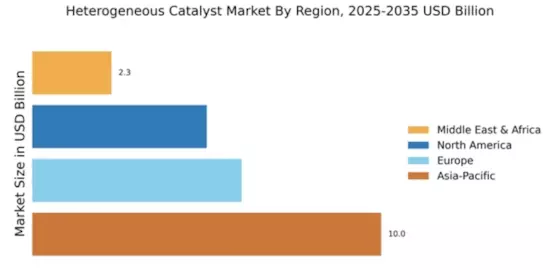
The North American Heterogeneous Catalyst Market is projected to reach $5.0 billion by 2025, driven by increasing demand for cleaner technologies and stringent environmental regulations. The region's focus on sustainability and innovation in chemical processes is a key growth driver. Regulatory frameworks, such as the Clean Air Act, are pushing industries to adopt more efficient catalytic processes, enhancing market dynamics. Leading countries like the US and Canada are at the forefront of this market, with major players such as Albemarle and W.R. Grace contributing significantly. The competitive landscape is characterized by a mix of established companies and emerging players, all striving to innovate and meet the growing demand for eco-friendly solutions. The presence of key players ensures a robust supply chain and technological advancements in catalyst development.
The European Heterogeneous Catalyst Market is expected to grow to $6.0 billion by 2025, fueled by stringent regulations aimed at reducing emissions and promoting sustainable practices. The region's commitment to environmental sustainability and innovation in chemical processes is a significant driver. Regulatory bodies are enforcing policies that encourage the adoption of advanced catalytic technologies, thereby enhancing market growth. Germany, France, and the UK are leading the market, with key players like BASF and Johnson Matthey dominating the landscape. The competitive environment is robust, with companies investing heavily in R&D to develop next-generation catalysts. The presence of established firms ensures a steady supply of innovative solutions, catering to the increasing demand for efficient and eco-friendly catalysts.
The Asia-Pacific Heterogeneous Catalyst Market is projected to reach $10.0 billion by 2025, making it the largest regional market. Rapid industrialization, urbanization, and increasing energy demands are key growth drivers. The region's focus on improving air quality and adopting cleaner technologies is further supported by government initiatives and regulations promoting the use of advanced catalysts in various industries. China, Japan, and India are the leading countries in this market, with significant contributions from major players like Haldor Topsoe and Clariant. The competitive landscape is marked by a mix of local and international companies, all vying for market share. The presence of key players ensures a continuous flow of innovation and technological advancements, catering to the growing demand for efficient catalytic solutions.
The Middle East and Africa Heterogeneous Catalyst Market is expected to reach $2.27 billion by 2025, driven by the region's rich natural resources and increasing investments in refining and petrochemical industries. The demand for efficient catalytic processes is rising as countries aim to enhance production capabilities and meet global energy demands. Regulatory frameworks are gradually evolving to support cleaner technologies, further boosting market potential. Leading countries such as Saudi Arabia and South Africa are pivotal in this market, with key players like SABIC and Evonik Industries making significant contributions. The competitive landscape is developing, with both local and international firms investing in R&D to innovate and improve catalyst technologies. This growth trajectory indicates a promising future for the heterogeneous catalyst market in the region.
The Heterogeneous Catalyst Market is currently characterized by a dynamic competitive landscape, driven by increasing demand for efficient catalytic processes across various industries, including petrochemicals, pharmaceuticals, and environmental applications. Key players such as BASF (DE), Johnson Matthey (GB), and Haldor Topsoe (DK) are strategically positioned to leverage their technological expertise and extensive product portfolios. BASF (DE) focuses on innovation and sustainability, emphasizing the development of catalysts that enhance process efficiency while reducing environmental impact. Meanwhile, Johnson Matthey (GB) has been actively pursuing partnerships to expand its capabilities in green technologies, indicating a strong commitment to sustainable practices. Haldor Topsoe (DK) is also enhancing its operational focus on digital transformation, integrating advanced analytics into its catalyst development processes, which collectively shapes a competitive environment that prioritizes innovation and sustainability.In terms of business tactics, companies are increasingly localizing manufacturing to reduce lead times and optimize supply chains. The market structure appears moderately fragmented, with several key players exerting considerable influence. This fragmentation allows for niche players to thrive, while larger corporations consolidate their market positions through strategic acquisitions and partnerships. The collective influence of these key players fosters a competitive atmosphere where innovation and operational efficiency are paramount.
In November BASF (DE) announced the launch of a new line of catalysts designed specifically for the hydrogenation of bio-based feedstocks. This strategic move not only aligns with the growing trend towards sustainable chemistry but also positions BASF (DE) as a leader in the transition to greener processes. The introduction of these catalysts is expected to enhance the efficiency of biofuel production, thereby addressing both market demand and environmental concerns.
In October Johnson Matthey (GB) entered into a strategic partnership with a leading technology firm to develop AI-driven solutions for catalyst optimization. This collaboration is significant as it underscores the increasing importance of digital technologies in enhancing catalyst performance and operational efficiency. By integrating AI into its processes, Johnson Matthey (GB) aims to streamline its R&D efforts, potentially leading to faster time-to-market for new products.
In September Haldor Topsoe (DK) expanded its production capacity in response to rising global demand for its catalysts used in ammonia synthesis. This expansion is indicative of Haldor Topsoe's commitment to meeting market needs while also enhancing its competitive edge. By increasing production capabilities, the company is likely to solidify its position as a key supplier in the agricultural and chemical sectors.
As of December current competitive trends in the Heterogeneous Catalyst Market are increasingly defined by digitalization, sustainability, and the integration of AI technologies. Strategic alliances are becoming more prevalent, as companies recognize the need to collaborate in order to innovate effectively. The competitive differentiation is expected to evolve, shifting from traditional price-based competition to a focus on technological advancements, innovation, and supply chain reliability. This transition suggests that companies that prioritize R&D and sustainable practices will likely emerge as leaders in the market.





September 2026: Clariant announced that it had won a contract from Zhejiang Petroleum & Chemical Co. to supply CATOFIN™ catalyst and Heat Generating Material (HGM) for the world’s largest licensed propane dehydrogenation unit in China, with capacity of 1.2 million metric tons per year. The project will use the catalyst technology to produce propylene for downstream petrochemical derivatives.
July 2026: Honeywell Technologies completed its acquisition of Johnson Matthey’s Catalyst Technologies business for £1.325 billion in cash. The transaction expands Honeywell’s catalyst portfolio across refining, petrochemicals and renewable fuels and combines catalyst technologies with Honeywell’s process and digital capabilities.
May 2026: BASF opened a new refinery catalyst R&D center in Attapulgus, Georgia, located alongside its largest refinery catalyst production site globally. The facility focuses on applied research for next-generation fluid catalytic cracking (FCC) catalysts and is intended to accelerate development and scale-up of new catalyst solutions.
April 2026: Clariant launched CATOFIN™ 1000, its next-generation propane dehydrogenation catalyst. The catalyst provides improved selectivity and productivity compared with the CATOFIN 310 Series, with an extended lifetime and up to 20% lower tar precursors, helping reduce fouling and maintenance requirements.
April 2026: Evonik launched a new generation of isodewaxing catalysts for fuel and lubricant production incorporating Zeopore’s proprietary mesoporized zeolite technology. The heterogeneous catalysts are designed to increase valuable product yields, improve cold-flow properties and reduce CO₂ emissions while operating at industrial scale.
March 2026: BASF started up the world’s first industrial-scale production plant for 3D-printed catalysts at its Ludwigshafen site. Its X3D® catalysts use engineered geometries to increase active surface area and reduce reactor pressure drop, with BASF stating that the technology can improve throughput and product quality while lowering energy consumption.
Le marché mondial des catalyseurs hétérogènes devrait croître à un TCAC de 5,48 % de 2025 à 2035, soutenu par une demande croissante de processus chimiques durables et des avancées dans la technologie des catalyseurs.
De nouvelles opportunités résident dans :
D'ici 2035, le marché devrait afficher une croissance robuste, reflétant l'évolution des besoins industriels et des avancées technologiques.
| MARKET SIZE 2024 | 23.27(USD Billion) |
| MARKET SIZE 2025 | 24.55(USD Billion) |
| MARKET SIZE 2035 | 41.86(USD Billion) |
| COMPOUND ANNUAL GROWTH RATE (CAGR) | 5.48% (2025 - 2035) |
| REPORT COVERAGE | Revenue Forecast, Competitive Landscape, Growth Factors, and Trends |
| BASE YEAR | 2024 |
| Market Forecast Period | 2025 - 2035 |
| Historical Data | 2019 - 2024 |
| Market Forecast Units | USD Billion |
| Key Companies Profiled | BASF (DE), Johnson Matthey (GB), Haldor Topsoe (DK), Clariant (CH), Albemarle (US), SABIC (SA), W.R. Grace (US), Evonik Industries (DE), Linde (DE) |
| Segments Covered | Application, End Use Industry, Catalyst Type, Form, Process Type |
| Key Market Opportunities | Advancements in green chemistry drive demand for innovative solutions in the Heterogeneous Catalyst Market. |
| Key Market Dynamics | Rising demand for sustainable processes drives innovation in heterogeneous catalysts across various industrial applications. |
| Countries Covered | North America, Europe, APAC, South America, MEA |
 Priya Nagrale

The secondary research process involved comprehensive analysis of regulatory databases, peer-reviewed scientific journals, chemical engineering publications, patent repositories, and authoritative industrial organizations. Key sources included the US Environmental Protection Agency (EPA), European Chemicals Agency (ECHA), International Union of Pure and Applied Chemistry (IUPAC), American Chemical Society (ACS), Royal Society of Chemistry (RSC), Catalysis Society of North America, European Federation of Catalysis Societies (EFCATS), National Institute of Standards and Technology (NIST), US Patent and Trademark Office (USPTO), European Patent Office (EPO), International Energy Agency (IEA), Organization of the Petroleum Exporting Countries (OPEC), US Energy Information Administration (EIA), International Council of Chemical Associations (ICCA), German Chemical Industry Association (VCI), China Petroleum and Chemical Industry Federation (CPCIF), Japan Chemical Industry Association (JCIA), World Refining Association, Hydrocarbon Processing Magazine Archives, Chemical Engineering Journal, Journal of Catalysis, Applied Catalysis A: General, Catalysis Today, and national chemical industry reports from key markets.
These sources were used to collect production capacity statistics, regulatory compliance data, catalytic process efficiency studies, patent filing trends, feedstock pricing dynamics, and market landscape analysis for supported catalysts, metal catalysts, zeolite catalysts, metal oxide catalysts, and emerging catalytic technologies.
In order to gather both qualitative and quantitative insights, supply-side and demand-side stakeholders were interviewed during the primary research process. CEOs, VPs of Technology & Innovation, Chief Technology Officers, Heads of Catalyst Development, regulatory affairs managers, and commercial directors from industrial gas firms, catalyst technology licensors, and heterogeneous catalyst manufacturers were examples of supply-side sources. Chief process engineers, managers of refinery operations, directors of petrochemical plants, heads of pharmaceutical manufacturing, environmental compliance officers, and procurement leads from oil and gas refineries, chemical processing facilities, automakers, pharmaceutical manufacturers, and specialty chemical companies were examples of demand-side sources. In addition to gathering information on catalyst adoption patterns, performance benchmarking, pricing tactics, and long-term supply agreements, primary research verified market segmentation and R&D pipeline timings.
Primary Respondent Breakdown:
By Designation: C-level Primaries (28%), Director Level (32%), Others (40%)
By Region: North America (32%), Europe (30%), Asia-Pacific (33%), Rest of World (5%)
Global market valuation was derived through revenue mapping and production volume analysis. The methodology included:
Identification of 50+ key manufacturers across North America, Europe, Asia-Pacific, Middle East, and Latin America
Product mapping across supported catalysts, unsupported catalysts, metal-based catalysts, zeolite catalysts, metal oxide catalysts, and emerging nanostructured catalyst categories
Analysis of reported and modeled annual revenues specific to heterogeneous catalyst portfolios
Coverage of manufacturers representing 75-80% of global market share in 2024
Extrapolation using bottom-up (catalyst consumption volume × ASP by application and region) and top-down (manufacturer revenue validation) approaches to derive segment-specific valuations
Veuillez remplir le formulaire ci-dessous pour recevoir un échantillon gratuit de ce rapport


“This is really good guys. Excellent work on a tight deadline. I will continue to use you going forward and recommend you to others. Nice job”
 Noah Malgeri
Co-Founder

“Thanks for sending the report it gives us a good global view of the Betaïne market.”
 Peter Groot koerkamp
Account and Business Manager

“We found the report very insightful! we found your research firm very helpful. I'm sending this email to secure our future business.”
 Younghwan Choi
Senior Retail Manager

“I am very pleased with how market segments have been defined in a relevant way for my purposes (such as "Portable Freezers & refrigerators" and "last-mile"). In general the report is well structured. Thanks very much for your efforts.”
 Mark Irwin
Management Consultant

“We got the report in time, we really thank you for your support in this process. I also thank to all of your team as they did a great job.”
 Akif Moroglu
Strategy & Business Development Director

“The Automotive 48V ECU Components Procurement Intelligence Study” was a complex project, but the Market Research Future (MRFR) team handled it with quality, agility, and customer-centricity. They delivered all requested data on time and within the agreed scope. The team, including Shubhendra Anand and Rahul Gotadki, was always readily available to clarify questions and swiftly implement necessary adjustments, driving the project to a successful conclusion within a very demanding timeframe.
I would also like to specifically commend Akshay Agarwal for his responsiveness and support at every stage—from our initial inquiry on May 6th through to final delivery on June 18th. His dedication made the entire process seamless.”
 Guilherme Gomes Martins
Product Management Director

“Thanks. It’s been a pleasure working with you, please use me as reference with any other Intel employees.”
 Joseph Aguayo
Sales Operations & Pricing Manager

“Thank you, this will be very helpful for OQS.”
 La Terria Dodd
Program Support Specialist

“I have been reading the first document or the study, ,the Global HVAC and FP market report 2021 till 2026. Must say, good info! I have not gone in depth at all parts, but got a good indication of the data inside!”
 Rob Kooiker
Group Product Manager HVAC & Fire Protection GMA