Marché des dispositifs portables intelligents pour les consommateurs Résumé
Principales tendances et faits saillants du marché
Taille du marché et prévisions
| CAGR (2025 - 2035) | 14.81% |
| CAGR (2025 - 2035) | 14.81% |
The Consumer Smart Wearable Market is currently experiencing a dynamic evolution, driven by advancements in technology and shifting consumer preferences. As individuals increasingly prioritize health and wellness, devices such as smartwatches and fitness trackers are becoming integral to daily routines. These wearables not only monitor physical activity but also provide insights into overall health, thereby enhancing user engagement. Furthermore, the integration of artificial intelligence and machine learning into these devices appears to enhance their functionality, offering personalized experiences that cater to individual needs. This trend suggests a growing demand for wearables that not only track metrics but also provide actionable recommendations based on user data. In addition to health monitoring, the Consumer Smart Wearable Market is witnessing a surge in demand for multifunctional devices. Consumers seem to favor wearables that combine various features, such as communication, navigation, and entertainment, into a single device. This convergence of functionalities indicates a shift towards convenience and efficiency, as users seek to minimize the number of devices they carry. Moreover, the increasing compatibility of wearables with other smart devices, such as smartphones and home automation systems, further enhances their appeal. As the market continues to evolve, it is likely that innovation will remain at the forefront, driving the development of new features and capabilities that meet the diverse needs of consumers.
The emphasis on health and wellness is reshaping the Consumer Smart Wearable Market. Devices are increasingly designed to monitor vital signs, track fitness activities, and promote healthier lifestyles. This trend reflects a broader societal shift towards preventive healthcare and personal well-being.
The incorporation of artificial intelligence into wearables is enhancing user experiences. Smart devices are now capable of providing personalized insights and recommendations based on individual data, making them more relevant and engaging for users.
Consumers are gravitating towards wearables that offer multiple functionalities. The trend towards multifunctional devices indicates a preference for convenience, as users seek to consolidate various features into a single, streamlined device.
Technological innovations play a crucial role in shaping the Consumer Smart Wearable Market. The integration of advanced sensors, improved battery life, and enhanced connectivity options has led to the development of more sophisticated wearable devices. For instance, the introduction of biometric sensors allows for real-time health monitoring, which is becoming a standard feature in many smart wearables. The market is expected to grow at a compound annual growth rate of around 15% over the next few years, driven by these advancements. As technology continues to evolve, the Consumer Smart Wearable Market is likely to witness the emergence of new functionalities, such as augmented reality and artificial intelligence, further enhancing user experience and engagement.
The increasing awareness of health and wellness among consumers is a primary driver of the Consumer Smart Wearable Market. As individuals become more health-conscious, they seek devices that can monitor their physical activity, heart rate, and sleep patterns. This trend is reflected in the growing demand for fitness trackers and smartwatches, which are projected to reach a market size of approximately 60 billion dollars by 2026. The Consumer Smart Wearable Market is thus experiencing a surge in innovation, with manufacturers focusing on developing advanced health monitoring features. This shift towards proactive health management is likely to continue, as consumers increasingly prioritize their well-being and seek technology that supports their health goals.
The rise of e-commerce platforms is transforming the way consumers purchase smart wearables, thereby driving the Consumer Smart Wearable Market. Online shopping provides consumers with greater access to a variety of products, competitive pricing, and convenience. As more consumers turn to online channels for their shopping needs, the market for smart wearables is expected to grow. E-commerce sales of wearable technology are projected to account for a significant portion of total sales, as consumers appreciate the ability to compare products and read reviews before making a purchase. This shift towards online retail is likely to continue, further propelling the growth of the Consumer Smart Wearable Market.
Smartwatches represent the dominant force in the Consumer Smart Wearable Market, characterized by their multifunctionality and extensive integration with smartphones. They cater to tech-savvy consumers looking for comprehensive health tracking and communication features. These devices have established a loyal user base as they evolve with sophisticated capabilities. On the other hand, smart glasses are emerging as a novel yet niche segment, aiming to enhance visual experiences and incorporate augmented reality features. Despite their current limited market penetration, they have significant potential to grow due to advances in technology and increasing consumer curiosity. As connectivity expands, smart glasses could revolutionize personal and professional interactions, attracting interest beyond traditional wearable markets.
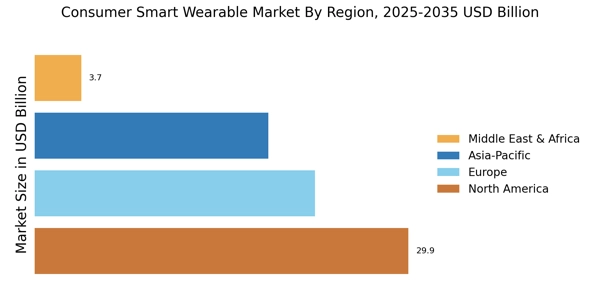
North America is the largest market for consumer smart wearables, holding approximately 40% of the global market share. The region's growth is driven by high consumer demand for health monitoring devices, advancements in technology, and increasing awareness of fitness and wellness. Regulatory support for health tech innovations further catalyzes market expansion, with initiatives promoting digital health solutions. The United States leads the market, followed by Canada, with major players like Apple Inc., Garmin Ltd., and Fitbit LLC dominating the landscape. The competitive environment is characterized by continuous innovation and product launches, with companies focusing on integrating advanced features such as health tracking and connectivity. This competitive edge is crucial for maintaining market leadership in a rapidly evolving sector.
Europe is witnessing significant growth in the consumer smart wearable market, accounting for approximately 30% of the global share. The rise in health consciousness among consumers, coupled with supportive regulations promoting digital health, drives this trend. Countries like Germany and the UK are at the forefront, with increasing adoption of wearables for health monitoring and fitness tracking, supported by government initiatives aimed at enhancing public health. Germany, the UK, and France are leading markets, with key players such as Withings and Garmin Ltd. establishing a strong presence. The competitive landscape is marked by innovation, with companies focusing on user-friendly designs and advanced functionalities. Regulatory frameworks in Europe encourage the development of smart wearables, ensuring safety and efficacy, which further boosts consumer confidence in these technologies.
Asia-Pacific is rapidly emerging as a significant player in the consumer smart wearable market, holding around 25% of the global market share. The region's growth is fueled by increasing disposable incomes, a tech-savvy population, and a rising focus on health and fitness. Countries like China and Japan are leading the charge, with a growing demand for smart wearables that cater to health monitoring and lifestyle tracking needs. China is the largest market in the region, with companies like Xiaomi Corp. and Huawei Technologies Co. Ltd. driving innovation and affordability. The competitive landscape is vibrant, with numerous local and international players vying for market share. The presence of advanced manufacturing capabilities in the region further enhances the availability and affordability of smart wearables, making them accessible to a broader audience.
The Middle East and Africa region is gradually emerging in the consumer smart wearable market, currently holding about 5% of the global share. The growth is primarily driven by increasing health awareness, urbanization, and the adoption of technology among the youth. Countries like South Africa and the UAE are witnessing a rise in demand for smart wearables, supported by government initiatives promoting health and wellness. South Africa leads the market in the region, with a growing number of local and international brands entering the space. The competitive landscape is still developing, with opportunities for innovation and market penetration. As the region continues to embrace digital health solutions, the potential for growth in the smart wearable sector is significant, attracting investments and fostering local startups.
The Consumer Smart Wearable Market is currently characterized by intense competition and rapid innovation, driven by increasing consumer demand for health monitoring and fitness tracking solutions. Major players such as Apple Inc (US), Samsung Electronics (KR), and Xiaomi Corp (CN) are at the forefront, each adopting distinct strategies to enhance their market presence. Apple Inc (US) continues to leverage its ecosystem, integrating wearables with its broader suite of devices, while Samsung Electronics (KR) focuses on diversifying its product range to cater to various consumer segments. Xiaomi Corp (CN) emphasizes affordability and accessibility, appealing to a broader demographic, which collectively shapes a competitive landscape that is both dynamic and multifaceted.In terms of business tactics, companies are increasingly localizing manufacturing to mitigate supply chain disruptions and optimize costs. The market structure appears moderately fragmented, with a mix of established brands and emerging players vying for market share. This fragmentation allows for innovation and niche offerings, although the collective influence of key players like Garmin Ltd (US) and Fitbit LLC (US) remains substantial, as they continue to set benchmarks in product quality and technological advancement.
In August Garmin Ltd (US) announced the launch of its latest smartwatch, which features advanced health metrics and improved battery life. This strategic move not only reinforces Garmin's commitment to innovation but also positions the company to capture a larger share of the health-conscious consumer segment. The introduction of such cutting-edge technology is likely to enhance Garmin's competitive edge, particularly in the fitness and outdoor activity markets.
In September Fitbit LLC (US) unveiled a new subscription service that offers personalized health coaching and insights based on user data collected from its wearables. This initiative signifies a shift towards a more service-oriented approach, potentially increasing customer loyalty and engagement. By integrating health coaching with its existing product line, Fitbit aims to differentiate itself in a crowded market, suggesting a trend towards holistic health management solutions.
In July Xiaomi Corp (CN) expanded its product line with the introduction of a budget-friendly smartwatch aimed at emerging markets. This strategic expansion not only reflects Xiaomi's commitment to affordability but also indicates a calculated effort to penetrate markets with less competition. By offering high-quality features at a lower price point, Xiaomi is likely to attract price-sensitive consumers, thereby enhancing its market share in regions where premium brands dominate.
As of October the competitive trends in the Consumer Smart Wearable Market are increasingly defined by digitalization, sustainability, and the integration of artificial intelligence. Strategic alliances among companies are becoming more prevalent, as firms seek to combine resources and expertise to enhance product offerings. Looking ahead, competitive differentiation is expected to evolve, with a notable shift from price-based competition towards innovation, technological advancements, and supply chain reliability. This transition underscores the importance of adaptability and forward-thinking strategies in maintaining a competitive edge in a rapidly changing market.

Le marché des dispositifs portables intelligents pour les consommateurs devrait croître à un taux de croissance annuel composé (CAGR) de 14,81 % entre 2024 et 2035, soutenu par les avancées technologiques, la sensibilisation à la santé et l'augmentation de la demande des consommateurs.
De nouvelles opportunités résident dans :
D'ici 2035, le marché devrait être robuste, soutenu par l'innovation et des besoins consommateurs divers.
| Parameter | Details |
|---|---|
| Market Scope | Consumer Smart Wearable Market revenue across Smartwatches, Head-Mounted Displays, Smart Clothing, Ear Worn, Fitness Trackers and Body-Worn Cameras in five regions and 25 country-level markets |
| Study Period | 2021–2035 (Historical: 2021–2024; Base Year: 2025; Forecast: 2026–2035) |
| CAGR | 18.2% (2026–2035) |
| Market Size checkpoints | USD 138.6 Billion (2025); USD 163.8 Billion (2026); USD 737.7 Billion (2035) |
| Fastest Growing Segments | Head-Mounted Displays (product); Asia-Pacific (region) |
| Companies Profiled | Apple, Samsung Electronics, Huawei Technologies, Meta Platforms, Xiaomi, Alphabet (Google/Fitbit), Garmin, Sony Group, Zepp Health, Oura Health |
| Valuation Currency | USD Billion |
 Aarti Dhapte

Veuillez remplir le formulaire ci-dessous pour recevoir un échantillon gratuit de ce rapport

“This is really good guys. Excellent work on a tight deadline. I will continue to use you going forward and recommend you to others. Nice job”
 Noah Malgeri
Co-Founder

“Thanks for sending the report it gives us a good global view of the Betaïne market.”
 Peter Groot koerkamp
Account and Business Manager

“We found the report very insightful! we found your research firm very helpful. I'm sending this email to secure our future business.”
 Younghwan Choi
Senior Retail Manager

“I am very pleased with how market segments have been defined in a relevant way for my purposes (such as "Portable Freezers & refrigerators" and "last-mile"). In general the report is well structured. Thanks very much for your efforts.”
 Mark Irwin
Management Consultant

“We got the report in time, we really thank you for your support in this process. I also thank to all of your team as they did a great job.”
 Akif Moroglu
Strategy & Business Development Director

“The Automotive 48V ECU Components Procurement Intelligence Study” was a complex project, but the Market Research Future (MRFR) team handled it with quality, agility, and customer-centricity. They delivered all requested data on time and within the agreed scope. The team, including Shubhendra Anand and Rahul Gotadki, was always readily available to clarify questions and swiftly implement necessary adjustments, driving the project to a successful conclusion within a very demanding timeframe.
I would also like to specifically commend Akshay Agarwal for his responsiveness and support at every stage—from our initial inquiry on May 6th through to final delivery on June 18th. His dedication made the entire process seamless.”
 Guilherme Gomes Martins
Product Management Director

“Thanks. It’s been a pleasure working with you, please use me as reference with any other Intel employees.”
 Joseph Aguayo
Sales Operations & Pricing Manager

“Thank you, this will be very helpful for OQS.”
 La Terria Dodd
Program Support Specialist

“I have been reading the first document or the study, ,the Global HVAC and FP market report 2021 till 2026. Must say, good info! I have not gone in depth at all parts, but got a good indication of the data inside!”
 Rob Kooiker
Group Product Manager HVAC & Fire Protection GMA