Marché des services de satellite à large bande Résumé
Principales tendances et faits saillants du marché
Taille du marché et prévisions
| CAGR (2025 - 2035) | 7.32% |
| CAGR (2025 - 2035) | 7.32% |
The Broadband Satellite Service Market is currently experiencing a transformative phase, driven by advancements in technology and increasing demand for high-speed internet access in remote and underserved regions. As satellite technology evolves, the market appears poised for growth, with new players entering the field and established companies enhancing their service offerings. This evolution is characterized by a shift towards more efficient satellite systems, which may provide improved bandwidth and lower latency, thereby attracting a broader customer base. Furthermore, the integration of satellite services with terrestrial networks is likely to enhance overall connectivity, making broadband access more reliable and accessible. In addition, the rising need for connectivity in various sectors, including education, healthcare, and agriculture, suggests that the Broadband Satellite Service Market could play a pivotal role in bridging the digital divide. The ongoing expansion of satellite constellations and the development of next-generation satellites may further facilitate this growth. As the market continues to adapt to changing consumer needs and technological advancements, it is essential to monitor these trends closely to understand their implications for future developments in the industry.
The Broadband Satellite Service Market is witnessing rapid technological innovations, particularly in satellite design and deployment. New satellite constellations are being launched, which may enhance coverage and reduce latency, thereby improving user experience. These advancements could lead to more competitive pricing and service offerings.
There is a growing demand for reliable internet access in remote and rural areas, which the Broadband Satellite Service Market is well-positioned to address. As more individuals and businesses seek high-speed internet solutions, the market may expand its reach and customer base significantly.
The convergence of satellite and terrestrial networks is becoming increasingly prevalent. This integration may provide users with seamless connectivity options, enhancing the overall service quality. Such developments could lead to innovative service models that cater to diverse consumer needs.
The integration of emerging technologies is significantly influencing the Broadband Satellite Service Market. Technologies such as artificial intelligence (AI), machine learning, and the Internet of Things (IoT) are being incorporated into satellite services to enhance operational efficiency and customer experience. For example, AI can optimize satellite operations and improve data analytics, leading to better service delivery. As of 2025, the convergence of these technologies is likely to create new business models and service offerings, further driving market growth. The ability to provide tailored solutions for various sectors, including agriculture, healthcare, and transportation, is expected to expand the customer base for satellite services. This integration not only enhances the capabilities of the Broadband Satellite Service Market but also positions it as a key player in the broader telecommunications landscape.
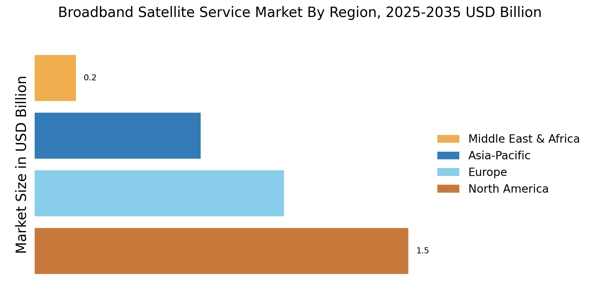
North America is the largest market for broadband satellite services, holding approximately 45% of the global market share. The region's growth is driven by increasing demand for high-speed internet in rural areas, advancements in satellite technology, and supportive regulatory frameworks. The Federal Communications Commission (FCC) has implemented policies to enhance broadband access, further fueling market expansion. The United States is the primary player in this region, with key companies like SpaceX, Intelsat, and Hughes Network Systems leading the charge. Canada also plays a significant role, with Telesat contributing to the competitive landscape. The presence of these major players ensures a robust market environment, characterized by continuous innovation and service improvements.
Europe is witnessing significant growth in the broadband satellite service market, accounting for approximately 30% of the global share. The demand is driven by the need for enhanced connectivity in remote areas and the European Union's commitment to digital inclusion. Regulatory initiatives, such as the European Commission's Digital Compass, aim to ensure that all Europeans have access to high-speed internet by 2030, acting as a catalyst for market growth. Leading countries in this region include the United Kingdom, France, and Germany, with key players like SES S.A. and Eutelsat Communications dominating the landscape. The competitive environment is marked by collaborations and partnerships aimed at expanding service offerings and improving technology. This dynamic landscape is expected to foster innovation and enhance service delivery across Europe.
Asia-Pacific is rapidly emerging as a significant player in the broadband satellite service market, holding around 20% of the global market share. The region's growth is fueled by increasing internet penetration, government initiatives to improve digital infrastructure, and the rising demand for connectivity in underserved areas. Countries like India and Australia are leading the charge, with supportive regulations promoting satellite technology adoption. Key players in this region include OneWeb and Viasat, which are actively working to expand their services. The competitive landscape is characterized by a mix of established companies and new entrants, all vying to capture market share. As the region continues to invest in satellite technology, the potential for growth remains substantial, with innovations expected to drive further advancements in service delivery.
The Middle East and Africa region is witnessing a gradual increase in the broadband satellite service market, currently holding about 5% of the global share. The growth is primarily driven by the need for improved connectivity in remote and rural areas, coupled with government initiatives aimed at enhancing digital infrastructure. Regulatory bodies are increasingly recognizing the importance of satellite services in bridging the digital divide, which is expected to catalyze market growth. Leading countries in this region include South Africa and the United Arab Emirates, where companies like Hughes Network Systems and Eutelsat are making significant inroads. The competitive landscape is evolving, with both local and international players striving to expand their footprint. As investments in satellite technology increase, the region is poised for substantial growth in broadband connectivity.
The Broadband Satellite Service Market is currently characterized by a dynamic competitive landscape, driven by the increasing demand for high-speed internet connectivity in remote and underserved regions. Key players are actively pursuing strategies that emphasize innovation, regional expansion, and partnerships to enhance their service offerings. Notably, SpaceX (US) has positioned itself as a leader in the market with its Starlink service, focusing on rapid deployment of satellite constellations to provide global coverage. Similarly, Viasat Inc. (US) is enhancing its competitive edge through strategic partnerships aimed at expanding its service capabilities, particularly in the aviation sector. These strategies collectively contribute to a competitive environment that is increasingly focused on technological advancement and customer-centric solutions.In terms of business tactics, companies are increasingly localizing their operations and optimizing supply chains to improve service delivery and reduce costs. The market structure appears moderately fragmented, with several players vying for market share, yet dominated by a few key firms that significantly influence pricing and service standards. This competitive structure fosters an environment where innovation and strategic partnerships are essential for maintaining a competitive advantage.
In August SES S.A. (LU) announced a strategic partnership with a leading telecommunications provider to enhance its broadband services in Europe. This collaboration is expected to leverage SES's satellite technology to deliver high-speed internet to rural areas, thereby expanding its market reach and reinforcing its commitment to bridging the digital divide. The strategic importance of this partnership lies in its potential to enhance SES's service offerings while addressing the growing demand for reliable internet access in underserved regions.
In September Intelsat S.A. (US) launched a new satellite designed specifically for broadband services, aimed at improving connectivity in North America and parts of South America. This move is indicative of Intelsat's focus on innovation and its commitment to enhancing service quality. The introduction of this satellite is likely to strengthen Intelsat's competitive position by providing faster and more reliable internet services, which are crucial in a market that increasingly prioritizes quality over price.
In October Eutelsat Communications (FR) unveiled a new initiative aimed at integrating artificial intelligence into its satellite operations to optimize bandwidth allocation and improve service efficiency. This strategic move reflects a broader trend within the industry towards digitalization and the adoption of advanced technologies. By leveraging AI, Eutelsat aims to enhance its operational capabilities, thereby positioning itself as a forward-thinking player in the broadband satellite market.
As of October the competitive trends within the Broadband Satellite Service Market are increasingly defined by digitalization, sustainability, and the integration of advanced technologies such as AI. Strategic alliances are playing a pivotal role in shaping the current landscape, enabling companies to pool resources and expertise to enhance service delivery. Looking ahead, it appears that competitive differentiation will increasingly hinge on innovation and technological advancements rather than solely on price. Companies that prioritize reliability in their supply chains and invest in cutting-edge technologies are likely to emerge as leaders in this evolving market.




Q3 2026: SpaceX (US): SpaceX deployed its first 26 next-generation Starlink V3 satellites by the end of September, introducing increased satellite capacity, data density, and power generation to support expanded broadband service for customers worldwide.
Q3 2026: SES S.A. (LU): SES completed the first rendezvous milestone under Europe’s IRIS² satellite programme, advancing implementation of a sovereign multi-orbit connectivity system designed to strengthen resilient satellite communications across European markets.
Q3 2026: Eutelsat Communications (FR): Eutelsat confirmed completion of the first 32 new OneWeb low-Earth-orbit satellites by Airbus Defence and Space in October 2026, advancing constellation renewal and supporting future broadband capacity and service continuity.
Q3 2026: Viasat Inc. (US): Viasat announced that its ViaSat-3 F2 satellite entered service across the Americas in September 2026, increasing network capacity, flexibility, and resilience for broadband, aviation, maritime, and government connectivity customers.
The Broadband Satellite Service Market is anticipated to grow from a valuation of USD 57.8 billion in 2023 to USD 97.28 billion by 2032, exhibiting a CAGR of 5.95% during the forecast period. The market growth can be attributed to the rising demand for high-speed internet connectivity in remote and rural areas, coupled with the increasing adoption of cloud-based services and the proliferation of connected devices. Furthermore, government initiatives to bridge the digital divide and the growing focus on digital transformation across various industries are expected to drive market expansion.
Key recent developments in the Broadband Satellite Service Market include the launch of new satellites with enhanced capabilities and the entry of new players into the market. Strategic partnerships and collaborations between service providers and satellite operators are also expected to shape the competitive landscape in the coming years.
Le marché des services de satellite à large bande devrait croître à un taux de croissance annuel composé (CAGR) de 7,32 % de 2024 à 2035, soutenu par une demande croissante d'internet haut débit et des avancées dans la technologie satellite.
De nouvelles opportunités résident dans :
D'ici 2035, le marché devrait connaître une croissance substantielle, se positionnant comme un acteur clé de la connectivité mondiale.
| MARKET SIZE 2024 | 3.4(USD Billion) |
| MARKET SIZE 2025 | 3.649(USD Billion) |
| MARKET SIZE 2035 | 7.396(USD Billion) |
| COMPOUND ANNUAL GROWTH RATE (CAGR) | 7.32% (2025 - 2035) |
| REPORT COVERAGE | Revenue Forecast, Competitive Landscape, Growth Factors, and Trends |
| BASE YEAR | 2024 |
| Market Forecast Period | 2025 - 2035 |
| Historical Data | 2019 - 2024 |
| Market Forecast Units | USD Billion |
| Key Companies Profiled | SpaceX (US), SES S.A. (LU), Intelsat S.A. (US), Eutelsat Communications (FR), Viasat Inc. (US), Hughes Network Systems (US), Telesat (CA), OneWeb (GB) |
| Segments Covered | Service Type, Frequency Band, Satellite Type, Application, Region |
| Key Market Opportunities | Expansion of low Earth orbit satellite constellations enhances The Broadband Satellite Service. |
| Key Market Dynamics | Technological advancements and regulatory changes drive competitive dynamics in the Broadband Satellite Service Market. |
| Countries Covered | North America, Europe, APAC, South America, MEA |
 Nirmit Biswas

 Aarti Dhapte
Veuillez remplir le formulaire ci-dessous pour recevoir un échantillon gratuit de ce rapport


“This is really good guys. Excellent work on a tight deadline. I will continue to use you going forward and recommend you to others. Nice job”
 Noah Malgeri
Co-Founder

“Thanks for sending the report it gives us a good global view of the Betaïne market.”
 Peter Groot koerkamp
Account and Business Manager

“We found the report very insightful! we found your research firm very helpful. I'm sending this email to secure our future business.”
 Younghwan Choi
Senior Retail Manager

“I am very pleased with how market segments have been defined in a relevant way for my purposes (such as "Portable Freezers & refrigerators" and "last-mile"). In general the report is well structured. Thanks very much for your efforts.”
 Mark Irwin
Management Consultant

“We got the report in time, we really thank you for your support in this process. I also thank to all of your team as they did a great job.”
 Akif Moroglu
Strategy & Business Development Director

“The Automotive 48V ECU Components Procurement Intelligence Study” was a complex project, but the Market Research Future (MRFR) team handled it with quality, agility, and customer-centricity. They delivered all requested data on time and within the agreed scope. The team, including Shubhendra Anand and Rahul Gotadki, was always readily available to clarify questions and swiftly implement necessary adjustments, driving the project to a successful conclusion within a very demanding timeframe.
I would also like to specifically commend Akshay Agarwal for his responsiveness and support at every stage—from our initial inquiry on May 6th through to final delivery on June 18th. His dedication made the entire process seamless.”
 Guilherme Gomes Martins
Product Management Director

“Thanks. It’s been a pleasure working with you, please use me as reference with any other Intel employees.”
 Joseph Aguayo
Sales Operations & Pricing Manager

“Thank you, this will be very helpful for OQS.”
 La Terria Dodd
Program Support Specialist

“I have been reading the first document or the study, ,the Global HVAC and FP market report 2021 till 2026. Must say, good info! I have not gone in depth at all parts, but got a good indication of the data inside!”
 Rob Kooiker
Group Product Manager HVAC & Fire Protection GMA


