Marché des pompes à huile automobile Résumé
Principales tendances et faits saillants du marché
Taille du marché et prévisions
| CAGR (2025 - 2035) | 3.22% |
| CAGR (2025 - 2035) | 3.22% |
The Automobile Oil Pump Market is currently experiencing a dynamic phase characterized by evolving consumer preferences and technological advancements. As vehicles become increasingly sophisticated, the demand for efficient oil pumps that enhance engine performance and longevity appears to be on the rise. This trend is likely driven by a growing awareness of the importance of engine maintenance and the role of oil pumps in ensuring optimal lubrication. Furthermore, the shift towards electric vehicles may also influence the market, as manufacturers explore innovative designs to accommodate new powertrains and reduce energy consumption. In addition, The Automobile Oil Pump Market. Companies are likely focusing on developing eco-friendly materials and manufacturing processes to meet regulatory standards and consumer expectations. This shift not only reflects a commitment to reducing the carbon footprint but also indicates a potential for growth in the market as consumers increasingly prioritize sustainable products. Overall, the Automobile Oil Pump Market appears poised for transformation, driven by technological innovation and a heightened emphasis on sustainability.
Recent innovations in oil pump technology suggest a trend towards more efficient and reliable designs. Manufacturers are likely investing in research and development to create pumps that optimize oil flow and reduce energy consumption, thereby enhancing overall vehicle performance.
The increasing adoption of electric vehicles may lead to a re-evaluation of oil pump designs. As traditional combustion engines give way to electric powertrains, the Automobile Oil Pump Market could see a demand for specialized pumps that cater to the unique requirements of electric vehicles.
A growing emphasis on sustainability appears to be influencing the Automobile Oil Pump Market. Companies may be prioritizing the use of recyclable materials and environmentally friendly manufacturing processes to align with consumer preferences and regulatory demands.
Le marché des pompes à huile automobiles est également façonné par une conformité réglementaire stricte et des normes visant à réduire les émissions et à améliorer l'efficacité énergétique. Les gouvernements du monde entier mettent en œuvre des réglementations qui nécessitent l'utilisation de technologies de pompes à huile avancées pour répondre aux normes environnementales. Par exemple, les réglementations concernant l'économie de carburant et les émissions ont poussé les fabricants à innover et à développer des pompes à huile qui optimisent les performances du moteur tout en minimisant l'impact environnemental. Ce paysage réglementaire devrait stimuler le marché, car la conformité à ces normes nécessite souvent l'adoption de nouvelles technologies. Le marché devrait s'élargir à mesure que les fabricants alignent leurs produits sur ces réglementations évolutives, augmentant potentiellement la taille du marché de 4 % au cours des prochaines années.
Le marché des pompes à huile automobiles bénéficie de la croissance du secteur de l'après-vente automobile. À mesure que les véhicules vieillissent, la demande de pièces de rechange, y compris les pompes à huile, augmente. Cette tendance est particulièrement prononcée dans les régions où un grand nombre de véhicules anciens sont encore en circulation. Le marché de l'après-vente pour les pompes à huile devrait croître à un taux de croissance annuel composé (CAGR) d'environ 5,5 %, soutenu par le besoin de services d'entretien et de réparation. De plus, la montée des plateformes de commerce électronique a facilité l'accès des consommateurs aux pompes à huile de remplacement, alimentant ainsi la croissance du marché. Cette dynamique crée des opportunités pour les fabricants d'élargir leur gamme de produits et de répondre à une clientèle plus large.
Le marché des pompes à huile automobiles connaît une augmentation de la sensibilisation des consommateurs concernant l'importance de l'entretien des moteurs. À mesure que les propriétaires de véhicules deviennent plus informés sur le rôle des pompes à huile dans les performances et la longévité du moteur, la demande pour des pompes à huile de haute qualité augmente. Cette prise de conscience entraîne un changement dans les préférences des consommateurs vers des produits premium qui garantissent une lubrification optimale du moteur. Les données du marché suggèrent que le segment des pompes à huile premium devrait croître d'environ 7 % dans les années à venir. Par conséquent, les fabricants se concentrent sur des stratégies marketing qui mettent en avant les avantages d'un entretien régulier et de l'utilisation de technologies de pompes à huile supérieures, stimulant ainsi les ventes dans ce segment.
Le marché des pompes à huile automobiles est fortement influencé par la demande croissante de véhicules haute performance. À mesure que les consommateurs recherchent de plus en plus des véhicules offrant des performances supérieures, les fabricants sont contraints d'améliorer l'efficacité des moteurs, ce qui est directement corrélé à la nécessité de pompes à huile avancées. Les moteurs haute performance nécessitent des pompes à huile capables de maintenir une pression et des débits d'huile optimaux, garantissant que les composants du moteur sont correctement lubrifiés. Cette tendance se reflète dans les données du marché, qui indiquent que le segment des pompes à huile haute performance devrait connaître un taux de croissance d'environ 6 % par an. Par conséquent, les fabricants investissent dans la recherche et le développement pour créer des pompes à huile qui répondent à ces exigences de performance strictes.
Le marché des pompes à huile automobiles connaît une augmentation des innovations technologiques qui améliorent l'efficacité et les performances des pompes à huile. Des techniques de fabrication avancées, telles que l'impression 3D et l'ingénierie de précision, sont adoptées pour produire des composants plus fiables et durables. Ces innovations améliorent non seulement la durée de vie des pompes à huile, mais réduisent également les coûts de production, les rendant plus accessibles aux fabricants. De plus, l'intégration de technologies intelligentes, telles que les capteurs IoT, permet une surveillance en temps réel des performances des pompes à huile, ce qui peut conduire à une maintenance prédictive et à une réduction des temps d'arrêt. En conséquence, le marché devrait croître à un taux de croissance annuel composé (CAGR) d'environ 5 % au cours des cinq prochaines années, soutenu par ces avancées.
In the Automobile Oil Pump Market, the distribution of market share among engine types reveals a clear dominance of gasoline engines. Gasoline oil pumps continue to be the preferred choice due to their widespread adoption and established infrastructure. Conversely, diesel oil pumps, while currently a smaller segment, display rapid growth fueled by the rising popularity of diesel vehicles in various regions. As emissions standards tighten, diesel technology is adapting, increasing its market appeal. Looking ahead, the growth trends for diesel oil pumps are bolstered by advancements in engine efficiency and the increasing demand for fuel economy. Additionally, a surge in the development and adoption of hybrid and electric vehicles poses a challenge but also an opportunity for manufacturers. Manufacturers are innovating to address the unique oil pump needs of hybrid and electric vehicles, which could lead to significant shifts in market dynamics over the coming years.
Gasoline engine oil pumps dominate the Automobile Oil Pump Market, primarily due to their long-standing presence and the pervasive use of gasoline vehicles. These pumps are designed to meet the high-performance demands of internal combustion engines, providing essential lubrication and cooling. In contrast, electric oil pumps represent an emerging segment driven by the increasing adoption of electric vehicles. They are typically designed to be compact and efficient, catering to the unique requirements of electric drivetrains, including variable control based on real-time needs. As the market shifts toward electrification, the demand for such innovative solutions in oil pumping technology will likely expand, paving the way for new entrants and innovations.
Gear-Type pumps have long been established as the dominant oil pump choice in the automobile industry, known for their robust construction and ability to handle high pressure. They operate on the principle of rotating gears that create a suction effect to draw oil into the system, ensuring efficient oil flow. Their reliability has made them the preferred choice for traditional combustion engine applications. On the other hand, Screw-Type pumps are emerging as a viable alternative, particularly in electric and hybrid vehicles where weight and efficiency are crucial. These pumps utilize helical rotors to provide a steady oil flow with minimal pulsation, making them ideal for modern engines that require precise lubrication under varying conditions.
The Automobile Oil Pump Market showcases a diverse segmentation across vehicle types, with Passenger Cars leading the market share due to their high production volumes and essential oil pump requirements. Commercial Vehicles are quickly gaining traction, facilitated by the growing demand for logistics and transportation services globally. Together, these segments shape the landscape of automotive oil pump sales, driven by their unique operational requirements and maintenance practices. In terms of growth trends, the Passenger Cars segment is expected to see steady demand due to continuous advancements in engine technology and increased vehicle production. In contrast, the Commercial Vehicles segment exhibits the fastest growth, fueled by the expansion of e-commerce and the need for efficient freight transport solutions. This trend is likely to enhance investments in oil pump technologies and innovations tailored specifically for larger and heavier vehicles.
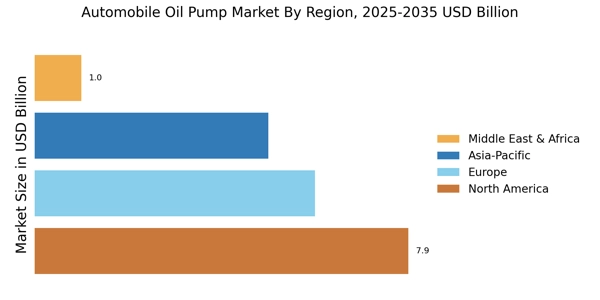
North America is witnessing robust growth in the automobile oil pump market, driven by increasing vehicle production and stringent emission regulations. The region holds approximately 40% of the global market share, making it the largest market. The demand for advanced oil pump technologies, including electric and variable displacement pumps, is on the rise, supported by government initiatives promoting fuel efficiency and reduced emissions. The United States and Canada are the leading countries in this market, with major players like Aisin Seiki Co., Ltd. and Bosch GmbH establishing strong footholds. The competitive landscape is characterized by innovation and strategic partnerships among key manufacturers. The presence of established automotive hubs further enhances market dynamics, fostering collaboration and technological advancements.
Europe is emerging as a significant player in the automobile oil pump market, driven by stringent environmental regulations and a shift towards electric vehicles. The region accounts for approximately 30% of the global market share, making it the second-largest market. Regulatory frameworks, such as the European Union's Green Deal, are catalyzing the adoption of advanced oil pump technologies that enhance fuel efficiency and reduce emissions. Germany, France, and the UK are at the forefront of this market, with key players like Denso Corporation and Schaeffler AG leading the charge. The competitive landscape is marked by innovation and sustainability, as manufacturers invest in research and development to meet evolving consumer demands. The presence of a robust automotive supply chain further supports market growth, ensuring a steady supply of advanced components.
Asia-Pacific is rapidly becoming a powerhouse in the automobile oil pump market, fueled by increasing vehicle production and rising disposable incomes. The region holds approximately 25% of the global market share, driven by countries like China and India, which are experiencing significant growth in automotive manufacturing. The demand for oil pumps is expected to surge as consumers seek more efficient and reliable vehicle performance. China is the largest market in the region, with major manufacturers like Zhejiang Lisheng Auto Parts Co., Ltd. leading the way. The competitive landscape is characterized by a mix of local and international players, with companies focusing on innovation and cost-effective solutions. The presence of a growing middle class and urbanization trends further bolster market prospects, making Asia-Pacific a key area for future investments.
The Middle East and Africa region is witnessing gradual growth in the automobile oil pump market, driven by increasing vehicle ownership and infrastructure development. The region holds approximately 5% of the global market share, with potential for expansion as economic conditions improve. The demand for oil pumps is expected to rise, particularly in emerging markets where automotive sectors are developing rapidly. Countries like South Africa and the UAE are leading the market, with a growing number of automotive manufacturers establishing operations in the region. The competitive landscape is evolving, with both local and international players vying for market share. Investment in infrastructure and favorable government policies are expected to further stimulate growth, making this region an attractive market for future opportunities.
Major players in the Automobile Oil Pump Market industry are continuously engaged in research and development to introduce advanced Automobile Oil Pump Market products and solutions to meet the evolving demands of customers. Market rivalry is likely to intensify as key companies invest heavily in innovation and strategic collaborations to enhance their market positions. Leading Automobile Oil Pump Market players are focusing on sustainable practices and environmentally friendly solutions to meet evolving market demands. The Automobile Oil Pump Market industry is experiencing ongoing consolidation, with mergers and acquisitions enabling leading players to expand their product portfolios and geographical reach. The competitive dynamics of the Automobile Oil Pump Market are expected to remain dynamic in the coming years, driven by technological advancements, changing customer preferences, and the entry of new market entrants. Aisin Seiki Co., Ltd., with its headquarters in Japan, is a leading supplier of Automobile Oil Pump Market products and systems. The company has a strong presence in the Automotive Oil Pump Market industry and provides innovative solutions to meet the demands of its customers. Aisin Seiki operates manufacturing facilities worldwide and has a robust supply chain network. The company focuses on developing and producing high-quality Automobile Oil Pumps that meet the performance and durability requirements of the automotive industry. Aisin Seiki's commitment to innovation and customer satisfaction has established the company as a trusted partner to automakers and automotive suppliers around the world. In contrast, Schaeffler AG, with its headquarters in Germany, is another prominent player in the Automobile Oil Pump Market industry. The company is a leading manufacturer of high-precision components and systems for the automotive and industrial sectors. Schaeffler offers a wide range of Automobile Oil Pump Market products, including oil pumps, modules, and systems. It also provides engineering services and solutions to support its customers in developing and optimizing their products. With a presence and a commitment to innovation, Schaeffler AG is a formidable competitor in the Automobile Oil Pump Market.
Increasing vehicle production, coupled with rising demand for fuel-efficient vehicles, is anticipated to drive market growth. Moreover, government regulations aimed at reducing emissions are expected to augment demand for efficient oil pumps further. Technological advancements, such as the development of variable displacement oil pumps, are likely to create growth opportunities in the market.
The Asia Pacific region is expected to account for the largest market share due to the presence of major automotive manufacturers and the growing demand for vehicles in developing countries. Key industry participants are focusing on product innovation and strategic partnerships to gain a competitive edge.
- AISIN Seiki Co., Ltd. (JP) (March 2025): AISIN introduced new oil pumps for Toyota and Lexus vehicles through its aftermarket product programme, expanding its replacement-parts offering for engine lubrication systems and supporting maintenance requirements across compatible vehicle models.
- Magna International Inc. (CA) (July 2026): Magna secured an 800V electric-drive programme award with Chery, expanding its electrified powertrain business and strengthening its portfolio of integrated propulsion technologies for next-generation vehicles.
Le marché des pompes à huile automobiles devrait croître à un TCAC de 3,22 % de 2025 à 2035, soutenu par les avancées en technologie automobile et l'augmentation de la production de véhicules.
De nouvelles opportunités résident dans :
D'ici 2035, le marché devrait connaître une croissance robuste, reflétant l'évolution des besoins automobiles.
| MARKET SIZE 2024 | 19.83(USD Billion) |
| MARKET SIZE 2025 | 20.47(USD Billion) |
| MARKET SIZE 2035 | 28.1(USD Billion) |
| COMPOUND ANNUAL GROWTH RATE (CAGR) | 3.22% (2025 - 2035) |
| REPORT COVERAGE | Revenue Forecast, Competitive Landscape, Growth Factors, and Trends |
| BASE YEAR | 2024 |
| Market Forecast Period | 2025 - 2035 |
| Historical Data | 2019 - 2024 |
| Market Forecast Units | USD Billion |
| Key Companies Profiled | Aisin Seiki Co., Ltd. (JP), Bosch GmbH (DE), Denso Corporation (JP), Magna International Inc. (CA), Melling Engine Parts (US), Pierburg GmbH (DE), Schaeffler AG (DE), Valeo SA (FR), Zhejiang Lisheng Auto Parts Co., Ltd. (CN) |
| Segments Covered | Engine Type, Oil Pump Type, Vehicle Type, Sales Channel, Regional |
| Key Market Opportunities | Integration of advanced materials and smart technologies enhances efficiency in the Automobile Oil Pump Market. |
| Key Market Dynamics | Technological advancements in oil pump efficiency drive competitive dynamics and influence consumer preferences in the automotive sector. |
| Countries Covered | North America, Europe, APAC, South America, MEA |
La valorisation de marché projetée pour le marché des pompes à huile automobiles est de 28,1 milliards USD d'ici 2035.
La valorisation globale du marché des pompes à huile automobiles était de 19,83 milliards USD en 2024.
Le CAGR attendu pour le marché des pompes à huile automobiles pendant la période de prévision 2025 - 2035 est de 3,22 %.
Les acteurs clés du marché des pompes à huile automobiles incluent Aisin Seiki Co., Ltd., Bosch GmbH et Denso Corporation.
Les valorisations projetées pour les pompes à huile à essence et à diesel sont respectivement de 10,5 milliards USD et 8,0 milliards USD d'ici 2035.
Les canaux de vente pour le marché des pompes à huile automobiles incluent les OEM projetés à 12,0 milliards USD et le marché secondaire à 9,0 milliards USD d'ici 2035.
Le segment des pompes à huile à vis devrait atteindre 10,6 milliards USD d'ici 2035.
La taille de marché projetée pour les voitures particulières sur le marché des pompes à huile automobiles est de 10,5 milliards USD d'ici 2035.
La valorisation attendue pour le segment des pompes à huile électriques est de 5,0 milliards USD d'ici 2035.
Les voitures particulières devraient avoir la plus haute valorisation de marché sur le marché des pompes à huile automobiles avec 10,5 milliards USD d'ici 2035.
 Shubham Munde

 Sejal Akre
Veuillez remplir le formulaire ci-dessous pour recevoir un échantillon gratuit de ce rapport


“This is really good guys. Excellent work on a tight deadline. I will continue to use you going forward and recommend you to others. Nice job”
 Noah Malgeri
Co-Founder

“Thanks for sending the report it gives us a good global view of the Betaïne market.”
 Peter Groot koerkamp
Account and Business Manager

“We found the report very insightful! we found your research firm very helpful. I'm sending this email to secure our future business.”
 Younghwan Choi
Senior Retail Manager

“I am very pleased with how market segments have been defined in a relevant way for my purposes (such as "Portable Freezers & refrigerators" and "last-mile"). In general the report is well structured. Thanks very much for your efforts.”
 Mark Irwin
Management Consultant

“We got the report in time, we really thank you for your support in this process. I also thank to all of your team as they did a great job.”
 Akif Moroglu
Strategy & Business Development Director

“The Automotive 48V ECU Components Procurement Intelligence Study” was a complex project, but the Market Research Future (MRFR) team handled it with quality, agility, and customer-centricity. They delivered all requested data on time and within the agreed scope. The team, including Shubhendra Anand and Rahul Gotadki, was always readily available to clarify questions and swiftly implement necessary adjustments, driving the project to a successful conclusion within a very demanding timeframe.
I would also like to specifically commend Akshay Agarwal for his responsiveness and support at every stage—from our initial inquiry on May 6th through to final delivery on June 18th. His dedication made the entire process seamless.”
 Guilherme Gomes Martins
Product Management Director

“Thanks. It’s been a pleasure working with you, please use me as reference with any other Intel employees.”
 Joseph Aguayo
Sales Operations & Pricing Manager

“Thank you, this will be very helpful for OQS.”
 La Terria Dodd
Program Support Specialist

“I have been reading the first document or the study, ,the Global HVAC and FP market report 2021 till 2026. Must say, good info! I have not gone in depth at all parts, but got a good indication of the data inside!”
 Rob Kooiker
Group Product Manager HVAC & Fire Protection GMA



