Marché des services de location automobile Résumé
Principales tendances et faits saillants du marché
Taille du marché et prévisions
| CAGR (2025 - 2035) | 5.24% |
| CAGR (2025 - 2035) | 5.24% |
The Auto Leasing Service Market is currently experiencing a transformative phase, characterized by evolving consumer preferences and technological advancements. As individuals increasingly seek flexibility and convenience, leasing options are becoming more appealing compared to traditional vehicle ownership. This shift is further fueled by the growing awareness of environmental sustainability, prompting consumers to consider electric and hybrid vehicles as part of their leasing choices. Additionally, the rise of digital platforms facilitates seamless transactions, enhancing customer experiences and broadening market access. Moreover, the competitive landscape of the Auto Leasing Service Market is intensifying, with various players striving to differentiate their offerings. Companies are likely to invest in innovative services, such as subscription models and tailored leasing agreements, to attract a diverse clientele. The integration of telematics and data analytics into leasing services may also provide valuable insights, enabling providers to optimize their fleets and improve customer satisfaction. Overall, the Auto Leasing Service Market appears poised for growth, driven by changing consumer dynamics and technological integration.
The Auto Leasing Service Market is witnessing a notable shift towards electric vehicles, as consumers increasingly prioritize sustainability. This trend suggests that leasing companies may need to adapt their fleets to include a higher proportion of electric and hybrid models, catering to environmentally conscious customers.
The ongoing digital transformation is reshaping the Auto Leasing Service Market, with online platforms streamlining the leasing process. This trend indicates that consumers now prefer digital interactions, leading companies to enhance their online presence and offer user-friendly interfaces for leasing transactions.
Flexible leasing options are gaining traction within the Auto Leasing Service Market, as consumers seek more adaptable agreements. This trend implies that leasing companies may explore subscription models and short-term leases, allowing customers to adjust their vehicle choices based on changing needs.
The trend of increasing urbanization appears to be a significant driver for the Auto Leasing Service Market. As more individuals migrate to urban areas, the demand for personal transportation options rises. Urban dwellers often prefer leasing over purchasing vehicles due to limited parking space and the high costs associated with vehicle ownership. In fact, studies indicate that urban populations are projected to reach 68% by 2050, which could lead to a surge in leasing services. This shift may encourage leasing companies to adapt their offerings to cater to the unique needs of urban customers, such as shorter lease terms and more compact vehicle options. Consequently, the Auto Leasing Service Market is likely to experience growth as urbanization continues to reshape transportation preferences.
Growing environmental concerns and the push for sustainability are influencing the Auto Leasing Service Market. Consumers are becoming more aware of their carbon footprints and are seeking eco-friendly transportation options. This shift is prompting leasing companies to expand their fleets to include electric and hybrid vehicles. Data indicates that the demand for electric vehicles is expected to rise significantly, with projections suggesting that they could account for 30% of all vehicle sales by 2030. As a result, leasing companies may need to adapt their offerings to include more sustainable options, thereby attracting environmentally conscious consumers. This trend could lead to a transformation in the Auto Leasing Service Market, as companies strive to meet the evolving preferences of their customer base.
Technological advancements in vehicle management systems are transforming the Auto Leasing Service Market. Innovations such as telematics and mobile applications enable leasing companies to monitor vehicle performance, track usage patterns, and enhance customer service. These technologies facilitate more efficient fleet management and improve the overall leasing experience for consumers. For instance, the integration of telematics can provide real-time data on vehicle health, which may reduce maintenance costs and downtime. Furthermore, the adoption of mobile apps allows customers to manage their leases conveniently, from scheduling maintenance to making payments. As technology continues to evolve, it is expected that the Auto Leasing Service Market will increasingly leverage these advancements to enhance operational efficiency and customer satisfaction.
In the Auto Leasing Service Market, Passenger Cars command the largest share, becoming the preferred choice for many consumers due to their affordability and practicality for everyday use. In contrast, SUVs have emerged as a rapidly growing segment, appealing to customers seeking larger vehicles with enhanced safety and space for family and leisure activities. As consumer preferences shift, the market reflects a dynamic distribution of leasing options across these vehicle types. The growth trends are largely propelled by the rise in urbanization and an increasing consumer preference for flexibility in vehicle ownership. SUVs are quickly gaining traction among younger demographics who desire a combination of style and utility. Additionally, advancements in technology and improved fuel efficiency are making both Passenger Cars and SUVs more attractive options in the auto leasing market, further driving growth in these segments.
Passenger Cars continue to dominate the Auto Leasing Service Market, largely due to their versatility and affordability. They cater to a broad range of customers, from individuals to families, seeking reliable transportation. With a lower cost of leasing and maintenance, they remain the favored choice for many consumers. On the other hand, Commercial Vehicles are emerging as an important segment, primarily driven by the expanding logistics and transportation sector. Businesses looking to optimize their fleets without the burden of ownership are increasingly leasing commercial vehicles. This shift not only allows for better cash flow management but also provides companies with access to newer models, thereby enhancing operational efficiency. As such, while Passenger Cars remain dominant, the importance of Commercial Vehicles is on the rise.
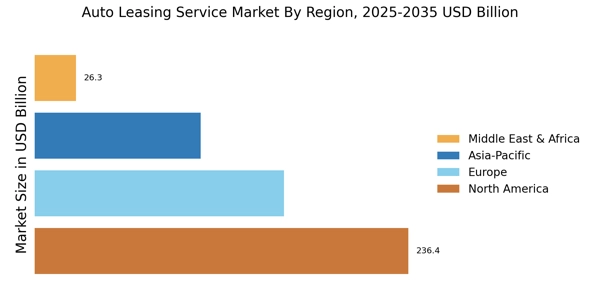
North America is the largest market for auto leasing services, accounting for approximately 45% of the global market share. The growth is driven by increasing consumer preference for leasing over purchasing, coupled with favorable financing options and a growing economy. Regulatory support for electric vehicles and sustainability initiatives further catalyze market expansion. The U.S. remains the largest contributor, followed by Canada, which holds about 10% of the market share. The competitive landscape in North America is robust, featuring key players such as Enterprise Holdings, Hertz Global Holdings, and Avis Budget Group. These companies dominate the market with extensive fleets and innovative leasing options. The presence of established brands and a strong consumer base fosters a competitive environment, driving service enhancements and customer satisfaction. The market is also witnessing a shift towards digital platforms for leasing services, enhancing accessibility for consumers.
Europe is witnessing significant growth in the auto leasing market, holding approximately 30% of the global share. The demand is fueled by urbanization, environmental regulations promoting electric vehicles, and a shift in consumer behavior towards flexible mobility solutions. Germany and France are the largest markets, contributing around 12% and 8% respectively, with strong regulatory frameworks supporting sustainable transport initiatives. Leading countries in Europe include Germany, France, and the Netherlands, where major players like Sixt SE, ALD Automotive, and LeasePlan Corporation operate. The competitive landscape is characterized by a mix of traditional leasing companies and new entrants focusing on innovative solutions. The market is also adapting to digital transformation, with many companies enhancing their online platforms to improve customer engagement and streamline leasing processes.
The Asia-Pacific region is rapidly emerging in the auto leasing market, accounting for about 20% of the global share. Key growth drivers include rising disposable incomes, urbanization, and a growing preference for leasing among consumers. China and India are the largest markets, with China alone holding approximately 15% of the market share, driven by government incentives for electric vehicles and a burgeoning middle class. In this region, the competitive landscape is evolving, with local and international players vying for market share. Major companies like Ryder System and Penske Automotive Group are expanding their presence, while local firms are innovating to meet consumer demands. The market is also seeing increased investment in technology to enhance customer experience and operational efficiency, positioning Asia-Pacific as a key player in the global auto leasing landscape.
The Middle East and Africa region is gradually developing its auto leasing market, currently holding about 5% of the global share. The growth is driven by increasing urbanization, a young population, and rising demand for flexible mobility solutions. Countries like South Africa and the UAE are leading the market, with the UAE accounting for approximately 3% of the global share, supported by government initiatives to promote leasing and sustainable transport solutions. The competitive landscape in this region is characterized by a mix of local and international players. Companies are focusing on expanding their service offerings and enhancing customer experience. The presence of key players is growing, with firms adapting to local market needs and investing in technology to streamline operations. The region's potential for growth is significant, as more consumers shift towards leasing as a preferred mobility option.





- Enterprise Holdings (US) (April 2026): Enterprise Mobility partnered with Eurokars Leasing to introduce Enterprise Rent-A-Car, National Car Rental and Alamo in Singapore, with new locations planned for the Central Business District and western region, expanding its international mobility and vehicle-rental network.
- Arval (FR) (March 2026): Arval’s 2026 Global Fleet and Mobility Barometer, based on 10,157 interviews across 33 countries, found that 66% of surveyed companies consider alternative-energy vehicles a strategic priority and 46% already operate electrified technologies, highlighting growing demand for fleet electrification and related leasing solutions.
Recent news includes ALD Automotive's partnership with LeasePlan to create a global leasing giant and Arval's acquisition of Alphabet's fleet management business in Europe. Key market trends include the rise of subscription-based leasing models, advancements in telematics and connectivity, and the growing popularity of car-sharing services.
Le marché des services de location automobile devrait croître à un TCAC de 5,24 % de 2025 à 2035, soutenu par l'urbanisation, les avancées technologiques et l'évolution des préférences des consommateurs.
De nouvelles opportunités résident dans :
D'ici 2035, le marché devrait être robuste, reflétant l'évolution des demandes des consommateurs et des solutions de location innovantes.
| MARKET SIZE 2024 | 525.39(USD Billion) |
| MARKET SIZE 2025 | 552.93(USD Billion) |
| MARKET SIZE 2035 | 921.65(USD Billion) |
| COMPOUND ANNUAL GROWTH RATE (CAGR) | 5.24% (2025 - 2035) |
| REPORT COVERAGE | Revenue Forecast, Competitive Landscape, Growth Factors, and Trends |
| BASE YEAR | 2024 |
| Market Forecast Period | 2025 - 2035 |
| Historical Data | 2019 - 2024 |
| Market Forecast Units | USD Billion |
| Key Companies Profiled | Enterprise Holdings (US), Hertz Global Holdings (US), Avis Budget Group (US), Sixt SE (DE), ALD Automotive (FR), LeasePlan Corporation (NL), Arval (FR), Ryder System (US), Penske Automotive Group (US) |
| Segments Covered | Vehicle Type, Lease Term, Lease Type, Customer Type, Regional |
| Key Market Opportunities | Integration of electric vehicles and flexible leasing options drives growth in the Auto Leasing Service Market. |
| Key Market Dynamics | Rising consumer preference for flexible mobility solutions drives growth in the auto leasing service market. |
| Countries Covered | North America, Europe, APAC, South America, MEA |
Le marché des services de location automobile devrait atteindre une valorisation de 921,65 milliards USD d'ici 2035.
En 2024, la valorisation de marché du marché des services de location automobile était de 525,39 milliards USD.
Le CAGR attendu pour le marché des services de location automobile pendant la période de prévision 2025 - 2035 est de 5,24 %.
En 2024, le segment des voitures particulières avait la plus haute valorisation à 210,0 milliards USD.
Les locations à court terme étaient évaluées à 52,54 milliards USD en 2024, tandis que les locations à long terme atteignaient 315,23 milliards USD.
Les acteurs clés du marché des services de location automobile incluent Enterprise Holdings, Hertz Global Holdings et Avis Budget Group.
Les locations à durée déterminée avaient une valorisation de 315,39 milliards USD en 2024.
Le segment de type de client entreprises, évalué à 300,0 milliards USD en 2024, devrait montrer une croissance substantielle.
Le segment des véhicules commerciaux devrait atteindre une valorisation de 210,0 milliards USD d'ici 2035.
En 2024, les véhicules de luxe étaient évalués à 65,39 milliards USD, tandis que les SUV étaient évalués à 130,0 milliards USD.
 Shubham Munde

 Aarti Dhapte
Veuillez remplir le formulaire ci-dessous pour recevoir un échantillon gratuit de ce rapport


“This is really good guys. Excellent work on a tight deadline. I will continue to use you going forward and recommend you to others. Nice job”
 Noah Malgeri
Co-Founder

“Thanks for sending the report it gives us a good global view of the Betaïne market.”
 Peter Groot koerkamp
Account and Business Manager

“We found the report very insightful! we found your research firm very helpful. I'm sending this email to secure our future business.”
 Younghwan Choi
Senior Retail Manager

“I am very pleased with how market segments have been defined in a relevant way for my purposes (such as "Portable Freezers & refrigerators" and "last-mile"). In general the report is well structured. Thanks very much for your efforts.”
 Mark Irwin
Management Consultant

“We got the report in time, we really thank you for your support in this process. I also thank to all of your team as they did a great job.”
 Akif Moroglu
Strategy & Business Development Director

“The Automotive 48V ECU Components Procurement Intelligence Study” was a complex project, but the Market Research Future (MRFR) team handled it with quality, agility, and customer-centricity. They delivered all requested data on time and within the agreed scope. The team, including Shubhendra Anand and Rahul Gotadki, was always readily available to clarify questions and swiftly implement necessary adjustments, driving the project to a successful conclusion within a very demanding timeframe.
I would also like to specifically commend Akshay Agarwal for his responsiveness and support at every stage—from our initial inquiry on May 6th through to final delivery on June 18th. His dedication made the entire process seamless.”
 Guilherme Gomes Martins
Product Management Director

“Thanks. It’s been a pleasure working with you, please use me as reference with any other Intel employees.”
 Joseph Aguayo
Sales Operations & Pricing Manager

“Thank you, this will be very helpful for OQS.”
 La Terria Dodd
Program Support Specialist

“I have been reading the first document or the study, ,the Global HVAC and FP market report 2021 till 2026. Must say, good info! I have not gone in depth at all parts, but got a good indication of the data inside!”
 Rob Kooiker
Group Product Manager HVAC & Fire Protection GMA


