Marché de l'intelligence artificielle dans la robotique Résumé
Principales tendances et faits saillants du marché
Taille du marché et prévisions
| CAGR (2025 - 2035) | 27.42% |
| CAGR (2025 - 2035) | 27.42% |
The Artificial Intelligence in Robotics Market is currently experiencing a transformative phase, characterized by rapid advancements in technology and increasing integration of AI capabilities into robotic systems. This evolution appears to be driven by a growing demand for automation across various sectors, including manufacturing, healthcare, and logistics. As organizations seek to enhance efficiency and reduce operational costs, the adoption of intelligent robotics is likely to accelerate. Furthermore, the convergence of AI with robotics is fostering innovative applications, enabling machines to perform complex tasks with greater precision and adaptability. In addition to technological advancements, the Artificial Intelligence in Robotics Market is influenced by shifting consumer expectations and the need for personalized solutions. Companies are increasingly focusing on developing robots that can learn from their environments and interact seamlessly with humans. This trend suggests a move towards more collaborative robots, or cobots, which are designed to work alongside human operators. As the market continues to evolve, it is essential for stakeholders to remain attuned to emerging trends and adapt their strategies accordingly, ensuring they remain competitive in this dynamic landscape.
The trend towards automation is gaining momentum as industries recognize the potential of AI-driven robotics to streamline operations. This shift is likely to enhance productivity and reduce human error, leading to more efficient workflows.
The rise of collaborative robots, or cobots, indicates a growing emphasis on human-robot interaction. These systems are designed to work alongside humans, enhancing safety and efficiency in various applications.
The integration of AI in robotics is facilitating advanced decision-making capabilities. Robots equipped with AI can analyze data in real-time, allowing for more informed actions and responses in dynamic environments.
Les avancées technologiques en intelligence artificielle influencent considérablement le marché de l'intelligence artificielle dans la robotique. Les innovations en apprentissage automatique, vision par ordinateur et traitement du langage naturel améliorent les capacités des robots, les rendant plus intelligents et adaptables. Par exemple, le développement d'algorithmes d'apprentissage profond a permis aux robots d'apprendre à partir de vastes quantités de données, améliorant ainsi leur performance dans des applications en temps réel. Le marché des technologies d'IA devrait atteindre des chiffres substantiels, avec des estimations suggérant un taux de croissance d'environ 30 % par an. Cette évolution rapide des capacités de l'IA devrait favoriser l'adoption de la robotique dans divers secteurs, alors que les organisations cherchent à tirer parti de ces avancées pour obtenir un avantage concurrentiel. Par conséquent, la synergie entre l'IA et la robotique devrait créer de nouvelles opportunités et applications, élargissant encore le marché.
La demande croissante d'automatisation dans divers secteurs est un moteur principal du marché de l'intelligence artificielle dans la robotique. Des industries telles que la fabrication, la logistique et la santé adoptent de plus en plus des solutions robotiques pour améliorer l'efficacité et réduire les coûts opérationnels. Selon des données récentes, le marché de l'automatisation devrait croître à un taux de croissance annuel composé de plus de 20 % dans les années à venir. Cette tendance indique un appétit robuste pour la robotique alimentée par l'IA, alors que les organisations cherchent à rationaliser les processus et à améliorer la productivité. L'intégration des technologies d'IA dans la robotique permet des solutions d'automatisation plus sophistiquées, permettant aux machines d'effectuer des tâches complexes avec un minimum d'intervention humaine. Alors que les entreprises reconnaissent les avantages potentiels de l'automatisation, la demande d'IA dans la robotique devrait augmenter, propulsant encore davantage le marché.
L'expansion des applications de la robotique sur les marchés émergents est un moteur notable du marché de l'intelligence artificielle dans la robotique. Les pays d'Asie, d'Afrique et d'Amérique latine adoptent de plus en plus des solutions robotiques pour faire face à des défis tels que les pénuries de main-d'œuvre et les inefficacités des processus traditionnels. Le marché de la robotique dans ces régions devrait croître à un rythme rapide, avec des projections indiquant un taux de croissance de plus de 18 % par an. Cette tendance est alimentée par la prise de conscience croissante des avantages de l'automatisation et des technologies d'IA. À mesure que les marchés émergents continuent de développer leurs capacités industrielles, l'intégration de l'IA dans la robotique devrait jouer un rôle clé dans l'amélioration de la productivité et de la compétitivité. Par conséquent, l'expansion de la robotique dans ces régions présente d'importantes opportunités de croissance sur le marché.
L'accent croissant mis sur la sécurité et la précision dans divers secteurs stimule la demande pour des robots alimentés par l'IA. Dans des secteurs tels que la santé, la construction et la fabrication, le besoin d'opérations précises et sûres est primordial. L'intégration des technologies de l'IA dans la robotique améliore leur capacité à effectuer des tâches avec une grande précision, réduisant ainsi le risque d'erreurs et d'accidents. Par exemple, les robots chirurgicaux pilotés par l'IA révolutionnent le secteur de la santé en permettant des procédures peu invasives avec une plus grande précision. Le marché des robots de précision devrait connaître une croissance significative, avec des estimations suggérant une augmentation d'environ 25 % au cours des prochaines années. Ce besoin croissant d'une sécurité et d'une précision améliorées devrait propulser l'adoption de l'IA dans la robotique, alors que les organisations cherchent à améliorer les normes opérationnelles et les résultats.
L'augmentation des investissements dirigés vers la recherche et le développement en robotique est un moteur crucial du marché de l'intelligence artificielle dans la robotique. Les gouvernements et les entités privées reconnaissent l'importance stratégique de la robotique pour améliorer la compétitivité économique et l'innovation. Des rapports récents indiquent que le financement de la recherche en robotique a augmenté de plus de 15 % par an, reflétant un engagement croissant à faire progresser les technologies robotiques. Cet afflux de capitaux facilite des percées dans l'intégration de l'IA, permettant le développement de systèmes robotiques plus sophistiqués et capables. À mesure que la recherche continue d'évoluer, les applications potentielles de l'IA dans la robotique s'élargissent, allant des véhicules autonomes aux solutions de fabrication avancées. Cette tendance suggère qu'un investissement soutenu dans la recherche en robotique devrait probablement entraîner des avancées significatives, propulsant davantage la croissance du marché.
The Artificial Intelligence in Robotics Market is significantly shaped by various applications, among which Industrial Automation holds the largest market share. This segment substantially influences productivity across manufacturing sectors, automating processes that were traditionally manual. Healthcare Robotics, while currently smaller in share, is experiencing rapid growth due to advancements in surgical robots and rehabilitation aids, thus reflecting an increasing investment in healthcare efficiencies and enhancements.
The Artificial Intelligence in Robotics Market showcases a compelling segmentation by integration level, with the fully integrated systems capturing the largest share of the market. These systems feature seamless interaction between hardware and AI software, enabling enhanced operational efficiency and performance. On the other hand, partially integrated systems are increasingly being adopted as businesses look for cost-effective solutions to gradually incorporate AI capabilities into their existing robotic infrastructures. While their share is smaller, the growth trajectory of partially integrated systems is noteworthy, highlighting a burgeoning interest among companies seeking to modernize step by step. Growth trends indicate a noticeable shift towards fully integrated AI solutions, driven by increased automation needs in various industries, including manufacturing, logistics, and healthcare. The rapid advancements in AI technology are making fully integrated solutions more accessible and efficient, paving the way for a robust expansion in this segment. Conversely, the partial integration segment is witnessing the fastest growth due to smaller businesses eager to adopt robotics without fully committing to comprehensive systems at once. This trend caters to a broader market seeking flexibility and scalability in their robotic processes.
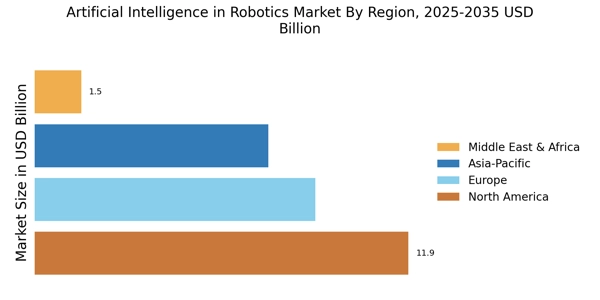
North America is the largest market for Artificial Intelligence in Robotics Market, holding approximately 40% of the global share. The region benefits from significant investments in technology and innovation, driven by a robust ecosystem of startups and established companies. Regulatory support from government initiatives further catalyzes growth, with a focus on enhancing automation in various sectors, including manufacturing and healthcare. The United States leads the market, followed by Canada, with key players like Boston Dynamics, NVIDIA, and Intuitive Surgical driving advancements. The competitive landscape is characterized by rapid technological developments and collaborations between tech firms and research institutions. This synergy fosters a dynamic environment for AI robotics, positioning North America as a leader in the field.
Europe is the second-largest market for Artificial Intelligence in Robotics Market, accounting for around 30% of the global market share. The region's growth is propelled by stringent regulations promoting automation and efficiency across industries. Initiatives from the European Union, such as the Digital Single Market strategy, aim to enhance the adoption of AI technologies, creating a favorable environment for investment and innovation. Germany and the United Kingdom are the leading countries in this sector, with companies like KUKA and Siemens at the forefront. The competitive landscape is marked by a blend of established firms and innovative startups, fostering a collaborative ecosystem. The presence of research institutions further enhances the region's capabilities, driving advancements in AI robotics technology.
Asia-Pacific is witnessing rapid growth in the Artificial Intelligence in Robotics Market, holding approximately 25% of the global share. The region's expansion is driven by increasing demand for automation in manufacturing, logistics, and healthcare. Countries like Japan and China are at the forefront, supported by government initiatives aimed at boosting technological advancements and enhancing productivity across various sectors. Japan is a leader in robotics technology, with companies like Fanuc and Yaskawa Electric leading the charge. China is also emerging as a significant player, focusing on integrating AI into its manufacturing processes. The competitive landscape is characterized by a mix of traditional manufacturers and innovative tech startups, creating a vibrant ecosystem for AI robotics development.
The Middle East and Africa region is gradually emerging in the Artificial Intelligence in Robotics Market, holding about 5% of the global share. The growth is primarily driven by increasing investments in technology and infrastructure, alongside a rising interest in automation across various sectors. Governments in the region are recognizing the potential of AI to enhance operational efficiency and are implementing supportive policies to foster innovation. Countries like the United Arab Emirates and South Africa are leading the charge, with initiatives aimed at integrating AI into their economies. The competitive landscape is still developing, with a mix of local startups and international players looking to capitalize on the growing demand for AI robotics solutions. This region presents significant opportunities for growth as it continues to embrace technological advancements.
The Artificial Intelligence in Robotics Market is currently characterized by a dynamic competitive landscape, driven by rapid technological advancements and increasing demand for automation across various sectors. Key players such as Boston Dynamics (US), ABB (CH), and NVIDIA (US) are at the forefront, each adopting distinct strategies to enhance their market positioning. Boston Dynamics (US) focuses on innovation in robotic mobility and manipulation, while ABB (CH) emphasizes digital transformation through its robotics and automation solutions. NVIDIA (US) leverages its expertise in AI and machine learning to provide advanced computing solutions for robotics, thereby shaping a competitive environment that prioritizes technological prowess and operational efficiency.In terms of business tactics, companies are increasingly localizing manufacturing and optimizing supply chains to enhance responsiveness to market demands. The market structure appears moderately fragmented, with a mix of established players and emerging startups. This fragmentation allows for diverse innovations and competitive strategies, as key players collaborate and compete simultaneously, influencing the overall market dynamics.
In August Boston Dynamics (US) announced a partnership with a leading logistics firm to integrate its robotic solutions into warehouse operations. This strategic move is likely to enhance operational efficiency and reduce labor costs, positioning Boston Dynamics as a pivotal player in the logistics sector. The collaboration underscores the growing trend of integrating robotics into supply chain processes, reflecting a shift towards automation in traditionally labor-intensive industries.
In September ABB (CH) unveiled a new AI-driven robotic arm designed for precision manufacturing. This development not only showcases ABB's commitment to innovation but also highlights the increasing importance of AI in enhancing robotic capabilities. The introduction of such advanced solutions may enable ABB to capture a larger market share by addressing the specific needs of manufacturers seeking to improve productivity and reduce errors.
In October NVIDIA (US) launched a new software platform aimed at optimizing AI algorithms for robotic applications. This initiative is indicative of NVIDIA's strategy to solidify its leadership in AI technology, particularly in robotics. By providing developers with enhanced tools, NVIDIA is likely to foster innovation and accelerate the adoption of AI-driven robotics across various sectors, further intensifying competition in the market.
As of October current competitive trends are heavily influenced by digitalization, sustainability, and the integration of AI technologies. Strategic alliances among key players are shaping the landscape, facilitating knowledge sharing and resource pooling. Looking ahead, competitive differentiation is expected to evolve, with a pronounced shift from price-based competition to a focus on innovation, technological advancements, and supply chain reliability. This transition may redefine market dynamics, compelling companies to invest in cutting-edge solutions to maintain a competitive edge.



Recent developments in the Artificial Intelligence in Robotics Market have underscored the rapid advancements and increasing integration of AI technologies within robotic systems. Companies are focusing on enhancing robotic capabilities through machine learning, which allows robots to learn from experiences and adapt to changing environments. Key sectors, such as manufacturing, healthcare, and logistics, are witnessing significant investments in AI-driven robotic solutions, driven by the demand for efficiency and automation. \Moreover, partnerships between tech firms and robotics manufacturers are on the rise, fostering innovation and the development of smarter robots.
The ongoing evolution of AI algorithms, combined with advancements in machine vision and natural language processing, is paving the way for more intuitive and versatile robotic applications. Governments are also playing a role by investing in AI research and supporting policies aimed at promoting robotics in various industries, setting the stage for robust growth and projected market expansion from $18.35 billion in 2024 to an impressive $162.39 billion by 2032. This evolving landscape emphasizes the critical role of AI in shaping the future of robotics.
Le marché de l'intelligence artificielle dans la robotique devrait croître à un taux de croissance annuel composé (CAGR) de 27,42 % de 2024 à 2035, soutenu par les avancées en apprentissage automatique, en automatisation et par la demande croissante de solutions robotiques intelligentes.
De nouvelles opportunités résident dans :
D'ici 2035, le marché devrait être robuste, soutenu par des applications innovantes et une adoption généralisée.
| Parameter | Details |
|---|---|
| Market Scope | Artificial Intelligence In Robotics Market revenue from AI-enabled hardware, software, and services across robot types, applications, and end users |
| Study Period | 2021–2035 (Historical: 2021–2024; Base Year: 2025; Forecast: 2026–2035) |
| CAGR | 12.14% (2026–2035) |
| Market Size checkpoints | USD 23.65 billion (2025); USD 26.56 billion (2026); USD 42.00 billion (2030); USD 74.49 billion (2035) |
| Fastest Growing Segments | Software (21.6% CAGR); Medical and Healthcare Robots (23.2% CAGR); Logistics and Warehousing (22.4% CAGR); Healthcare (22.1% CAGR); Asia-Pacific (13.4% CAGR) |
| Companies Profiled | ABB, FANUC, Yaskawa, KUKA, NVIDIA, Intuitive Surgical, Teradyne, Amazon Robotics, Boston Dynamics, Alphabet (Google DeepMind) |
| Valuation Currency | USD Billion (constant 2025 exchange rates) |
 Nirmit Biswas

 Aarti Dhapte
Veuillez remplir le formulaire ci-dessous pour recevoir un échantillon gratuit de ce rapport

“This is really good guys. Excellent work on a tight deadline. I will continue to use you going forward and recommend you to others. Nice job”
 Noah Malgeri
Co-Founder

“Thanks for sending the report it gives us a good global view of the Betaïne market.”
 Peter Groot koerkamp
Account and Business Manager

“We found the report very insightful! we found your research firm very helpful. I'm sending this email to secure our future business.”
 Younghwan Choi
Senior Retail Manager

“I am very pleased with how market segments have been defined in a relevant way for my purposes (such as "Portable Freezers & refrigerators" and "last-mile"). In general the report is well structured. Thanks very much for your efforts.”
 Mark Irwin
Management Consultant

“We got the report in time, we really thank you for your support in this process. I also thank to all of your team as they did a great job.”
 Akif Moroglu
Strategy & Business Development Director

“The Automotive 48V ECU Components Procurement Intelligence Study” was a complex project, but the Market Research Future (MRFR) team handled it with quality, agility, and customer-centricity. They delivered all requested data on time and within the agreed scope. The team, including Shubhendra Anand and Rahul Gotadki, was always readily available to clarify questions and swiftly implement necessary adjustments, driving the project to a successful conclusion within a very demanding timeframe.
I would also like to specifically commend Akshay Agarwal for his responsiveness and support at every stage—from our initial inquiry on May 6th through to final delivery on June 18th. His dedication made the entire process seamless.”
 Guilherme Gomes Martins
Product Management Director

“Thanks. It’s been a pleasure working with you, please use me as reference with any other Intel employees.”
 Joseph Aguayo
Sales Operations & Pricing Manager

“Thank you, this will be very helpful for OQS.”
 La Terria Dodd
Program Support Specialist

“I have been reading the first document or the study, ,the Global HVAC and FP market report 2021 till 2026. Must say, good info! I have not gone in depth at all parts, but got a good indication of the data inside!”
 Rob Kooiker
Group Product Manager HVAC & Fire Protection GMA



