Marché des ingrédients alcoolisés Résumé
Principales tendances et faits saillants du marché
Taille du marché et prévisions
| CAGR (2025 - 2035) | 3.64% |
| CAGR (2025 - 2035) | 3.64% |
The Alcohol Ingredient Market is currently experiencing a dynamic evolution, driven by shifting consumer preferences and an increasing focus on health and wellness. As individuals become more discerning about their choices, there is a noticeable trend towards natural and organic ingredients. This shift is not merely a passing phase; it appears to be a fundamental change in how consumers perceive alcoholic beverages. Additionally, the rise of craft and artisanal products has led to a greater demand for unique flavors and innovative combinations, further diversifying the market landscape. Moreover, the Alcohol Ingredient Market is witnessing a growing interest in low-alcohol and alcohol-free alternatives. This trend suggests that consumers are seeking options that align with their lifestyle choices without compromising on taste or experience. As manufacturers respond to these evolving demands, the market is likely to see an influx of new products that cater to these preferences. Overall, the Alcohol Ingredient Market is poised for continued growth, reflecting broader societal shifts towards healthier and more conscious consumption patterns.
There is a marked increase in the demand for natural and organic components within the Alcohol Ingredient Market. Consumers are gravitating towards products that boast minimal processing and transparency in sourcing, which aligns with their health-conscious values.
The popularity of craft and artisanal beverages is reshaping the Alcohol Ingredient Market. This trend emphasizes unique flavors and small-batch production, appealing to consumers who seek authenticity and distinctiveness in their drinking experiences.
A growing segment of the Alcohol Ingredient Market is dedicated to low-alcohol and alcohol-free alternatives. This trend indicates a shift in consumer behavior, as individuals increasingly prioritize moderation while still desiring enjoyable and flavorful beverages.
The Alcohol Ingredient Market is increasingly influenced by health-conscious consumer trends, as individuals become more aware of the impact of alcohol on their well-being. This awareness has led to a surge in demand for low-calorie and low-sugar alcoholic beverages, with a reported increase of 15% in sales of such products. Additionally, the rise of functional beverages, which incorporate health-promoting ingredients, is reshaping the market landscape. Consumers are now seeking options that align with their health goals, prompting manufacturers to reformulate existing products and introduce new offerings. This shift towards healthier choices is expected to drive innovation within the Alcohol Ingredient Market, as brands strive to create products that appeal to this growing demographic.
Sustainability has emerged as a critical driver within the Alcohol Ingredient Market, as consumers increasingly prioritize environmentally friendly practices. The demand for sustainably sourced ingredients is on the rise, with many brands adopting transparent supply chains and eco-friendly production methods. This trend is evidenced by a 25% increase in the use of organic ingredients in alcoholic beverages over the past two years. As consumers become more environmentally conscious, they are more likely to support brands that demonstrate a commitment to sustainability. This shift not only enhances brand loyalty but also encourages innovation in ingredient sourcing and production processes, ultimately benefiting the Alcohol Ingredient Market as a whole.
Yeast is a dominant player in the Alcohol Ingredient Market, being the primary agent responsible for the fermentation process that transforms sugars into alcohol. Its versatility allows it to be used in a variety of products, from beer to wine, appealing to a broad consumer base. Meanwhile, enzymes are emerging as a key ingredient that improves production efficiency and enhances the flavor complexity of alcoholic beverages. They facilitate various processes, such as clarifying liquids and optimizing fermentation, making them attractive for manufacturers looking to streamline operations while meeting consumer demands for quality. As the market grows, the combination of traditional yeast and innovative enzyme applications is expected to shape the future landscape of alcoholic beverages.
The Alcohol Ingredient Market showcases a diverse array of applications, with beer Production holding the largest share among segment values. This segment has historically been a staple in the market, bolstered by a consistent consumer base that appreciates a wide range of beer styles. On the other hand, Spirits Production is quickly gaining momentum, driven largely by shifting consumer preferences towards premium and artisanal options, effectively capturing a larger segment of the market share over time. As health-conscious trends and innovative product offerings take center stage, Spirits Production is expected to register the fastest growth in the market. The rise of craft distilleries and the increasing popularity of cocktails are significant drivers contributing to this growth. Furthermore, both segments face evolving consumer preferences, necessitating a focus on quality ingredients, sustainability, and unique flavor profiles to meet the demand of modern consumers.
Beer Production (Dominant) vs. cider Production (Emerging)
Beer Production stands out as the dominant force in the Alcohol Ingredient Market, characterized by a robust infrastructure and a rich tradition that resonates with consumers worldwide. This segment benefits from extensive distribution networks and a diverse range of styles that cater to various tastes and preferences. On the other hand, cider Production represents an emerging segment that is gaining traction, especially among health-conscious consumers seeking alternatives to traditional alcoholic beverages. Cider is often perceived as a lighter and more refreshing option, which enhances its appeal. As producers innovate with unique flavors and ingredients, the cider market is poised for growth, driven by an increasing interest in craft beverages and a demand for gluten-free options.
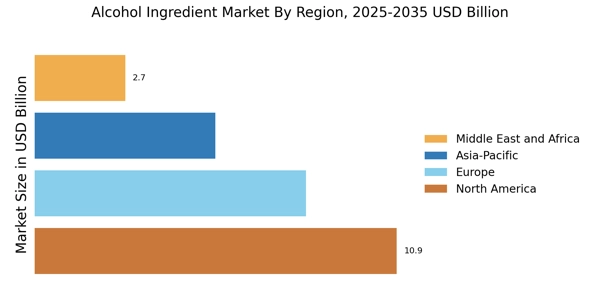
North America is the largest market for alcohol ingredients, holding approximately 40% of the global share. The region's growth is driven by increasing consumer demand for craft beverages and innovative flavor profiles. Regulatory support for alcohol production and distribution further fuels this growth, with a focus on quality and safety standards. The U.S. and Canada are the primary contributors, with a robust framework for alcohol ingredient regulations. The competitive landscape in North America is characterized by the presence of major players such as BASF SE, Cargill, and Archer Daniels Midland. These companies leverage advanced technologies and sustainable practices to meet the evolving consumer preferences. The market is also witnessing a rise in partnerships and collaborations aimed at enhancing product offerings and expanding market reach, ensuring a dynamic and competitive environment.
Europe is the second-largest market for alcohol ingredients, accounting for approximately 30% of the global market share. The region's growth is propelled by a rising trend in premium alcoholic beverages and stringent regulations that ensure product quality and safety. Countries like Germany and the UK are at the forefront, with a strong emphasis on sustainability and organic ingredients, which are becoming increasingly popular among consumers. Leading countries in Europe include Germany, the UK, and France, where key players like Givaudan and Kerry Group are actively innovating to meet market demands. The competitive landscape is marked by a focus on natural and organic ingredients, driven by consumer preferences for healthier options. The presence of established companies and a growing number of startups contribute to a vibrant market, fostering innovation and competition.
Asia-Pacific is witnessing rapid growth in the alcohol ingredient market, holding approximately 20% of the global share. The region's expansion is driven by increasing disposable incomes, changing consumer lifestyles, and a growing interest in alcoholic beverages among younger demographics. Countries like China and India are leading this growth, supported by favorable government policies that encourage local production and consumption. The competitive landscape in Asia-Pacific is evolving, with both local and international players vying for market share. Key companies such as MGP Ingredients and DuPont are expanding their presence in the region, focusing on innovative product development and strategic partnerships. The market is characterized by a diverse range of alcoholic beverages, catering to varying consumer preferences and tastes, which further fuels competition and growth.
The Middle East and Africa region is emerging as a significant player in the alcohol ingredient market, holding approximately 10% of the global share. The growth is driven by increasing urbanization, a young population, and a gradual shift in consumer attitudes towards alcohol consumption. Countries like South Africa and the UAE are leading this trend, supported by evolving regulations that are becoming more favorable for alcohol production and sales. The competitive landscape in this region is still developing, with a mix of local and international companies entering the market. Key players are focusing on adapting their products to meet local tastes and preferences, which is crucial for success. The presence of companies like Symrise and Tate & Lyle is notable, as they invest in understanding regional consumer behavior and preferences, paving the way for future growth and innovation.
The Alcohol Ingredient Market is currently characterized by a dynamic competitive landscape, driven by innovation, sustainability, and strategic partnerships. Key players such as BASF SE (Germany), Cargill, Incorporated (US), and Givaudan SA (Switzerland) are actively shaping the market through their distinct operational focuses. BASF SE (Germany) emphasizes innovation in bio-based ingredients, aiming to enhance product sustainability. Cargill, Incorporated (US) is strategically expanding its portfolio to include plant-based alcohol ingredients, reflecting a growing consumer preference for natural products. Givaudan SA (Switzerland) is leveraging its expertise in flavor and fragrance to develop unique alcohol ingredients that cater to evolving consumer tastes. Collectively, these strategies contribute to a competitive environment that prioritizes sustainability and innovation, setting the stage for future growth.In terms of business tactics, companies are increasingly localizing manufacturing and optimizing supply chains to enhance efficiency and responsiveness to market demands. The Alcohol Ingredient Market appears moderately fragmented, with a mix of large multinational corporations and smaller niche players. The collective influence of these key players is significant, as they not only drive innovation but also set industry standards that smaller companies often follow.
In August BASF SE (Germany) announced a partnership with a leading beverage manufacturer to develop a new line of bio-based alcohol ingredients. This collaboration is strategically important as it aligns with the growing consumer demand for sustainable products, positioning BASF as a leader in eco-friendly ingredient solutions. The partnership is expected to enhance BASF's market share while reinforcing its commitment to sustainability.
In September Cargill, Incorporated (US) launched a new range of plant-based alcohol ingredients aimed at the craft beverage sector. This strategic move is significant as it not only diversifies Cargill's product offerings but also taps into the burgeoning craft beverage market, which is increasingly seeking unique and natural ingredients. This initiative may enhance Cargill's competitive edge by appealing to health-conscious consumers.
In July Givaudan SA (Switzerland) unveiled a new innovation center focused on developing alcohol flavoring solutions. This center is expected to foster creativity and collaboration, allowing Givaudan to stay ahead of market trends and consumer preferences. The establishment of this center indicates Givaudan's commitment to innovation and its strategic focus on enhancing product offerings in the alcohol ingredient sector.
As of October the Alcohol Ingredient Market is witnessing trends such as digitalization, sustainability, and the integration of artificial intelligence in product development. Strategic alliances among key players are increasingly shaping the competitive landscape, fostering innovation and enhancing supply chain reliability. Looking ahead, competitive differentiation is likely to evolve from traditional price-based competition to a focus on innovation, technology, and sustainable practices, reflecting the changing preferences of consumers and the broader market dynamics.


Le marché des ingrédients alcoolisés devrait croître à un taux de croissance annuel composé (CAGR) de 3,64 % de 2024 à 2035, soutenu par une demande croissante des consommateurs pour des produits premium et des profils de saveurs innovants.
De nouvelles opportunités résident dans :
D'ici 2035, le marché devrait être robuste, reflétant l'évolution des préférences des consommateurs et des pratiques durables.
| MARKET SIZE 2024 | 27.26(USD Billion) |
| MARKET SIZE 2025 | 28.26(USD Billion) |
| MARKET SIZE 2035 | 40.41(USD Billion) |
| COMPOUND ANNUAL GROWTH RATE (CAGR) | 3.64% (2025 - 2035) |
| REPORT COVERAGE | Revenue Forecast, Competitive Landscape, Growth Factors, and Trends |
| BASE YEAR | 2024 |
| Market Forecast Period | 2025 - 2035 |
| Historical Data | 2019 - 2024 |
| Market Forecast Units | USD Billion |
| Key Companies Profiled | BASF SE (DE), Cargill, Incorporated (US), Archer Daniels Midland Company (US), DuPont de Nemours, Inc. (US), Givaudan SA (CH), Tate & Lyle PLC (GB), MGP Ingredients, Inc. (US), Kerry Group plc (IE), Symrise AG (DE) |
| Segments Covered | Ingredient Type, Application, Form, Source, Regulatory Compliance, Regional |
| Key Market Opportunities | Growing demand for natural and organic ingredients in the Alcohol Ingredient Market presents significant opportunities. |
| Key Market Dynamics | Rising consumer demand for natural ingredients drives innovation and competition in the Alcohol Ingredient Market. |
| Countries Covered | North America, Europe, APAC, South America, MEA |
 Snehal Singh

Veuillez remplir le formulaire ci-dessous pour recevoir un échantillon gratuit de ce rapport

“This is really good guys. Excellent work on a tight deadline. I will continue to use you going forward and recommend you to others. Nice job”
 Noah Malgeri
Co-Founder

“Thanks for sending the report it gives us a good global view of the Betaïne market.”
 Peter Groot koerkamp
Account and Business Manager

“We found the report very insightful! we found your research firm very helpful. I'm sending this email to secure our future business.”
 Younghwan Choi
Senior Retail Manager

“I am very pleased with how market segments have been defined in a relevant way for my purposes (such as "Portable Freezers & refrigerators" and "last-mile"). In general the report is well structured. Thanks very much for your efforts.”
 Mark Irwin
Management Consultant

“We got the report in time, we really thank you for your support in this process. I also thank to all of your team as they did a great job.”
 Akif Moroglu
Strategy & Business Development Director

“The Automotive 48V ECU Components Procurement Intelligence Study” was a complex project, but the Market Research Future (MRFR) team handled it with quality, agility, and customer-centricity. They delivered all requested data on time and within the agreed scope. The team, including Shubhendra Anand and Rahul Gotadki, was always readily available to clarify questions and swiftly implement necessary adjustments, driving the project to a successful conclusion within a very demanding timeframe.
I would also like to specifically commend Akshay Agarwal for his responsiveness and support at every stage—from our initial inquiry on May 6th through to final delivery on June 18th. His dedication made the entire process seamless.”
 Guilherme Gomes Martins
Product Management Director

“Thanks. It’s been a pleasure working with you, please use me as reference with any other Intel employees.”
 Joseph Aguayo
Sales Operations & Pricing Manager

“Thank you, this will be very helpful for OQS.”
 La Terria Dodd
Program Support Specialist

“I have been reading the first document or the study, ,the Global HVAC and FP market report 2021 till 2026. Must say, good info! I have not gone in depth at all parts, but got a good indication of the data inside!”
 Rob Kooiker
Group Product Manager HVAC & Fire Protection GMA


