Software Analytics Market Resumen
Tendencias clave del mercado y aspectos destacados
Tamaño del mercado y previsión
| CAGR (2025 - 2035) | 9.05% |
| CAGR (2025 - 2035) | 9.05% |
The Software Analytics Market is currently experiencing a transformative phase, driven by the increasing demand for data-driven decision-making across various industries. Organizations are recognizing the value of harnessing software analytics to gain insights into user behavior, operational efficiency, and market trends. This shift towards analytics is not merely a trend but appears to be a fundamental change in how businesses operate. As companies strive to remain competitive, the integration of advanced analytics tools into their workflows is becoming essential. Furthermore, the rise of cloud computing and the proliferation of big data technologies are likely to enhance the capabilities of software analytics, enabling more sophisticated analyses and real-time insights. In addition, the Software Analytics Market seems to be influenced by the growing emphasis on customer experience and personalization. Businesses are increasingly utilizing analytics to tailor their offerings to meet the specific needs of their clients. This focus on user-centric strategies may lead to the development of more intuitive and responsive software solutions. Moreover, the ongoing advancements in artificial intelligence and machine learning technologies could further propel the market, as these innovations allow for deeper insights and predictive capabilities. Overall, the Software Analytics Market is poised for substantial growth, driven by technological advancements and evolving business needs.
The Software Analytics Market is witnessing a notable shift towards cloud-based analytics solutions. This trend is driven by the flexibility, scalability, and cost-effectiveness that cloud platforms offer. Organizations are increasingly migrating their analytics operations to the cloud, enabling them to access real-time data and insights from anywhere, thus enhancing decision-making processes.
A growing emphasis on customer experience is shaping the Software Analytics Market. Companies are leveraging analytics to gain a deeper understanding of customer preferences and behaviors. This focus on personalization is likely to lead to the development of more tailored software solutions that cater to individual user needs.
The integration of artificial intelligence and machine learning technologies is becoming a defining characteristic of the Software Analytics Market. These advancements allow for more sophisticated data analyses and predictive modeling, enabling organizations to uncover insights that were previously unattainable. This trend may significantly enhance the capabilities of software analytics tools.
The emergence of predictive analytics is reshaping the Software Analytics Market. Organizations are increasingly adopting predictive models to forecast future trends and behaviors, allowing them to make proactive decisions. This trend is particularly relevant in sectors such as retail and manufacturing, where understanding customer preferences and operational efficiencies can lead to substantial competitive advantages. The predictive analytics market is anticipated to grow at a robust pace, with estimates suggesting a potential market size of over 20 billion dollars by 2025. This growth is indicative of a broader shift towards leveraging historical data to inform future strategies. As businesses seek to enhance their forecasting capabilities, the demand for sophisticated predictive analytics tools is likely to rise, further driving innovation within the Software Analytics Market.
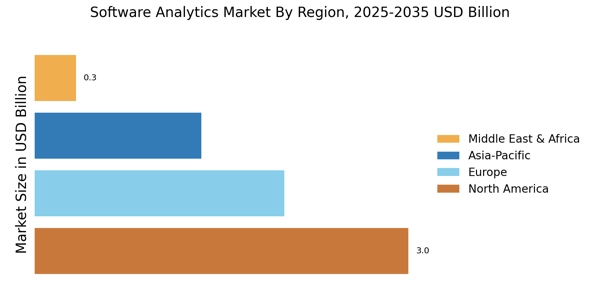
North America leads the Software Analytics Market, holding approximately 45% of the global share, driven by rapid technological advancements and a strong demand for data-driven decision-making. The region benefits from a robust regulatory environment that encourages innovation and investment in analytics solutions. The increasing adoption of cloud-based analytics tools and AI technologies further propels market growth, making it a key player in the global landscape. The United States is the largest market, followed by Canada, both showcasing a competitive landscape with major players like Microsoft, IBM, and Oracle. These companies are continuously innovating to meet the growing demand for advanced analytics solutions. The presence of numerous startups and established firms fosters a dynamic ecosystem, ensuring that North America remains at the forefront of software analytics development.
Europe is witnessing significant growth in the Software Analytics Market, accounting for around 30% of the global share. The region's growth is fueled by stringent data protection regulations, such as GDPR, which drive organizations to adopt advanced analytics solutions for compliance and operational efficiency. The increasing focus on digital transformation across various sectors is also a key driver, enhancing the demand for sophisticated analytics tools. Leading countries in this region include Germany, the UK, and France, where companies are investing heavily in analytics capabilities. Major players like SAP and IBM are expanding their offerings to cater to the evolving needs of businesses. The competitive landscape is characterized by a mix of established firms and innovative startups, ensuring a vibrant market environment that fosters continuous improvement and adaptation to new technologies.
Asia-Pacific is rapidly emerging as a significant player in the Software Analytics Market, holding approximately 20% of the global share. The region's growth is driven by increasing digitalization, a surge in data generation, and a growing emphasis on data-driven decision-making across industries. Governments are also promoting initiatives to enhance technological adoption, further catalyzing market expansion. Countries like China, India, and Japan are leading the charge, with a strong presence of both local and international players. Companies such as SAS and Tableau are expanding their footprint in the region, catering to the diverse needs of businesses. The competitive landscape is evolving, with a mix of established firms and new entrants, creating a dynamic environment that encourages innovation and growth in software analytics solutions.
The Middle East and Africa region is gradually emerging in the Software Analytics Market, currently holding about 5% of the global share. The growth is primarily driven by increasing investments in technology and a rising awareness of the importance of data analytics in business operations. Governments are initiating various digital transformation projects, which are expected to boost the adoption of analytics solutions across sectors. Leading countries in this region include South Africa, UAE, and Kenya, where there is a growing interest in leveraging analytics for improved decision-making. The competitive landscape is still developing, with a mix of local and international players entering the market. Companies are focusing on tailored solutions to meet the unique needs of businesses in this diverse region, paving the way for future growth in software analytics.
Leading market players are investing heavily in research and development to expand their product lines, which will help the software analytics market, grow even more. Market participants are also undertaking different strategic activities to expand their footprint, with important market developments including new product launches, contractual agreements, mergers and acquisitions, higher investments, and collaboration with other organizations. To expand and survive in a more competitive and rising market climate, the software analytics industry must offer cost-effective items.
Manufacturing locally to minimize operational costs is one of the key business tactics manufacturers use in the software analytics industry to benefit clients and increase the market sector. In recent years, the software analytics industry has offered some of the most significant advantages to medicine. Major players in the software analytics market, including Microsoft Corporation (U.S.), Oracle Corporation (U.S.), SAP SE (Germany), SAS Institute (U.S.), and others, are attempting to boost their market demand by investing in research and development operations.
Microsoft Corporation is a multinational technology company based in Redmond, Washington. The Windows operating system, the Microsoft Office suite, and the Internet Explorer and Edge web browsers are among Microsoft's most well-known software products. Its major hardware products are the Xbox video game consoles and the Microsoft Surface family of touchscreen personal PCs.
In March Microsoft introduced Azure Health Data Services. It is a Platform as a Service (PaaS) created primarily to serve analytical and transactional workloads. It integrates health data and drives cloud-based Artificial Intelligence (AI) that only supports Protected Health Information (PHI).
The International Business Machines Corporation (IBM), or Big Blue, is a multinational technology business headquartered in Armonk, New York, with operations in over 175 countries. It specializes in computer hardware, middleware, and software, as well as hosting and consulting services spanning from mainframe computers to nanotechnology.
In November IBM announced the launching of Business Analytics Enterprise, a business intelligence and analytics suite. The solution is intended to assist enterprises in breaking down data barriers and silos produced by employing diverse analytics tools across different departments.
According to the company, the new suite will include a new Analytics Content Center and upgraded versions of Planning Analytics and Cognos Analytics with IBM Watson.


Se proyecta que el Mercado de Análisis de Software crecerá a un CAGR del 9.05% desde 2025 hasta 2035, impulsado por la creciente complejidad de los datos, la demanda de información en tiempo real y los avances en tecnologías de IA.
Para 2035, se espera que el Mercado de Análisis de Software sea robusto, impulsado por la innovación y expansiones estratégicas.
| MARKET SIZE 2024 | 6.63(USD Billion) |
| MARKET SIZE 2025 | 7.23(USD Billion) |
| MARKET SIZE 2035 | 17.2(USD Billion) |
| COMPOUND ANNUAL GROWTH RATE (CAGR) | 9.05% (2025 - 2035) |
| REPORT COVERAGE | Revenue Forecast, Competitive Landscape, Growth Factors, and Trends |
| BASE YEAR | 2024 |
| Market Forecast Period | 2025 - 2035 |
| Historical Data | 2019 - 2024 |
| Market Forecast Units | USD Billion |
| Key Companies Profiled | Microsoft (US), IBM (US), SAP (DE), Oracle (US), SAS (US), Tableau (US), Qlik (US), Google (US), MicroStrategy (US) |
| Segments Covered | Service, Deployment, Vertical, Region |
| Key Market Opportunities | Integration of artificial intelligence enhances predictive capabilities in the Software Analytics Market. |
| Key Market Dynamics | Rising demand for data-driven decision-making fuels competition and innovation in the Software Analytics Market. |
| Countries Covered | North America, Europe, APAC, South America, MEA |
Se proyecta que el Mercado de Análisis de Software alcanzará una valoración de 17.2 mil millones de USD para 2035.
En 2024, el Mercado de Análisis de Software tenía una valoración de 6.63 mil millones de USD.
El CAGR esperado para el Mercado de Análisis de Software durante el período de pronóstico 2025 - 2035 es del 9.05%.
Los actores clave en el Mercado de Análisis de Software incluyen Microsoft, IBM, SAP, Oracle, SAS, Tableau, Qlik, Google y MicroStrategy.
Se proyecta que el segmento de Servicios Profesionales crecerá de 2.65 mil millones de USD en 2024 a 6.85 mil millones de USD para 2035.
Se espera que el segmento de implementación On-Premise aumente de 2.63 mil millones de USD en 2024 a 7.2 mil millones de USD para 2035, mientras que se proyecta que el segmento de Nube crecerá de 4.0 mil millones de USD a 10.0 mil millones de USD.
 Apoorva Priyadarshi

 Shubham Munde
Research Methodology on Software Analytics Market
Abstract
This research proposal aims to explore the current market for software analytics and identify the factors that have contributed to the growth of the software analytics industry. To achieve this goal, a detailed research methodology including quantitative and qualitative approaches are utilized. Primary data is collected through interviews and surveys, whilst secondary data is gathered from online and published sources. The research plan also includes a detailed timeline and a budget. The conclusion of this research evaluates the results of the study and provides recommendations for the future of the software analytics market and forecast for 2023 to 2030.
Introduction
Software analytics is a relatively new term that has emerged alongside the rapidly growing acumen and applications of artificial intelligence and machine learning. As businesses become increasingly reliant and dependent on technology, they are increasingly turning towards software analytics as a means of attaining market insights that can be used to improve customer service, optimize operations and ensure compliance, among other uses. Software analytics can allow businesses to gather and process consumer data faster than non-analytical software and can thus result in shorter response times, increased sales and improved efficiency.
In light of this, the need for an understanding of the present market for software analytics is pertinent for business owners who wish to remain competitive in the modern digital landscape. To this end, this research proposal will aim to evaluate the current trends, factors and statistics that have contributed to the growth of the software analytics market and assess the potential opportunities for businesses to leverage software analytics to better serve their customers.
Research Objectives
The broad objective of this research is to evaluate the current market for software analytics, identify the factors that have contributed to the growth of the market and explore the potential opportunities present for businesses to leverage software analytics.
To achieve this broad objective, the following specific research objectives have been identified:
- To identify the current market trends and assess their impacts on the software analytics market
- To evaluate the factors that have contributed to the growth of the software analytics industry
- To analyse the opportunities that the software analytics market presents for businesses
- To identify the most promising segments of the software analytics market
- To assess the potential for growth of the software analytics industry
Research Methodology
A mixed methods approach is employed for this research project by combining quantitative and qualitative data collection and analysis. To begin with, primary data is sourced through semi-structured interviews and surveys conducted with key industry stakeholders. Through these participants, relevant insights, experiences and opinions regarding software analytics are obtained.
Secondary data is also collected to build a comprehensive picture of the software analytics market, with the assistance of both online and published sources. Information and statistics sourced from these sources are used to assess the current state of the market, identify key trends and validate the primary data obtained through the survey/interview process.
Research Schedule
Research activities are conducted over a period of three months to ensure the research can be completed within a reasonable timeframe.
Phase 1- Data Collection
Duration: One month
This phase of the research focuses on data collection. Primary data is collected through semi-structured interviews conducted with experts in the software analytics field, as well as surveys distributed to key industry stakeholders. Meanwhile, secondary data is gathered from online and published sources.
Phase 2 - Data Analysis
Duration: One month
In this phase of the project, the data collected is analysed using both quantitative and qualitative techniques to achieve the research objectives. Statistical analysis is used to analyse the quantitative data, whilst content analysis will be employed to interpret the qualitative information obtained.
Phase 3 - Writing up and Finalising
Duration: One month
This final phase of the project involves writing up the research report and finalising it for submission. The findings of the study are collated and presented in the form of a report, and the recommendations section provides suggestions for the future of the software analytics market.
Conclusion
This research project intends to evaluate the current market for software analytics and identify the factors that have contributed to the growth of the market. A mixed methods approach combining quantitative and qualitative data collection and analysis is employed to achieve the broad research objective. Primary data is sourced through interviews and surveys, whilst secondary data is gathered from online and published sources. The research plan also includes a detailed timeline and a budget. The conclusion of the research project evaluates the findings of the study and provides recommendations for the future of the software analytics market.
Complete el formulario a continuación para recibir una muestra gratuita de este informe


“This is really good guys. Excellent work on a tight deadline. I will continue to use you going forward and recommend you to others. Nice job”
 Noah Malgeri
Co-Founder

“Thanks for sending the report it gives us a good global view of the Betaïne market.”
 Peter Groot koerkamp
Account and Business Manager

“We found the report very insightful! we found your research firm very helpful. I'm sending this email to secure our future business.”
 Younghwan Choi
Senior Retail Manager

“I am very pleased with how market segments have been defined in a relevant way for my purposes (such as "Portable Freezers & refrigerators" and "last-mile"). In general the report is well structured. Thanks very much for your efforts.”
 Mark Irwin
Management Consultant

“We got the report in time, we really thank you for your support in this process. I also thank to all of your team as they did a great job.”
 Akif Moroglu
Strategy & Business Development Director

“The Automotive 48V ECU Components Procurement Intelligence Study” was a complex project, but the Market Research Future (MRFR) team handled it with quality, agility, and customer-centricity. They delivered all requested data on time and within the agreed scope. The team, including Shubhendra Anand and Rahul Gotadki, was always readily available to clarify questions and swiftly implement necessary adjustments, driving the project to a successful conclusion within a very demanding timeframe.
I would also like to specifically commend Akshay Agarwal for his responsiveness and support at every stage—from our initial inquiry on May 6th through to final delivery on June 18th. His dedication made the entire process seamless.”
 Guilherme Gomes Martins
Product Management Director

“Thanks. It’s been a pleasure working with you, please use me as reference with any other Intel employees.”
 Joseph Aguayo
Sales Operations & Pricing Manager

“Thank you, this will be very helpful for OQS.”
 La Terria Dodd
Program Support Specialist

“I have been reading the first document or the study, ,the Global HVAC and FP market report 2021 till 2026. Must say, good info! I have not gone in depth at all parts, but got a good indication of the data inside!”
 Rob Kooiker
Group Product Manager HVAC & Fire Protection GMA


