Mercado de Software de Encuestas en Línea Resumen
Tendencias clave del mercado y aspectos destacados
Tamaño del mercado y previsión
| CAGR (2025 - 2035) | 10.92% |
| CAGR (2025 - 2035) | 10.92% |
The Online Survey Software Market is currently experiencing a dynamic evolution, driven by the increasing demand for data-driven decision-making across various sectors. Organizations are recognizing the value of gathering insights directly from their target audiences, which has led to a surge in the adoption of online survey tools. These platforms facilitate the collection of feedback, opinions, and preferences, enabling businesses to tailor their strategies effectively. Furthermore, the integration of advanced technologies such as artificial intelligence and machine learning into survey software is enhancing data analysis capabilities, allowing for more nuanced interpretations of results. As a result, companies are likely to gain a competitive edge by leveraging these insights to inform their operational and marketing strategies. In addition, the Online Survey Software Market is witnessing a shift towards user-friendly interfaces and mobile compatibility. This trend appears to stem from the growing reliance on mobile devices for internet access, prompting software developers to prioritize accessibility and ease of use. Consequently, organizations can engage a broader audience, ensuring that feedback is representative of diverse demographics. Moreover, the emphasis on data security and privacy is becoming increasingly paramount, as users demand assurance that their information is handled responsibly. This focus on safeguarding data integrity may influence the development of new features and compliance measures within the market, ultimately shaping its future trajectory.
The incorporation of artificial intelligence and machine learning into online survey tools is transforming data analysis processes. These technologies enable more sophisticated interpretations of survey results, allowing organizations to derive deeper insights and make informed decisions.
There is a noticeable trend towards designing intuitive interfaces and ensuring mobile compatibility in online survey software. This shift is likely driven by the increasing use of mobile devices, facilitating broader audience engagement and more diverse feedback.
As concerns regarding data protection grow, the Online Survey Software Market is placing greater emphasis on security measures. Organizations are prioritizing compliance with regulations and implementing features that safeguard user information, reflecting a commitment to responsible data handling.
El mercado de software de encuestas en línea está cada vez más influenciado por la integración de tecnologías de inteligencia artificial (IA). La IA mejora las herramientas de encuesta al permitir un análisis de datos avanzado, análisis predictivo y experiencias de encuesta personalizadas. Este avance tecnológico permite a las organizaciones obtener información más profunda de las respuestas de las encuestas, mejorando la calidad general de los datos recopilados. Las tendencias actuales indican que las soluciones de encuestas impulsadas por IA pueden aumentar las tasas de respuesta en hasta un 30%, ya que ofrecen preguntas personalizadas basadas en el comportamiento del usuario. A medida que las empresas buscan optimizar sus procesos de encuesta, la adopción de tecnologías de IA se convierte en un factor crítico en el mercado de software de encuestas en línea. Además, la IA puede automatizar el procesamiento de datos, reduciendo el tiempo requerido para el análisis y permitiendo a las organizaciones actuar rápidamente sobre los conocimientos. Esta integración no solo agiliza las operaciones, sino que también mejora la experiencia del usuario, haciendo que las encuestas sean más atractivas y relevantes.
El mercado de software de encuestas en línea está significativamente influenciado por la expansión de la cultura de trabajo remoto. A medida que las organizaciones se adaptan a arreglos de trabajo flexibles, la necesidad de mecanismos de comunicación y retroalimentación efectivos se ha intensificado. Las encuestas sirven como una herramienta vital para medir el compromiso y la satisfacción de los empleados en entornos remotos. Los datos sugieren que más del 60% de las empresas han adoptado políticas de trabajo remoto, lo que ha llevado a una mayor dependencia de herramientas digitales para la colaboración y la retroalimentación. Este cambio no solo mejora la transparencia organizacional, sino que también fomenta un sentido de comunidad entre los equipos remotos. En consecuencia, el mercado de software de encuestas en línea está preparado para crecer a medida que las empresas buscan implementar soluciones que faciliten ciclos de retroalimentación continuos y mejoren la experiencia general de los empleados. La capacidad de realizar encuestas de forma remota asegura que las organizaciones puedan mantener un pulso sobre el sentimiento de los empleados, independientemente de la ubicación física.
El mercado de software de encuestas en línea se ve significativamente impactado por la creciente importancia de la analítica de datos en los procesos de toma de decisiones. Las organizaciones están reconociendo cada vez más el valor de los conocimientos basados en datos derivados de las respuestas a las encuestas. Esta tendencia se refleja en el hecho de que aproximadamente el 75% de las empresas priorizan la analítica de datos como un componente clave de sus estrategias. Al utilizar software de encuestas, las empresas pueden analizar tendencias, identificar patrones y tomar decisiones informadas basadas en evidencia empírica. La capacidad de aprovechar la analítica de datos empodera a las organizaciones para refinar sus productos y servicios, mejorando en última instancia la satisfacción del cliente. A medida que la demanda de conocimientos procesables continúa en aumento, es probable que el mercado de software de encuestas en línea se expanda, impulsado por la necesidad de capacidades analíticas sofisticadas. Este enfoque en la analítica de datos no solo apoya la planificación estratégica, sino que también fomenta una cultura de mejora continua dentro de las organizaciones.
El mercado de software de encuestas en línea está experimentando un enfoque creciente en el futuro de la investigación de mercado, ya que las empresas se esfuerzan por comprender su panorama competitivo. Las compañías están invirtiendo en herramientas de encuestas para recopilar información sobre tendencias del mercado, preferencias de los consumidores y estrategias de los competidores. Estadísticas recientes indican que casi el 80% de los profesionales de marketing utilizan encuestas como parte de sus metodologías de investigación. Esta tendencia subraya la importancia de la toma de decisiones basada en datos en el entorno empresarial actual. Al aprovechar el software de encuestas, las organizaciones pueden obtener información procesable que informa el desarrollo de productos, las estrategias de marketing y las iniciativas de compromiso con el cliente. Por lo tanto, el mercado de software de encuestas en línea está posicionado para beneficiarse de este énfasis aumentado en la investigación, ya que las empresas buscan refinar sus ofertas y mejorar su posicionamiento en el mercado. La capacidad de realizar encuestas exhaustivas permite a las empresas mantenerse a la vanguardia de las tendencias de la industria y responder de manera efectiva a las demandas cambiantes de los consumidores.
El mercado de software de encuestas en línea experimenta un notable aumento en la demanda de soluciones para la retroalimentación del cliente. Las organizaciones reconocen cada vez más el valor de comprender las preferencias y niveles de satisfacción del cliente. Esta tendencia está impulsada por la necesidad de que las empresas se adapten a los comportamientos y expectativas cambiantes de los consumidores. Según datos recientes, aproximadamente el 70% de las empresas utilizan encuestas para recopilar información, lo que indica una sólida dependencia de las herramientas de encuestas. Este creciente énfasis en estrategias centradas en el cliente impulsa el mercado de software de encuestas en línea hacia adelante, ya que las empresas buscan mejorar sus ofertas basándose en la retroalimentación directa. Además, la capacidad de analizar el sentimiento del cliente en tiempo real permite a las organizaciones tomar decisiones informadas, fomentando así la lealtad y la retención. A medida que las empresas se esfuerzan por seguir siendo competitivas, la integración de soluciones de encuestas efectivas se vuelve primordial.
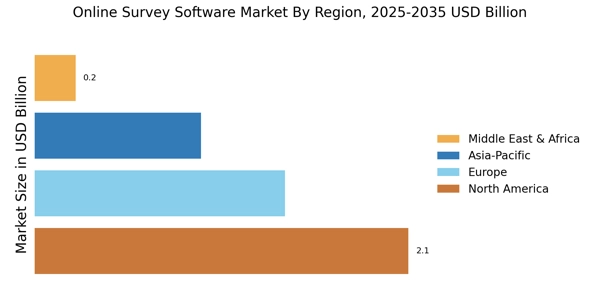
North America is the largest market for online survey software, holding approximately 45% of the global market share. The region's growth is driven by the increasing adoption of digital tools for data collection and analysis, alongside a strong emphasis on customer experience. Regulatory support for data privacy and security, such as the CCPA, further catalyzes market expansion. The United States leads the market, with key players like SurveyMonkey, Qualtrics, and Google Forms dominating the landscape. The competitive environment is characterized by continuous innovation and the introduction of advanced features, such as AI-driven analytics. Canada also contributes significantly, focusing on enhancing user experience and accessibility in survey tools.
Europe is witnessing a robust growth trajectory in the online survey software market, accounting for around 30% of the global share. The demand is fueled by the increasing need for Market Research Future and customer feedback mechanisms, alongside stringent data protection regulations like GDPR, which enhance consumer trust and engagement. Leading countries include the UK, Germany, and France, where companies are increasingly leveraging survey tools for insights. The competitive landscape features prominent players such as Typeform and SurveyGizmo, which are innovating to meet local market needs. The region's focus on data privacy and user-centric design is shaping the future of survey software.
Asia-Pacific is rapidly emerging as a significant player in the online survey software market, holding about 20% of the global market share. The region's growth is driven by the increasing digitalization of businesses and the rising demand for customer insights. Countries like India and China are leading this trend, supported by favorable government initiatives promoting technology adoption. India is particularly noteworthy, with companies like Zoho Survey gaining traction. The competitive landscape is diverse, featuring both local and international players. The region's unique cultural and economic dynamics are influencing the development of tailored survey solutions, making it a vibrant market for innovation.
The Middle East and Africa region is gradually developing its online survey software market, currently holding about 5% of the global share. The growth is driven by increasing internet penetration and a growing awareness of data-driven decision-making among businesses. Government initiatives aimed at enhancing digital infrastructure are also contributing to this trend. Countries like South Africa and the UAE are at the forefront, with a rising number of startups and established companies exploring survey solutions. The competitive landscape is still evolving, with opportunities for both local and international players to establish a foothold. The region's unique challenges and opportunities are shaping the future of survey software adoption.
The Online Survey Software Market is currently characterized by a dynamic competitive landscape, driven by the increasing demand for data-driven decision-making across various sectors. Key players such as SurveyMonkey (US), Qualtrics (US), and Typeform (ES) are at the forefront, each adopting distinct strategies to enhance their market positioning. SurveyMonkey (US) focuses on innovation through continuous product enhancements, while Qualtrics (US) emphasizes its experience management platform, integrating survey capabilities with broader analytics. Typeform (ES), on the other hand, leverages user-friendly design to attract a diverse clientele, thereby shaping a competitive environment that prioritizes user experience and data integration.The market structure appears moderately fragmented, with numerous players vying for market share. Key business tactics include localizing services to cater to regional preferences and optimizing supply chains to enhance service delivery. The collective influence of these major players fosters a competitive atmosphere where differentiation is increasingly based on technological advancements and customer engagement strategies rather than solely on pricing.
In August SurveyMonkey (US) launched a new AI-driven analytics feature aimed at providing deeper insights into survey responses. This strategic move is significant as it positions the company to capitalize on the growing trend of AI integration in data analysis, potentially enhancing user satisfaction and retention. By offering advanced analytics, SurveyMonkey (US) not only strengthens its product offering but also reinforces its commitment to innovation in the survey software space.
In September Qualtrics (US) announced a partnership with a leading CRM provider to enhance its survey distribution capabilities. This collaboration is crucial as it allows Qualtrics (US) to tap into a broader customer base, integrating survey functionalities directly into existing customer relationship management systems. Such strategic alliances are likely to enhance user engagement and streamline data collection processes, thereby solidifying Qualtrics' position in the market.
In July Typeform (ES) introduced a new feature that allows users to create interactive surveys with multimedia elements. This development is indicative of Typeform's strategy to differentiate itself through innovative design and user engagement. By enabling richer content in surveys, Typeform (ES) enhances the overall user experience, which may lead to higher response rates and customer satisfaction.
As of October the Online Survey Software Market is witnessing trends such as digitalization, sustainability, and the integration of artificial intelligence. These trends are reshaping competitive dynamics, with strategic alliances becoming increasingly vital for market players. The shift from price-based competition to a focus on innovation, technology, and supply chain reliability is evident, suggesting that future competitive differentiation will hinge on the ability to adapt to these evolving trends.






Se proyecta que el mercado de software de encuestas en línea crecerá a una Tasa de Crecimiento Anual Compuesto (CAGR) del 10.92% desde 2024 hasta 2035, impulsado por la creciente digitalización, la demanda de retroalimentación en tiempo real y las capacidades mejoradas de análisis de datos.
Nuevas oportunidades se encuentran en:
Para 2035, se espera que el mercado sea robusto, reflejando un crecimiento e innovación sustanciales.
| Parameter | Details |
|---|---|
| Market Scope | Cloud and on-premise software for designing, distributing, and analyzing online surveys across email, web, SMS, messaging, in-app, and QR channels for enterprises, SMBs, and public bodies |
| Study Period | 2021–2035 |
| Base Year | 2025 |
| Historical Data | 2021–2024 |
| Forecast Period | 2026–2035 |
| Market Size in 2025 | USD 5.80 Billion |
| Market Size in 2035 | USD 29.02 Billion |
| CAGR (2026–2035) | 17.4% (2026–2035) |
| Fastest Growing Segments | Academic and Public Sector (21.6% CAGR); Social Media and Messaging Apps (20.6% CAGR); Government and Public Sector (19.8% CAGR); SMBs (19.7% CAGR) |
| Regions Covered | North America, Europe, South America, Asia Pacific, Middle East and Africa and ROW |
| Companies Profiled | Qualtrics, SurveyMonkey (Momentive), Medallia, Microsoft, Forsta (Press Ganey), Google, Alchemer, QuestionPro, Zoho Corporation, Typeform |
| Valuation Currency | USD Billion |
| Methodology | 350+ primary expert interviews; bottom-up market sizing; top-down validation; data triangulation; scenario-based forecasting; real-time project tracking |
 Shubham Munde

 Sejal Akre
The secondary research process involved comprehensive analysis of regulatory databases, technology publications, SaaS industry reports, and authoritative IT research organizations. Key sources included the US National Institute of Standards and Technology (NIST), European Union Agency for Cybersecurity (ENISA), International Organization for Standardization (ISO), Cloud Security Alliance (CSA), Software & Information Industry Association (SIIA), TechAmerica Foundation, National Science Foundation (NSF) Computer and Information Science and Engineering (CISE) Directorate, IEEE Computer Society Digital Library, ACM Digital Library, US Bureau of Labor Statistics (BLS) Occupational Employment and Wage Statistics, World Economic Forum (WEF) Global Technology Governance reports, Organisation for Economic Co-operation and Development (OECD) Digital Economy Outlook, and national digital transformation reports from key markets. These sources were used to collect cloud adoption statistics, data privacy regulation compliance data, enterprise software spending patterns, workforce digitalization trends, and competitive landscape analysis for cloud-based, on-premise, and hybrid deployment models across customer feedback, employee engagement, market research, and academic survey segments.
In order to gather both qualitative and quantitative insights, supply-side and demand-side stakeholders were interviewed during the primary research process. Supply-side sources included CEOs, CTOs, VPs of Product Development, Chief Information Security Officers (CISOs), and heads of customer success from online survey software vendors, SaaS platform providers, and enterprise software OEMs. Demand-side sources comprised Chief Information Officers (CIOs), Chief Marketing Officers (CMOs), heads of human resources, directors of customer experience, procurement leads from large enterprises, IT directors from small and medium enterprises, academic research coordinators, and healthcare quality improvement officers from education, healthcare, retail, finance, and technology sectors. Primary research validated market segmentation across deployment models (cloud-based, on-premise, hybrid), confirmed product pipeline timelines for AI integration and mobile compatibility features, and gathered insights on enterprise adoption patterns, pricing strategies for subscription tiers, and data localization requirements.
Primary Respondent Breakdown:
By Designation: C-level Primaries (29%), Director Level (33%), Others (38%)
By Region: North America (38%), Europe (25%), Asia-Pacific (29%), Rest of World (8%)
Global market valuation was derived through revenue mapping and user adoption analysis. The methodology included:
Identification of 50+ key vendors across North America, Europe, Asia-Pacific, and Latin America
Product mapping across cloud-based, on-premise, and hybrid deployment categories
Segment analysis across survey types including customer feedback surveys, employee engagement surveys, market research surveys, and academic research surveys
End-user industry coverage spanning education, healthcare, retail, finance, and technology sectors
Analysis of reported and modeled annual recurring revenues (ARR) specific to online survey software portfolios
Coverage of vendors representing 72-78% of global market share in 2024
Extrapolation using bottom-up (active user accounts × average revenue per user by country) and top-down (vendor revenue validation) approaches to derive segment-specific valuations for features including multi-channel distribution, real-time analytics, customizable templates, and mobile compatibility
Complete el formulario a continuación para recibir una muestra gratuita de este informe


“This is really good guys. Excellent work on a tight deadline. I will continue to use you going forward and recommend you to others. Nice job”
 Noah Malgeri
Co-Founder

“Thanks for sending the report it gives us a good global view of the Betaïne market.”
 Peter Groot koerkamp
Account and Business Manager

“We found the report very insightful! we found your research firm very helpful. I'm sending this email to secure our future business.”
 Younghwan Choi
Senior Retail Manager

“I am very pleased with how market segments have been defined in a relevant way for my purposes (such as "Portable Freezers & refrigerators" and "last-mile"). In general the report is well structured. Thanks very much for your efforts.”
 Mark Irwin
Management Consultant

“We got the report in time, we really thank you for your support in this process. I also thank to all of your team as they did a great job.”
 Akif Moroglu
Strategy & Business Development Director

“The Automotive 48V ECU Components Procurement Intelligence Study” was a complex project, but the Market Research Future (MRFR) team handled it with quality, agility, and customer-centricity. They delivered all requested data on time and within the agreed scope. The team, including Shubhendra Anand and Rahul Gotadki, was always readily available to clarify questions and swiftly implement necessary adjustments, driving the project to a successful conclusion within a very demanding timeframe.
I would also like to specifically commend Akshay Agarwal for his responsiveness and support at every stage—from our initial inquiry on May 6th through to final delivery on June 18th. His dedication made the entire process seamless.”
 Guilherme Gomes Martins
Product Management Director

“Thanks. It’s been a pleasure working with you, please use me as reference with any other Intel employees.”
 Joseph Aguayo
Sales Operations & Pricing Manager

“Thank you, this will be very helpful for OQS.”
 La Terria Dodd
Program Support Specialist

“I have been reading the first document or the study, ,the Global HVAC and FP market report 2021 till 2026. Must say, good info! I have not gone in depth at all parts, but got a good indication of the data inside!”
 Rob Kooiker
Group Product Manager HVAC & Fire Protection GMA



