Mercado de Dispositivos de Bloqueo de Encendido Resumen
Tendencias clave del mercado y aspectos destacados
Tamaño del mercado y previsión
| CAGR (2025 - 2035) | 5.76% |
The Ignition Interlock Device Market is currently experiencing a notable transformation, driven by increasing awareness regarding road safety and stringent regulations aimed at reducing alcohol-related incidents. Governments across various regions are implementing laws that mandate the installation of these devices for individuals convicted of driving under the influence. This regulatory push appears to be fostering a more widespread acceptance of ignition interlock devices, as they are recognized as effective tools in preventing impaired driving. Furthermore, advancements in technology are enhancing the functionality and user experience of these devices, making them more appealing to both consumers and regulatory bodies. In addition to regulatory influences, the Ignition Interlock Device Market is also witnessing a shift in consumer attitudes towards responsible driving. Public campaigns and educational initiatives are promoting the importance of sober driving, which may lead to increased demand for these devices among individuals seeking to demonstrate their commitment to safety. Moreover, the integration of smart technology into ignition interlock devices is likely to attract a broader audience, as features such as mobile connectivity and real-time monitoring become more prevalent. Overall, the market appears poised for growth as it adapts to evolving societal norms and technological advancements.
Recent legislative measures are increasingly mandating the use of ignition interlock devices for offenders, which is likely to expand the market significantly. These regulations are designed to enhance public safety and reduce instances of impaired driving.
Innovations in technology are enhancing the functionality of ignition interlock devices, making them more user-friendly and efficient. Features such as mobile app integration and real-time data tracking may improve user engagement and compliance.
There is a growing societal emphasis on responsible driving, which could lead to increased acceptance of ignition interlock devices. Public awareness campaigns are fostering a culture of safety, potentially driving demand for these devices among conscientious drivers.
Los avances tecnológicos juegan un papel fundamental en la configuración del mercado de dispositivos de bloqueo de encendido. La introducción de dispositivos más sofisticados y fáciles de usar ha facilitado el cumplimiento para los usuarios. Innovaciones como la integración con teléfonos inteligentes, el monitoreo en tiempo real y el análisis de datos avanzado están mejorando la funcionalidad de los dispositivos de bloqueo de encendido. Estas tecnologías no solo mejoran la experiencia del usuario, sino que también proporcionan a las fuerzas del orden herramientas más efectivas para monitorear el cumplimiento. A partir de 2025, se proyecta que el mercado crecerá a una tasa de crecimiento anual compuesto de aproximadamente el 10%, impulsado por estas innovaciones tecnológicas. La evolución continua de las capacidades de los dispositivos probablemente atraerá a más consumidores y aumentará la penetración en el mercado.
El mercado de dispositivos de bloqueo de encendido está cada vez más influenciado por un enfoque global en la seguridad vial. Los gobiernos y las organizaciones están priorizando iniciativas destinadas a reducir las muertes en la carretera, particularmente aquellas relacionadas con el consumo de alcohol. Este enfoque está llevando a la implementación de leyes más estrictas y a la promoción de dispositivos de bloqueo de encendido como medida preventiva. A medida que la seguridad pública se convierte en una preocupación central, es probable que la demanda de estos dispositivos aumente. Se proyecta que el mercado experimentará un crecimiento sustancial a medida que más partes interesadas, incluidas las compañías de seguros y los grupos de defensa, apoyen la integración de dispositivos de bloqueo de encendido en estrategias más amplias de seguridad vial.
El mercado de dispositivos de bloqueo de encendido está experimentando un aumento en la demanda debido a las crecientes regulaciones gubernamentales destinadas a reducir los incidentes de conducción bajo los efectos del alcohol. Muchas jurisdicciones han promulgado leyes que exigen la instalación de dispositivos de bloqueo de encendido para individuos condenados por delitos de DUI. Este impulso regulatorio no solo tiene como objetivo mejorar la seguridad pública, sino también disminuir la carga económica asociada con los accidentes relacionados con el alcohol. A partir de 2025, se estima que más de 30 estados han implementado tales leyes, lo que ha llevado a un aumento significativo en la adopción de dispositivos de bloqueo de encendido. La creciente conciencia sobre las consecuencias de la conducción bajo los efectos del alcohol probablemente fortalecerá aún más el mercado, ya que el cumplimiento de estas regulaciones se convierte en una necesidad para muchos conductores.
El mercado de dispositivos de bloqueo de encendido está experimentando un crecimiento debido a la expansión de los servicios de alquiler y flota que requieren cumplir con las regulaciones de seguridad. Muchas empresas de alquiler de automóviles y operadores de flotas están incorporando dispositivos de bloqueo de encendido en sus vehículos para garantizar que los conductores cumplan con los estándares de seguridad. Esta tendencia es particularmente evidente en regiones con leyes de DUI estrictas, donde se exige que los servicios de alquiler equipen sus vehículos con estos dispositivos. A partir de 2025, se estima que el segmento de alquiler y flota representará una parte significativa del mercado, impulsado por la necesidad de cumplimiento y el deseo de mejorar las medidas de seguridad.
El mercado de dispositivos de bloqueo de encendido se beneficia de una creciente conciencia sobre los riesgos asociados con el consumo de alcohol y la conducción. Las campañas de salud pública y las iniciativas educativas han sido fundamentales para informar al público sobre los peligros de conducir bajo los efectos del alcohol. Esta mayor conciencia está llevando a un cambio cultural donde las personas están más inclinadas a apoyar medidas que prevengan la conducción ebria. Como resultado, hay una aceptación creciente de los dispositivos de bloqueo de encendido como una solución viable para mejorar la seguridad vial. Se espera que el mercado se expanda a medida que más personas reconozcan la importancia de estos dispositivos para prevenir accidentes y salvar vidas.
Breathalyzer-Based Ignition Interlock Devices are considered the dominant technology in the market due to their extensive use in regulatory enforcement and rehabilitation programs. They provide consistent and accurate results, making them a trusted option for many jurisdictions. However, Camera-Based Ignition Interlock Devices are gaining traction rapidly as an emerging alternative, incorporating advanced features such as facial recognition and tamper detection. This segment of devices is attracting attention for their ability to prevent circumvention of the breath analysis process, thus ensuring higher compliance rates among users. The integration of these technologies can not only improve adherence to safety regulations but also enhance user experience.
In the Ignition Interlock Device Market, the distribution of market share among vehicle types reveals that passenger cars hold the largest segment. This dominance stems from the higher adoption rates of ignition interlock devices owing to stricter regulations and consumer awareness regarding drunk driving. On the other hand, commercial vehicles are witnessing a significant uptick in market share, driven by increasing safety regulations that mandate the integration of such devices to ensure the safety of drivers and passengers alike. The growth trends are influenced by governmental policies and public safety campaigns emphasizing the need for ignition interlock devices across various vehicle types. The expansion of the commercial vehicle segment particularly highlights the shift in focus toward ensuring safer transportation in logistics and public transport sectors. With innovations enhancing the functionality of interlock devices, the market is expected to experience further growth in these segments driven by both regulatory pressures and changing consumer attitudes.
Passenger cars remain the dominant force in the Ignition Interlock Device Market, characterized by widespread adoption fueled by stringent laws regarding alcohol-impaired driving. These vehicles benefit from advanced interlock technologies, which seamlessly integrate with modern automotive systems, making compliance easier for consumers. On the other hand, commercial vehicles, while currently an emerging market segment, are rapidly evolving as more fleet operators recognize the importance of safety features that include ignition interlocks. This segment is becoming increasingly important due to the implementation of broader safety regulations in the commercial transport sector. The ability to monitor driver behavior effectively with ignition interlocks positions commercial vehicles as a growing area for manufacturers and providers, reflecting a shift towards prioritizing safety and compliance.
First-Time DUI Offenders are characterized by their compliance with newly implemented ignition interlock regulations aimed at reducing recidivism. This segment benefits from education and support programs that encourage responsible driving behaviors. As the law increasingly targets these offenders with mandatory use of ignition interlocks, they dominate the market share. Conversely, High-Risk Drivers are emerging as a significant segment, spurred by technological advancements in ignition interlock devices designed for those who demonstrate a higher level of risk. The ability to monitor usage patterns and integrate with mobile applications enhances these devices' appeal among high-risk users, creating a niche that is expanding rapidly.
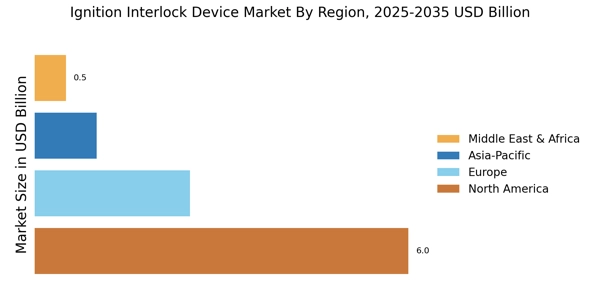
North America is the largest market for ignition interlock devices, accounting for approximately 60% of the global market share. The region's growth is driven by stringent regulations aimed at reducing drunk driving incidents, with states like California and Texas leading in adoption. Increasing awareness of road safety and the effectiveness of these devices in preventing repeat offenses further fuels demand. The United States dominates the North American market, with key players such as Intoxalock, Smart Start, and LifeSafer leading the competitive landscape. These companies benefit from established relationships with state governments and law enforcement agencies, ensuring a steady demand for their products. The presence of innovative technologies and continuous product improvements also contribute to the region's market strength.
Europe is witnessing a significant rise in the adoption of ignition interlock devices, driven by increasing regulatory measures aimed at enhancing road safety. The region holds approximately 25% of the global market share, with countries like Germany and Sweden leading the charge. The European Union's commitment to reducing alcohol-related accidents has catalyzed the implementation of stricter laws, promoting the use of these devices across member states. Germany stands out as a key player in the European market, with companies like Draeger leading the way. The competitive landscape is characterized by a mix of established firms and emerging startups, all vying for market share. The presence of robust regulatory frameworks and public awareness campaigns further bolster the demand for ignition interlock devices, making Europe a promising market for future growth.
Asia-Pacific is an emerging powerhouse in the ignition interlock device market, currently holding about 10% of the global share. The region's growth is propelled by rising road safety concerns and government initiatives aimed at curbing drunk driving. Countries like Australia and Japan are at the forefront, implementing regulations that encourage the use of these devices to enhance public safety and reduce accidents. Australia leads the market in the Asia-Pacific region, with a growing number of key players entering the landscape. Companies are increasingly focusing on technological advancements and partnerships with local governments to promote the adoption of ignition interlock devices. The competitive environment is evolving, with both local and international firms striving to capture market share in this rapidly growing sector.
The Middle East and Africa region represents an untapped potential for the ignition interlock device market, currently holding around 5% of the global share. The growth is driven by increasing awareness of road safety and the need for regulatory measures to combat drunk driving. Countries like South Africa and the UAE are beginning to implement laws that promote the use of these devices, signaling a shift towards enhanced road safety initiatives. South Africa is emerging as a key player in this market, with local companies starting to develop and distribute ignition interlock devices. The competitive landscape is still in its infancy, but there is a growing interest from international firms looking to enter this market. As regulations become more stringent and public awareness increases, the demand for ignition interlock devices is expected to rise significantly in the coming years.

The ignition interlock device market has witnessed significant growth in recent years due to increasing government regulations and rising awareness about drunk driving. The market is expected to continue its growth trajectory in the coming years, driven by factors such as technological advancements, increasing vehicle production, and growing emphasis on road safety. Key players in the market are focusing on developing innovative devices with advanced features and integrating them with vehicle systems. Strategic partnerships and collaborations are also prevalent as companies seek to expand their market reach and gain a competitive edge.
Government initiatives aimed at reducing drunk driving and improving road safety are providing further impetus to the market's growth. The market is also seeing a rise in demand for remote monitoring and data analytics capabilities, enabling real-time tracking and enhanced monitoring of drivers.
Se proyecta que el mercado de dispositivos de bloqueo de encendido crecerá a una Tasa de Crecimiento Anual Compuesto (CAGR) del 5.76% desde 2024 hasta 2035, impulsado por mandatos regulatorios, avances tecnológicos y una creciente conciencia sobre la seguridad vial.
Nuevas oportunidades se encuentran en:
Para 2035, se espera que el mercado sea robusto, impulsado por la innovación y asociaciones estratégicas.
| MARKET SIZE 2024 | 9.937(USD Billion) |
| MARKET SIZE 2025 | 10.51(USD Billion) |
| MARKET SIZE 2035 | 18.4(USD Billion) |
| COMPOUND ANNUAL GROWTH RATE (CAGR) | 5.76% (2025 - 2035) |
| REPORT COVERAGE | Revenue Forecast, Competitive Landscape, Growth Factors, and Trends |
| BASE YEAR | 2024 |
| Market Forecast Period | 2025 - 2035 |
| Historical Data | 2019 - 2024 |
| Market Forecast Units | USD Billion |
| Key Companies Profiled | Intoxalock (US), Smart Start (US), Alcohol Detection Systems (US), LifeSafer (US), Guardian Interlock (US), Draeger (DE), Breathe Easy (US), Soberlink (US) |
| Segments Covered | Device Type, Vehicle Type, Application, Installation, Regional |
| Key Market Opportunities | Increasing regulatory mandates for alcohol monitoring create growth opportunities in the Ignition Interlock Device Market. |
| Key Market Dynamics | Rising regulatory mandates for alcohol ignition interlock devices drive market growth and innovation in safety technology. |
| Countries Covered | North America, Europe, APAC, South America, MEA |
 Abbas Raut

 Swapnil Palwe
Complete el formulario a continuación para recibir una muestra gratuita de este informe


“This is really good guys. Excellent work on a tight deadline. I will continue to use you going forward and recommend you to others. Nice job”
 Noah Malgeri
Co-Founder

“Thanks for sending the report it gives us a good global view of the Betaïne market.”
 Peter Groot koerkamp
Account and Business Manager

“We found the report very insightful! we found your research firm very helpful. I'm sending this email to secure our future business.”
 Younghwan Choi
Senior Retail Manager

“I am very pleased with how market segments have been defined in a relevant way for my purposes (such as "Portable Freezers & refrigerators" and "last-mile"). In general the report is well structured. Thanks very much for your efforts.”
 Mark Irwin
Management Consultant

“We got the report in time, we really thank you for your support in this process. I also thank to all of your team as they did a great job.”
 Akif Moroglu
Strategy & Business Development Director

“The Automotive 48V ECU Components Procurement Intelligence Study” was a complex project, but the Market Research Future (MRFR) team handled it with quality, agility, and customer-centricity. They delivered all requested data on time and within the agreed scope. The team, including Shubhendra Anand and Rahul Gotadki, was always readily available to clarify questions and swiftly implement necessary adjustments, driving the project to a successful conclusion within a very demanding timeframe.
I would also like to specifically commend Akshay Agarwal for his responsiveness and support at every stage—from our initial inquiry on May 6th through to final delivery on June 18th. His dedication made the entire process seamless.”
 Guilherme Gomes Martins
Product Management Director

“Thanks. It’s been a pleasure working with you, please use me as reference with any other Intel employees.”
 Joseph Aguayo
Sales Operations & Pricing Manager

“Thank you, this will be very helpful for OQS.”
 La Terria Dodd
Program Support Specialist

“I have been reading the first document or the study, ,the Global HVAC and FP market report 2021 till 2026. Must say, good info! I have not gone in depth at all parts, but got a good indication of the data inside!”
 Rob Kooiker
Group Product Manager HVAC & Fire Protection GMA



