Mercado de Software de Realidad Aumentada Empresarial Resumen
Tendencias clave del mercado y aspectos destacados
Tamaño del mercado y previsión
| CAGR (2025 - 2035) | 25.92% |
| CAGR (2025 - 2035) | 25.92% |
The Enterprise Augmented Reality Software Market is currently experiencing a transformative phase, characterized by rapid advancements in technology and increasing adoption across various sectors. Organizations are increasingly recognizing the potential of augmented reality to enhance operational efficiency, improve training processes, and facilitate remote collaboration. This shift is driven by the need for innovative solutions that can provide immersive experiences, thereby enabling businesses to stay competitive in a fast-evolving landscape. As companies invest in digital transformation, the integration of augmented reality into their workflows appears to be a strategic priority, suggesting a robust growth trajectory for this market. Moreover, the Enterprise Augmented Reality Software Market is witnessing a surge in demand for customized solutions tailored to specific industry needs. Industries such as manufacturing, healthcare, and retail are leveraging augmented reality to streamline processes and enhance customer engagement. The ability to visualize complex data and provide real-time information is becoming increasingly valuable. As organizations continue to explore the capabilities of augmented reality, the market is likely to expand, driven by innovations that enhance user experience and operational effectiveness. This evolving landscape indicates a promising future for the Enterprise Augmented Reality Software Market, as it adapts to meet the diverse requirements of various sectors.
Organizations are increasingly utilizing augmented reality for training purposes, allowing employees to engage in immersive learning experiences. This trend enhances knowledge retention and skill acquisition, making training more effective.
The convergence of augmented reality with Internet of Things (IoT) and artificial intelligence (AI) is becoming more prevalent. This integration enables real-time data visualization and analytics, enhancing decision-making processes.
There is a growing emphasis on developing tailored augmented reality solutions that cater to the unique needs of different industries. This trend reflects the desire for more effective tools that address specific operational challenges.
El mercado de software de realidad aumentada empresarial está experimentando un aumento en la demanda a medida que las organizaciones buscan mejorar la eficiencia operativa. Al integrar soluciones de realidad aumentada, las empresas pueden optimizar procesos, reducir errores y mejorar la productividad. Por ejemplo, las aplicaciones de realidad aumentada en la fabricación permiten a los trabajadores visualizar instrucciones de ensamblaje complejas, lo que lleva a tiempos de finalización más rápidos. Según datos recientes, las organizaciones que han adoptado tecnologías de realidad aumentada informan un aumento del 30% en la eficiencia operativa. Esta tendencia probablemente continuará a medida que más empresas reconozcan el potencial de la realidad aumentada para optimizar flujos de trabajo y reducir costos.
La integración de la realidad aumentada con análisis avanzados se está convirtiendo en un motor fundamental en el mercado de software de realidad aumentada empresarial. Al combinar la realidad aumentada con análisis de datos, las organizaciones pueden obtener una comprensión más profunda de sus operaciones y comportamientos de los clientes. Esta sinergia permite una toma de decisiones más informada y la capacidad de personalizar experiencias de realidad aumentada para satisfacer necesidades específicas de los usuarios. Como resultado, las empresas están adoptando cada vez más soluciones de realidad aumentada que incorporan capacidades analíticas, lo que lleva a una mejora en el compromiso y la satisfacción del cliente. Se proyecta que el mercado de herramientas de análisis de realidad aumentada crecerá significativamente, reflejando la creciente importancia de las estrategias basadas en datos.
En el panorama actual, el mercado de software de realidad aumentada empresarial está experimentando un notable aumento en la demanda de herramientas de colaboración remota. A medida que las empresas expanden sus operaciones en diversas ubicaciones, la necesidad de una comunicación y colaboración efectivas se vuelve primordial. Las soluciones de realidad aumentada facilitan la interacción en tiempo real entre los equipos, permitiéndoles compartir ideas y resolver problemas desde diferentes ubicaciones geográficas. Los informes indican que las empresas que utilizan AR para la colaboración remota han visto una mejora del 25% en los tiempos de entrega de proyectos. Se espera que este impulso gane fuerza a medida que el trabajo remoto se arraigue más en la cultura corporativa.
La inversión en investigación y desarrollo dentro del mercado de software de realidad aumentada empresarial está en aumento, ya que las empresas se esfuerzan por innovar y mantenerse competitivas. Las organizaciones están asignando recursos significativos para desarrollar aplicaciones avanzadas de realidad aumentada que satisfacen necesidades específicas de la industria. Esta tendencia se refleja en el creciente número de patentes presentadas relacionadas con tecnologías de realidad aumentada, que han crecido aproximadamente un 40% en los últimos años. Tales inversiones no solo mejoran la oferta de productos, sino que también contribuyen al crecimiento general del mercado de realidad aumentada, ya que las empresas buscan aprovechar tecnologías de vanguardia para obtener una ventaja competitiva.
El énfasis en la capacitación en seguridad y cumplimiento dentro del mercado de software de realidad aumentada empresarial está ganando impulso. Las organizaciones están aprovechando las tecnologías de realidad aumentada para crear experiencias de capacitación inmersivas que mejoran los resultados de aprendizaje y las tasas de retención. Al simular escenarios del mundo real, los programas de capacitación en realidad aumentada pueden preparar eficazmente a los empleados para situaciones peligrosas sin los riesgos asociados. Los datos sugieren que las empresas que utilizan la realidad aumentada para la capacitación en seguridad han reducido las tasas de incidentes en hasta un 50%. Este enfoque en la seguridad no solo protege a los empleados, sino que también asegura el cumplimiento de las normas regulatorias, lo que convierte a la realidad aumentada en una solución atractiva para las industrias con requisitos de seguridad estrictos.
The Enterprise Augmented Reality Software Market showcases a diverse application landscape where 'Training Education' leads as the largest segment. This segment is pivotal for organizations looking to enhance workforce capabilities through immersive learning experiences. Following closely is the 'Healthcare' segment, witnessing rapid adoption of AR technologies for surgical simulations, patient education, and interactive training, contributing to its status as the fastest-growing sector in the market. In the current environment, growth in the 'Training Education' application is driven by educational institutions and corporates seeking innovative ways to engage learners and improve retention rates. Meanwhile, the 'Healthcare' segment's growth is propelled by the increasing demand for effective training solutions and advancements in AR technology, allowing for better visualization in medical fields. As a result, we can expect a significant expansion of these sectors within the broader market landscape.
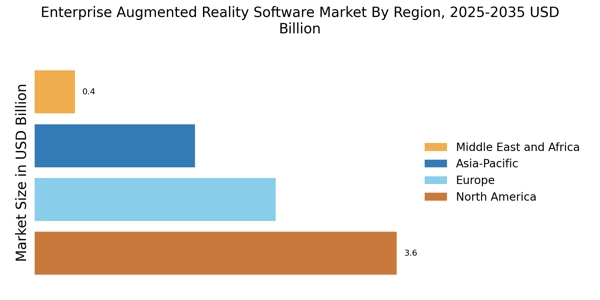
North America is the largest market for Enterprise Augmented Reality Software Market, holding approximately 45% of the global market share. The region's growth is driven by rapid technological advancements, increased investment in AR applications, and a strong focus on enhancing operational efficiency across industries. Regulatory support for digital transformation initiatives further catalyzes market expansion, making it a key player in the global landscape. The United States leads the North American market, with major players like Microsoft, PTC, and Unity Technologies driving innovation. The competitive landscape is characterized by a mix of established tech giants and emerging startups, all vying for market share. The presence of advanced infrastructure and a skilled workforce enhances the region's attractiveness for AR software development, ensuring sustained growth in the coming years.
Europe is witnessing significant growth in the Enterprise Augmented Reality Software Market, accounting for approximately 30% of the global share. The region's demand is fueled by increasing investments in Industry 4.0 initiatives and a growing emphasis on digital transformation across various sectors. Regulatory frameworks promoting innovation and technology adoption are also pivotal in driving market growth, positioning Europe as a competitive player in the AR landscape. Germany and the United Kingdom are the leading countries in this region, with a strong presence of key players like Siemens and Vuforia. The competitive landscape is marked by collaborations between tech companies and industrial firms, enhancing the development of tailored AR solutions. As businesses increasingly recognize the value of AR in improving operational efficiency, the market is expected to expand further, supported by favorable government policies.
Asia-Pacific is emerging as a significant player in the Enterprise Augmented Reality Software Market, holding around 20% of the global market share. The region's growth is driven by increasing investments in technology and a rising demand for innovative solutions across various industries, including manufacturing, healthcare, and education. Government initiatives aimed at promoting digital transformation and smart manufacturing are also contributing to the market's expansion in this region. China and Japan are the leading countries in the Asia-Pacific market, with a growing number of startups and established companies focusing on AR technology. The competitive landscape is characterized by rapid innovation and collaboration among tech firms, which is essential for developing advanced AR applications. As the region continues to embrace digital technologies, the demand for AR software is expected to rise significantly in the coming years.
The Middle East and Africa region is gradually emerging in the Enterprise Augmented Reality Software Market, currently holding about 5% of the global share. The growth is primarily driven by increasing investments in technology and a growing interest in digital solutions across various sectors. Government initiatives aimed at diversifying economies and enhancing technological capabilities are also fostering a conducive environment for AR adoption in the region. Countries like the UAE and South Africa are at the forefront of AR development, with several initiatives aimed at integrating AR into various industries. The competitive landscape is still developing, with a mix of local startups and international players entering the market. As awareness of AR's potential benefits grows, the region is expected to see a gradual increase in market share, supported by favorable government policies and investments.
The Enterprise Augmented Reality Software Market has witnessed significant growth and evolution, driven by increased demand for enhanced real-time data visualization and immersive experiences across various industries. This market encompasses a range of software solutions that utilize augmented reality technology to improve operational efficiency, facilitate training and education, and enhance customer engagement. In this competitive landscape, key players are continually innovating and developing advanced features to differentiate their offerings. With a diverse array of stakeholders, including technology firms, software developers, and industry-specific solution providers, this market presents a dynamic environment where collaboration and strategic partnerships are essential for success. The competition is primarily characterized by an emphasis on scalability, ease of integration, and user experience, which collectively contribute to the adoption of augmented reality solutions in enterprise settings.Oracle stands out in the Enterprise Augmented Reality Software Market due to its robust and comprehensive suite of enterprise solutions. The company leverages its proven expertise in cloud computing, data management, and enterprise software to deliver augmented reality applications that integrate seamlessly with its existing product offerings. Oracle's strengths lie in its strong focus on creating user-friendly interfaces that empower businesses to harness augmented reality's potential with minimal disruption to their workflows. Furthermore, Oracle's commitment to security and compliance assures enterprise clients that their sensitive data is well-protected while utilizing augmented reality technologies. With a well-established presence across various sectors, Oracle is well-positioned to enhance operational efficiencies and drive innovation for businesses looking to adopt augmented reality solutions.Varjo has emerged as a prominent player in the Enterprise Augmented Reality Software Market, particularly known for its high-fidelity visual performance. The company specializes in creating augmented reality experiences that focus on professional use in industries like engineering, healthcare, and training. Varjo's distinct advantage lies in its advanced hardware-software integration, which ensures that users benefit from realistic visuals and accurate representations of their environments. This capability positions Varjo as a preferred choice for enterprises seeking to implement augmented reality technologies for complex tasks that demand precision. Varjo's ongoing commitment to research and development allows it to stay at the forefront of technological advancements in augmented reality, continually improving its offerings to meet the specific needs of its enterprise clients. The company’s focus on delivering an unmatched experience makes it a competitive contender in this rapidly evolving market landscape.






Recent developments in the Enterprise Augmented Reality Software Market have showcased significant advancements and collaborations among key players. Microsoft continues to enhance its mixed reality capabilities, focusing on integrations with its Azure cloud services to provide robust solutions for enterprise users. Meanwhile, Oracle has been investing in augmented reality technologies to improve user experience in its enterprise applications.
Companies like Unity Technologies and Vuforia are expanding their offerings to create immersive training environments tailored for various industries, indicating a growing trend toward utilizing AR for employee training and development.In terms of mergers and acquisitions, Varjo recently completed strategic initiatives to expand its product line, while Zebra Technologies is actively strengthening its AR portfolio through acquisitions to drive innovation. Magic Leap has also been making headlines as it refines its focus on enterprise solutions, attracting attention to potential partnerships that can enhance its position in the market.
As these companies evolve, the overall market valuation is anticipated to grow, driven by increased demand for augmented reality applications across diverse sectors, including healthcare, manufacturing, and logistics, paving the way for a transformative impact on operational efficiencies and customer engagement.
Se proyecta que el mercado de software de realidad aumentada empresarial crecerá a una Tasa de Crecimiento Anual Compuesto (CAGR) del 25.92% desde 2024 hasta 2035, impulsado por los avances en tecnología, el aumento de la demanda de colaboración remota y las soluciones de capacitación mejoradas.
Nuevas oportunidades se encuentran en:
Para 2035, se espera que el mercado sea robusto, impulsado por aplicaciones innovadoras y una adopción generalizada.
| Parameter | Details |
|---|---|
| Market Scope | Enterprise Augmented Reality Software Market: software applications and management platforms for enterprise AR across smartphones, tablets, headsets and smart glasses |
| Study Period | 2021–2035 (Historical: 2021–2024; Base Year: 2025; Forecast: 2026–2035) |
| CAGR | 26.4% (2026–2035) |
| Market Size checkpoints | USD 8.62 Billion (2025); USD 10.94 Billion (2026); USD 29.71 Billion (2030); USD 90.00 Billion (2035) |
| Fastest Growing Segments | Healthcare (Category); Asia-Pacific (Region) |
| Companies Profiled | PTC Inc., Microsoft Corporation, Alphabet Inc. (Google), Apple Inc., Meta Platforms Inc., TeamViewer SE, Magic Leap Inc., Qualcomm Technologies Inc., Scope AR, Zappar Ltd. |
| Valuation Currency | USD Billion (constant 2025 exchange rates) |
 Aarti Dhapte

Complete el formulario a continuación para recibir una muestra gratuita de este informe

“This is really good guys. Excellent work on a tight deadline. I will continue to use you going forward and recommend you to others. Nice job”
 Noah Malgeri
Co-Founder

“Thanks for sending the report it gives us a good global view of the Betaïne market.”
 Peter Groot koerkamp
Account and Business Manager

“We found the report very insightful! we found your research firm very helpful. I'm sending this email to secure our future business.”
 Younghwan Choi
Senior Retail Manager

“I am very pleased with how market segments have been defined in a relevant way for my purposes (such as "Portable Freezers & refrigerators" and "last-mile"). In general the report is well structured. Thanks very much for your efforts.”
 Mark Irwin
Management Consultant

“We got the report in time, we really thank you for your support in this process. I also thank to all of your team as they did a great job.”
 Akif Moroglu
Strategy & Business Development Director

“The Automotive 48V ECU Components Procurement Intelligence Study” was a complex project, but the Market Research Future (MRFR) team handled it with quality, agility, and customer-centricity. They delivered all requested data on time and within the agreed scope. The team, including Shubhendra Anand and Rahul Gotadki, was always readily available to clarify questions and swiftly implement necessary adjustments, driving the project to a successful conclusion within a very demanding timeframe.
I would also like to specifically commend Akshay Agarwal for his responsiveness and support at every stage—from our initial inquiry on May 6th through to final delivery on June 18th. His dedication made the entire process seamless.”
 Guilherme Gomes Martins
Product Management Director

“Thanks. It’s been a pleasure working with you, please use me as reference with any other Intel employees.”
 Joseph Aguayo
Sales Operations & Pricing Manager

“Thank you, this will be very helpful for OQS.”
 La Terria Dodd
Program Support Specialist

“I have been reading the first document or the study, ,the Global HVAC and FP market report 2021 till 2026. Must say, good info! I have not gone in depth at all parts, but got a good indication of the data inside!”
 Rob Kooiker
Group Product Manager HVAC & Fire Protection GMA