Mercado de Paquetes de Baterías para Autobuses Eléctricos Resumen
Tendencias clave del mercado y aspectos destacados
Tamaño del mercado y previsión
| CAGR (2025 - 2035) | 14.32% |
| CAGR (2025 - 2035) | 14.32% |
The Electric Bus Battery Pack Market is currently experiencing a transformative phase, driven by the increasing demand for sustainable public transportation solutions. As urban areas grapple with pollution and congestion, electric buses are emerging as a viable alternative to traditional diesel-powered vehicles. This shift is not merely a trend but appears to be a fundamental change in how cities approach public transit. The integration of advanced battery technologies is crucial, as it enhances the efficiency and range of electric buses, making them more appealing to transit authorities and passengers alike. Furthermore, government initiatives aimed at reducing carbon emissions are likely to bolster the adoption of electric buses, thereby influencing the battery pack market significantly. In addition to environmental considerations, economic factors are also shaping the Electric Bus Battery Pack Market. The total cost of ownership for electric buses is becoming increasingly competitive compared to conventional buses, as operational costs decrease over time. This economic viability, combined with technological advancements in battery chemistry and management systems, suggests a promising future for electric bus battery packs. As manufacturers innovate and optimize their products, the market is poised for growth, with potential expansions into new regions and applications. The ongoing evolution of this market indicates a robust trajectory, reflecting a broader commitment to sustainable transportation solutions.
The Electric Bus Battery Pack Market is witnessing rapid innovations in battery chemistry, which enhance energy density and reduce charging times. These advancements are crucial for improving the overall performance of electric buses, making them more efficient and reliable for public transport.
Government policies and incentives are playing a pivotal role in the growth of the Electric Bus Battery Pack Market. Various countries are implementing regulations that promote the adoption of electric vehicles, including subsidies for electric bus purchases and investments in charging infrastructure.
As urban populations continue to expand, the demand for efficient public transportation systems is increasing. This trend is driving the Electric Bus Battery Pack Market, as cities seek to modernize their fleets with electric buses to meet the needs of their residents.
The Electric Bus Battery Pack Market is being propelled by stringent environmental regulations aimed at reducing greenhouse gas emissions. Governments worldwide are implementing policies that mandate the transition to cleaner public transport solutions, including electric buses. These regulations not only encourage the adoption of electric vehicles but also necessitate the development of efficient battery packs that comply with new standards. As of 2025, it is estimated that the demand for electric buses will rise sharply, driven by these regulatory frameworks. This shift is likely to create a robust market for electric bus battery packs, as manufacturers strive to meet the growing need for sustainable transport solutions. The alignment of regulatory measures with market demands suggests a favorable environment for the Electric Bus Battery Pack Market, fostering innovation and investment in battery technologies.
The Electric Bus Battery Pack Market is experiencing a surge in technological innovations, particularly in battery management systems (BMS). These advancements enhance the efficiency and longevity of battery packs, which is crucial for electric buses that operate in demanding environments. Improved BMS can optimize charging cycles and monitor battery health, thereby reducing operational costs. As of 2025, the market for advanced BMS is projected to grow significantly, driven by the need for reliable and efficient energy storage solutions. This trend indicates a shift towards more sophisticated battery technologies, which could potentially lead to longer ranges and faster charging times for electric buses, making them more appealing to transit authorities and operators. Consequently, the integration of advanced BMS is likely to play a pivotal role in the growth of the Electric Bus Battery Pack Market.
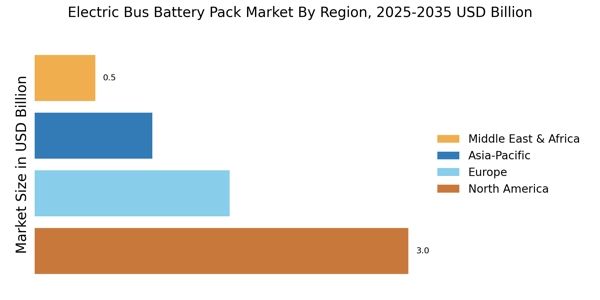
North America is witnessing a significant surge in the electric bus battery pack market, driven by stringent environmental regulations and a growing emphasis on sustainable public transport. The United States holds the largest market share at approximately 60%, followed by Canada at around 25%. Government initiatives, such as the Federal Transit Administration's funding programs, are catalyzing this growth, promoting the transition to electric fleets. The competitive landscape is dominated by key players like A123 Systems and Panasonic, which are investing heavily in R&D to enhance battery efficiency and reduce costs. The U.S. market is characterized by a robust supply chain, with local manufacturers collaborating with global leaders like BYD and LG Energy Solution. This synergy is expected to further accelerate the adoption of electric buses across urban centers.
Europe is at the forefront of the electric bus battery pack market, driven by ambitious climate goals and substantial investments in green technologies. The region's largest market, Germany, accounts for approximately 35% of the total market share, followed closely by France at 30%. The European Union's Green Deal and various national policies are pivotal in fostering demand for electric buses, aiming for a significant reduction in carbon emissions by 2030. Leading countries like the Netherlands and Sweden are also making strides in electric mobility, supported by local manufacturers and international players such as CATL and LG Energy Solution. The competitive landscape is vibrant, with numerous startups and established companies innovating in battery technology. This dynamic environment is expected to enhance the region's position as a global leader in electric bus adoption.
Asia-Pacific is rapidly emerging as a powerhouse in the electric bus battery pack market, primarily driven by urbanization and government support for electric vehicles. China leads the market with a staggering 70% share, followed by Japan at around 15%. The Chinese government's aggressive policies, including subsidies and incentives for electric bus manufacturers, are pivotal in driving this growth, aiming for a significant reduction in urban air pollution. Countries like India are also making notable advancements, with local manufacturers like BYD and Tata Motors entering the electric bus segment. The competitive landscape is characterized by a mix of established players and new entrants, all vying for market share. This region's focus on innovation and cost-effective solutions is expected to sustain its growth trajectory in the coming years.
The Middle East and Africa are gradually emerging in the electric bus battery pack market, driven by increasing urbanization and a shift towards sustainable transport solutions. South Africa holds the largest market share at approximately 40%, with countries like Kenya and the UAE also showing promising growth. Government initiatives aimed at reducing carbon footprints and enhancing public transport infrastructure are key drivers of this market's development. The competitive landscape is still developing, with local players and international companies like Hitachi Energy and BYD entering the market. The region's unique challenges, such as infrastructure development and financing, are being addressed through partnerships and investments. As awareness of electric mobility grows, the market is expected to expand significantly in the coming years.
The Electric Bus Battery Pack Market is currently characterized by a dynamic competitive landscape, driven by the increasing demand for sustainable public transportation solutions and advancements in battery technology. Major players such as CATL (China), LG Energy Solution (South Korea), and BYD (China) are at the forefront, each adopting distinct strategies to enhance their market positioning. CATL (China) focuses on innovation in battery chemistry and manufacturing efficiency, while LG Energy Solution (South Korea) emphasizes strategic partnerships with bus manufacturers to integrate their battery systems seamlessly. BYD (China), on the other hand, leverages its vertical integration to control the supply chain, thereby reducing costs and improving product reliability. Collectively, these strategies contribute to a competitive environment that is increasingly centered around technological advancement and strategic collaborations.Key business tactics within the Electric Bus Battery Pack Market include localizing manufacturing and optimizing supply chains to enhance responsiveness to regional demands. The market structure appears moderately fragmented, with several key players exerting influence over their respective segments. This fragmentation allows for a variety of innovations and competitive strategies, as companies strive to differentiate themselves through unique value propositions and operational efficiencies.
In August LG Energy Solution (South Korea) announced a partnership with a leading European bus manufacturer to develop a new generation of high-capacity battery packs tailored for electric buses. This collaboration is strategically significant as it not only expands LG's footprint in the European market but also aligns with the growing trend towards electrification in public transport. By leveraging its advanced battery technology, LG Energy Solution aims to enhance the performance and range of electric buses, thereby addressing one of the critical barriers to adoption.
In September BYD (China) unveiled its latest battery technology, which reportedly increases energy density by 20% compared to previous models. This development is crucial as it positions BYD to offer more efficient and longer-range electric buses, potentially reshaping consumer expectations and market standards. The introduction of this technology may also enable BYD to capture a larger share of the market, particularly in regions where range anxiety remains a significant concern for fleet operators.
In July CATL (China) expanded its production capacity by opening a new facility dedicated to electric bus battery packs. This strategic move is indicative of CATL's commitment to meeting the surging demand for electric buses globally. By increasing production capabilities, CATL not only strengthens its market position but also enhances its ability to respond to fluctuations in demand, thereby ensuring a reliable supply chain for its customers.
As of October the Electric Bus Battery Pack Market is witnessing trends that emphasize digitalization, sustainability, and the integration of artificial intelligence in battery management systems. Strategic alliances among key players are increasingly shaping the competitive landscape, fostering innovation and collaboration. Looking ahead, it is likely that competitive differentiation will evolve from traditional price-based competition to a focus on technological innovation, supply chain reliability, and sustainable practices, reflecting the broader shifts in consumer preferences and regulatory frameworks.

Se proyecta que el mercado de paquetes de baterías para autobuses eléctricos crecerá a una Tasa de Crecimiento Anual Compuesto (CAGR) del 14.32% desde 2024 hasta 2035, impulsado por avances tecnológicos, el aumento de la urbanización y políticas gubernamentales de apoyo.
Nuevas oportunidades se encuentran en:
Para 2035, se espera que el mercado sea robusto, impulsado por la innovación y asociaciones estratégicas.
| Parameter | Details |
|---|---|
| Market Scope | Electric Bus Battery Pack Market, covering battery packs for new electric and plug-in hybrid buses by type, propulsion, chemistry, capacity, form, voltage, architecture, component, and region |
| Study Period | 2021–2035 (Historical: 2021–2024; Base Year: 2025; Forecast: 2026–2035) |
| CAGR | 12.1% (2026–2035) |
| Market Size checkpoints | USD 4.50 B (2025); USD 5.04 B (2026); USD 14.09 B (2035) |
| Fastest Growing Segments | Articulated (18 M), LMFP, 100-150 kWh, Cylindrical, 800 V+, Cell-to-Pack (CTP) |
| Companies Profiled | CATL, BYD, CALB, LG Energy Solution, Gotion High-Tech, EVE Energy, Samsung SDI, Forsee Power, Microvast, Volvo Group, Akasol (BorgWarner) |
| Valuation Currency | USD (Billion) |
 Shubham Munde

 Swapnil Palwe
Complete el formulario a continuación para recibir una muestra gratuita de este informe


“This is really good guys. Excellent work on a tight deadline. I will continue to use you going forward and recommend you to others. Nice job”
 Noah Malgeri
Co-Founder

“Thanks for sending the report it gives us a good global view of the Betaïne market.”
 Peter Groot koerkamp
Account and Business Manager

“We found the report very insightful! we found your research firm very helpful. I'm sending this email to secure our future business.”
 Younghwan Choi
Senior Retail Manager

“I am very pleased with how market segments have been defined in a relevant way for my purposes (such as "Portable Freezers & refrigerators" and "last-mile"). In general the report is well structured. Thanks very much for your efforts.”
 Mark Irwin
Management Consultant

“We got the report in time, we really thank you for your support in this process. I also thank to all of your team as they did a great job.”
 Akif Moroglu
Strategy & Business Development Director

“The Automotive 48V ECU Components Procurement Intelligence Study” was a complex project, but the Market Research Future (MRFR) team handled it with quality, agility, and customer-centricity. They delivered all requested data on time and within the agreed scope. The team, including Shubhendra Anand and Rahul Gotadki, was always readily available to clarify questions and swiftly implement necessary adjustments, driving the project to a successful conclusion within a very demanding timeframe.
I would also like to specifically commend Akshay Agarwal for his responsiveness and support at every stage—from our initial inquiry on May 6th through to final delivery on June 18th. His dedication made the entire process seamless.”
 Guilherme Gomes Martins
Product Management Director

“Thanks. It’s been a pleasure working with you, please use me as reference with any other Intel employees.”
 Joseph Aguayo
Sales Operations & Pricing Manager

“Thank you, this will be very helpful for OQS.”
 La Terria Dodd
Program Support Specialist

“I have been reading the first document or the study, ,the Global HVAC and FP market report 2021 till 2026. Must say, good info! I have not gone in depth at all parts, but got a good indication of the data inside!”
 Rob Kooiker
Group Product Manager HVAC & Fire Protection GMA


