Mercado Geosintético de América del Sur Central Resumen
Tendencias clave del mercado y aspectos destacados
Tamaño del mercado y previsión
| CAGR (2025 - 2035) | 6.33% |
| CAGR (2025 - 2035) | 6.33% |
The Central South America Geosynthetic Market is currently experiencing a dynamic evolution, driven by various factors that influence its growth trajectory. The increasing demand for sustainable construction practices and the need for effective soil stabilization techniques are pivotal in shaping market dynamics. Additionally, the region's diverse geographical features necessitate innovative solutions for erosion control and drainage management. As infrastructure development continues to expand, the integration of geosynthetics into civil engineering projects appears to be gaining traction, suggesting a promising outlook for the industry. Furthermore, the growing awareness of environmental concerns and regulatory frameworks may further propel the adoption of geosynthetic materials, as stakeholders seek to minimize ecological impacts while enhancing project efficiency. In this context, the Central South America Geosynthetic Market seems poised for substantial growth. The interplay between technological advancements and market demands indicates a potential for new product innovations that cater to specific regional needs. As companies strive to differentiate themselves, collaboration with local governments and construction firms may emerge as a strategic approach to enhance market penetration. Overall, the future of the Central South America Geosynthetic Market appears optimistic, with opportunities for expansion and diversification across various applications, including transportation, waste management, and land reclamation.
The trend towards sustainable construction is reshaping the Central South America Geosynthetic Market. Stakeholders increasingly prioritize eco-friendly materials and methods, leading to a rise in the use of geosynthetics that promote environmental conservation. This shift not only addresses regulatory pressures but also aligns with global sustainability goals.
Innovations in geosynthetic materials and manufacturing processes are significantly influencing the market landscape. Enhanced durability, functionality, and performance characteristics of geosynthetics are emerging, which may lead to broader applications in various sectors, including infrastructure and environmental management.
The establishment of stringent environmental regulations is driving the adoption of geosynthetics in Central South America. Increased awareness of ecological impacts encourages stakeholders to seek solutions that comply with these regulations, thereby fostering a favorable environment for the growth of the geosynthetic market.
The Central South America Geosynthetic Market is experiencing a surge due to ongoing infrastructure development initiatives across the region. Governments are investing heavily in transportation, water management, and urban development projects. For instance, the construction of new highways and bridges necessitates the use of geosynthetic materials for soil stabilization and erosion control. In 2025, it is estimated that infrastructure spending in Central South America will reach approximately USD 150 billion, creating a robust demand for geosynthetics. This trend is likely to continue as countries aim to enhance their infrastructure resilience against natural disasters, thereby driving growth in the geosynthetic sector.
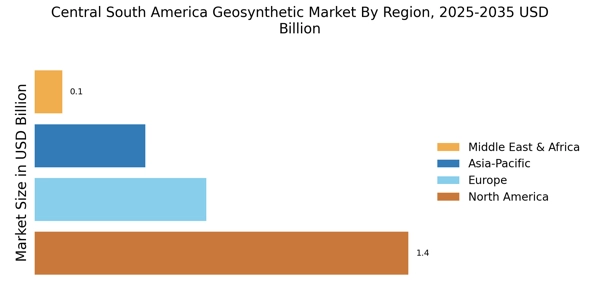
The North American geosynthetic market is driven by increasing infrastructure projects and stringent environmental regulations. The U.S. holds the largest market share at approximately 65%, followed by Canada at 20%. The demand for geosynthetics is bolstered by government initiatives aimed at sustainable construction and waste management, creating a favorable regulatory environment for growth. Leading players in this region include GSE Environmental and Tensar, which dominate the market with innovative solutions. The competitive landscape is characterized by a focus on R&D and partnerships to enhance product offerings. The presence of established companies ensures a robust supply chain, catering to various sectors such as transportation, environmental protection, and civil engineering.
Europe's geosynthetic market is experiencing significant growth, driven by increasing investments in infrastructure and a strong emphasis on sustainability. Germany and the UK are the largest markets, holding approximately 30% and 25% of the market share, respectively. Regulatory frameworks promoting eco-friendly construction practices are key catalysts for this growth, encouraging the adoption of geosynthetic materials in various applications. Countries like France and Italy are also emerging as important players in this market. The competitive landscape features key players such as Maccaferri and Huesker, who are focusing on innovative solutions to meet the growing demand. The presence of these companies fosters a dynamic environment, enhancing the overall market potential in Europe.
The Asia-Pacific geosynthetic market is witnessing rapid growth, fueled by urbanization and infrastructure development in countries like China and India. China is the largest market, accounting for approximately 40% of the regional share, while India follows with around 25%. Government initiatives aimed at improving infrastructure and environmental management are significant drivers of demand in this region. The competitive landscape is becoming increasingly dynamic, with local and international players vying for market share. Companies such as Solmax and Geosynthetics (BR) are expanding their presence, focusing on innovative products tailored to regional needs. The growing awareness of environmental issues is also pushing the adoption of geosynthetics in various applications, from road construction to waste management.
The Middle East and Africa geosynthetic market is characterized by growing demand driven by infrastructure projects and resource management needs. The UAE and South Africa are the largest markets, holding approximately 30% and 25% of the regional share, respectively. The region's focus on sustainable development and environmental protection is fostering a favorable regulatory environment for geosynthetic materials. Key players such as Layfield and TenCate Geosynthetics are actively participating in this market, leveraging their expertise to address local challenges. The competitive landscape is evolving, with an increasing number of companies entering the market to capitalize on the growing opportunities. The emphasis on innovative solutions is expected to drive further growth in the coming years.
The Central South America Geosynthetic Market is characterized by a dynamic competitive landscape, driven by increasing infrastructure development, environmental regulations, and a growing emphasis on sustainable construction practices. Key players such as TenCate Geosynthetics (NL), GSE Environmental (US), and Solmax (CA) are strategically positioned to leverage these trends. TenCate Geosynthetics (NL) focuses on innovation in product development, particularly in biodegradable geosynthetics, which aligns with the region's sustainability goals. GSE Environmental (US) emphasizes regional expansion, enhancing its distribution networks to cater to the burgeoning demand for geosynthetic solutions in civil engineering projects. Solmax (CA) is actively pursuing partnerships with local firms to bolster its market presence, indicating a collaborative approach to growth that enhances its competitive edge.The market structure appears moderately fragmented, with several players vying for market share. Companies are increasingly localizing manufacturing to reduce costs and improve supply chain efficiency. This tactic not only enhances responsiveness to local market demands but also mitigates risks associated with global supply chain disruptions. The collective influence of these key players shapes a competitive environment where innovation and operational efficiency are paramount.
In August GSE Environmental (US) announced the opening of a new manufacturing facility in Brazil, aimed at increasing production capacity for geomembranes. This strategic move is likely to enhance GSE's ability to meet the rising demand for geosynthetic products in the region, particularly in the mining and waste management sectors. The facility is expected to create local jobs and contribute to the economic development of the area, thereby strengthening GSE's brand reputation and market position.
In September Solmax (CA) entered into a strategic partnership with a Brazilian construction firm to develop innovative geosynthetic solutions tailored for local infrastructure projects. This collaboration is indicative of Solmax's commitment to understanding regional needs and customizing its offerings accordingly. By aligning with local expertise, Solmax may enhance its competitive advantage and foster long-term relationships within the market.
In October TenCate Geosynthetics (NL) launched a new line of eco-friendly geotextiles designed to reduce environmental impact while maintaining high performance. This initiative reflects a growing trend towards sustainability in the geosynthetic sector, positioning TenCate as a leader in environmentally responsible solutions. The introduction of these products may not only attract environmentally conscious clients but also set a benchmark for competitors in the industry.
As of October the competitive trends in the Central South America Geosynthetic Market are increasingly defined by digitalization, sustainability, and the integration of advanced technologies such as AI. Strategic alliances are becoming more prevalent, as companies recognize the value of collaboration in enhancing innovation and market reach. Looking ahead, competitive differentiation is likely to evolve from traditional price-based competition to a focus on technological advancements, sustainable practices, and reliable supply chains. This shift may redefine the competitive landscape, compelling companies to innovate continuously to maintain their market positions.


May 2026: Solmax began construction of an eight-hectare geosynthetics facility in Les Mureaux, France, bringing together nonwoven production, laboratory capabilities, and commercial functions. The facility is part of Solmax's manufacturing expansion and is relevant to its global geosynthetics supply network.
2026: Maccaferri supplied geosynthetic and slope-protection solutions for the Interoceanic South Highway connecting Brazil and Peru after heavy rainfall caused landslides and erosion along sections of the route. The project used high-strength nets, self-drilling anchors, and MacMat® R geocomposite, and was completed in seven months, allowing the affected highway corridor to resume normal operation.
Se proyecta que el mercado de geosintéticos de América del Sur Central crecerá a una Tasa de Crecimiento Anual Compuesto (CAGR) del 6.33% desde 2024 hasta 2035, impulsado por el desarrollo de infraestructura, regulaciones ambientales y un aumento en la demanda de soluciones sostenibles.
Nuevas oportunidades se encuentran en:
Para 2035, se espera que el mercado consolide su posición como líder en soluciones de construcción sostenible.
| MARKET SIZE 2024 | 2.08(USD Billion) |
| MARKET SIZE 2025 | 2.212(USD Billion) |
| MARKET SIZE 2035 | 4.086(USD Billion) |
| COMPOUND ANNUAL GROWTH RATE (CAGR) | 6.33% (2025 - 2035) |
| REPORT COVERAGE | Revenue Forecast, Competitive Landscape, Growth Factors, and Trends |
| BASE YEAR | 2024 |
| Market Forecast Period | 2025 - 2035 |
| Historical Data | 2019 - 2024 |
| Market Forecast Units | USD Billion |
| Key Companies Profiled | TenCate Geosynthetics (NL), GSE Environmental (US), Solmax (CA), Geosynthetics (BR), Maccaferri (IT), Huesker (DE), Tensar (US), Layfield (CA) |
| Segments Covered | Product Type, Application, Raw Material, Manufacturing Method, Process, Regional |
| Key Market Opportunities | Growing demand for sustainable infrastructure solutions drives innovation in the Central South America Geosynthetic Market. |
| Key Market Dynamics | Rising demand for sustainable construction materials drives innovation in the Central South America Geosynthetic Market. |
| Countries Covered | North America, Europe, APAC, South America, MEA |
 Priya Nagrale

Complete el formulario a continuación para recibir una muestra gratuita de este informe


“This is really good guys. Excellent work on a tight deadline. I will continue to use you going forward and recommend you to others. Nice job”
 Noah Malgeri
Co-Founder

“Thanks for sending the report it gives us a good global view of the Betaïne market.”
 Peter Groot koerkamp
Account and Business Manager

“We found the report very insightful! we found your research firm very helpful. I'm sending this email to secure our future business.”
 Younghwan Choi
Senior Retail Manager

“I am very pleased with how market segments have been defined in a relevant way for my purposes (such as "Portable Freezers & refrigerators" and "last-mile"). In general the report is well structured. Thanks very much for your efforts.”
 Mark Irwin
Management Consultant

“We got the report in time, we really thank you for your support in this process. I also thank to all of your team as they did a great job.”
 Akif Moroglu
Strategy & Business Development Director

“The Automotive 48V ECU Components Procurement Intelligence Study” was a complex project, but the Market Research Future (MRFR) team handled it with quality, agility, and customer-centricity. They delivered all requested data on time and within the agreed scope. The team, including Shubhendra Anand and Rahul Gotadki, was always readily available to clarify questions and swiftly implement necessary adjustments, driving the project to a successful conclusion within a very demanding timeframe.
I would also like to specifically commend Akshay Agarwal for his responsiveness and support at every stage—from our initial inquiry on May 6th through to final delivery on June 18th. His dedication made the entire process seamless.”
 Guilherme Gomes Martins
Product Management Director

“Thanks. It’s been a pleasure working with you, please use me as reference with any other Intel employees.”
 Joseph Aguayo
Sales Operations & Pricing Manager

“Thank you, this will be very helpful for OQS.”
 La Terria Dodd
Program Support Specialist

“I have been reading the first document or the study, ,the Global HVAC and FP market report 2021 till 2026. Must say, good info! I have not gone in depth at all parts, but got a good indication of the data inside!”
 Rob Kooiker
Group Product Manager HVAC & Fire Protection GMA


