Mercado de rellenos de huecos óseos Resumen
Tendencias clave del mercado y aspectos destacados
Tamaño del mercado y previsión
| CAGR (2025 - 2035) | 5.18% |
| CAGR (2025 - 2035) | 5.18% |
The Bone Void Fillers Market is currently experiencing a notable evolution, driven by advancements in material science and an increasing demand for effective orthopedic solutions. The market appears to be influenced by a growing awareness of the benefits associated with minimally invasive surgical techniques, which are often facilitated by the use of bone void fillers. These products are designed to support bone regeneration and repair, addressing various orthopedic conditions. As healthcare providers seek to enhance patient outcomes, the integration of innovative technologies into the development of these fillers is becoming increasingly prevalent.
Moreover, the rising geriatric population, coupled with a surge in sports-related injuries, seems to be propelling the demand for bone void fillers. This demographic shift indicates a potential for sustained growth in the market, as older individuals are more susceptible to fractures and bone-related ailments. Additionally, the ongoing research into biocompatible materials and their applications in bone repair suggests a promising future for the Bone Void Fillers Market. As stakeholders continue to explore new avenues for product development, the landscape of this market is likely to transform significantly in the coming years.
The Bone Void Fillers Market is witnessing a trend towards the incorporation of advanced materials that enhance the efficacy of bone repair. Innovations in biocompatible and bioactive substances are likely to improve the integration of fillers with natural bone, promoting faster healing and better outcomes.
There is a growing preference for minimally invasive surgical techniques within the Bone Void Fillers Market. These methods not only reduce recovery times but also minimize patient discomfort, leading to an increased adoption of fillers in various orthopedic applications.
The emphasis on regenerative medicine is shaping the future of the Bone Void Fillers Market. As research progresses, there is a potential for fillers to incorporate stem cell technology and growth factors, which may enhance their ability to stimulate bone regeneration.
The increase in healthcare expenditure across various regions is a notable driver for the Bone Void Fillers Market. As governments and private sectors invest more in healthcare infrastructure and services, the availability of advanced medical technologies, including bone void fillers, is improving. Higher healthcare spending often correlates with better access to innovative treatments and surgical procedures.
This trend is particularly evident in emerging markets, where economic growth is leading to enhanced healthcare capabilities. As a result, the Bone Void Fillers Market is likely to experience growth, as more healthcare facilities adopt advanced materials to meet the rising demand for orthopedic solutions. This investment in healthcare is expected to facilitate the development and distribution of effective bone void fillers, further propelling market expansion.
The rise in surgical procedures, particularly orthopedic surgeries, is a significant driver for the Bone Void Fillers Market. With advancements in surgical techniques and an increase in the number of procedures performed, the demand for effective bone void fillers is on the rise.
For instance, the number of hip and knee replacement surgeries has surged, with millions of procedures conducted annually. This trend is expected to continue, as an aging population and a growing focus on improving quality of life drive more individuals to seek surgical interventions. Consequently, the Bone Void Fillers Market is likely to benefit from this increase in surgical volume, as healthcare providers require reliable materials to support bone healing and integration.
The increasing prevalence of bone disorders, such as osteoporosis and osteoarthritis, is a primary driver for the Bone Void Fillers Market. As populations age, the incidence of these conditions rises, leading to a greater demand for effective treatment options. According to recent estimates, osteoporosis affects approximately 200 million individuals worldwide, necessitating innovative solutions for bone repair and regeneration.
This growing patient population is likely to propel the market forward, as healthcare providers seek advanced materials that can facilitate healing and improve patient outcomes. Furthermore, the rising awareness of bone health and the importance of timely intervention may contribute to the expansion of the Bone Void Fillers Market, as patients and practitioners alike prioritize effective treatment modalities.
The increasing emphasis on regenerative medicine is shaping the Bone Void Fillers Market. As the medical community shifts towards therapies that promote natural healing and tissue regeneration, the demand for bone void fillers that align with these principles is expected to rise. Regenerative medicine aims to restore the function of damaged tissues and organs, and bone void fillers play a crucial role in this process.
The market is witnessing a surge in research and development efforts aimed at creating products that not only fill voids but also actively stimulate bone growth. This focus on regenerative approaches is likely to enhance the appeal of the Bone Void Fillers Market, as healthcare providers seek innovative solutions that offer long-term benefits for patients.
Technological advancements in the development of bone fillers are significantly influencing the Bone Void Fillers Market. Innovations such as bioactive glass, calcium phosphate ceramics, and composite materials are enhancing the efficacy of these products. These materials not only promote bone regeneration but also offer improved mechanical properties and biocompatibility.
The market is witnessing a shift towards more sophisticated formulations that can better mimic natural bone structure. As a result, the market for bone void fillers is projected to grow at a compound annual growth rate of around 8% over the next few years. This trend indicates a robust demand for cutting-edge solutions that can address complex orthopedic challenges, thereby driving the Bone Void Fillers Market further.
en el mercado de rellenos óseos, el segmento de tipo de material revela una distribución fascinante de la cuota de mercado entre rellenos de vidrio bioactivos, a base de polímeros, a base de compuestos y de cerámica. Los rellenos a base de cerámica ocupan la mayor cuota de mercado debido a su biocompatibilidad y capacidad para promover la regeneración ósea. Los rellenos de contraste In a base de polímeros, aunque actualmente tienen una participación de mercado de in menor, están ganando terreno rápidamente debido a su flexibilidad y facilidad de aplicación, lo que los hace populares entre los proveedores de atención médica. A medida que aumenta la demanda de soluciones médicas innovadoras, las tendencias de crecimiento in del mercado de rellenos óseos se inclinan hacia opciones basadas en polímeros que prometen funcionalidades mejoradas. La creciente preferencia por las cirugías mínimamente invasivas y el creciente número de procedimientos ortopédicos están impulsando esta tendencia. Además, los avances en la tecnología de materiales in están facilitando tiempos de curación más rápidos y mejores resultados, impulsando así la adopción de rellenos in tanto cerámicos como a base de polímeros en el mercado.
De base cerámica (dominante) versus de base compuesta (emergente)
Los rellenos de base cerámica dominan el mercado de rellenos óseos debido a sus notables propiedades, como la biocompatibilidad y la excelente osteoconductividad, que permiten una integración eficaz del tejido óseo. Estos tipos de rellenos están compuestos principalmente de materiales de fosfato de calcio, que imitan fielmente la estructura ósea natural, promoviendo así una mejor curación y estabilidad. Por otro lado, los rellenos a base de composites representan un sector emergente en el mercado, combinando los beneficios de la cerámica y los polímeros para proporcionar una solución única que resume las ventajas de ambos. Estos compuestos ofrecen propiedades mecánicas personalizadas y tasas de degradación personalizables, lo que los convierte en aplicaciones ortopédicas cada vez más atractivas. A medida que los fabricantes innovan para mejorar estas propiedades, el segmento de compuestos está preparado para un crecimiento sustancial.
El mercado de rellenos óseos presenta una segmentación notable por aplicación, destacando particularmente la cirugía ortopédica como el segmento más grande. El dominio de este segmento está impulsado por la creciente incidencia de lesiones y cirugías ortopédicas a nivel mundial. In Por el contrario, la implantología dental está emergiendo como el segmento de más rápido crecimiento, impulsado por una mayor conciencia sobre la salud dental y los avances en las tecnologías de implantes in. A medida que la tecnología médica continúa evolucionando, la demanda de procedimientos mínimamente invasivos se correlaciona con el crecimiento de los rellenos de huecos óseos, en particular áreas in como Cirugía de columnay Cirugía de Traumatología. Estos segmentos también están experimentando un crecimiento sólido, aunque at a un ritmo más lento en comparación con los rápidos avances y tasas de adopción in Implantología dental. Las continuas innovaciones y aplicaciones de la ciencia de materiales in están impulsando aún más el mercado.
Cirugía ortopédica: dominante frente a cirugía de columna: emergente
La cirugía ortopédica se destaca como el segmento de aplicación dominante in en el mercado de rellenos óseos, principalmente debido a su amplia utilización in en el tratamiento de fracturas, reconstrucciones de articulaciones y lesiones deportivas. Este segmento se beneficia de un marco clínico bien establecido y avances constantes en técnicas quirúrgicas in. Por otro lado, la cirugía de columna, si bien está surgiendo, está ganando terreno debido a la creciente popularidad de los procedimientos de fusión espinal y al aumento de los trastornos de la columna entre la población que envejece. Las características distintivas de estos dos segmentos reflejan la dinámica general del mercado, en el que la demanda de soluciones ortopédicas sigue siendo sólida, mientras que se espera que las aplicaciones espinales crezcan, impulsadas por los avances tecnológicos y un mayor cambio hacia los procedimientos ambulatorios.
In en el mercado de rellenos de huecos óseos, el segmento de formulación se caracteriza por una amplia gama de productos, que incluyen gránulos, masillas, inyectables y tipos de bloques. Entre estos, los gránulos representan la mayor proporción debido a su uso generalizado en procedimientos quirúrgicos in, impulsado por su efectividad en la regeneración y restauración ósea in. Las formulaciones inyectables, aunque tienen una cuota de mercado actual más pequeña, están ganando terreno ya que ofrecen opciones no quirúrgicas y facilidad de aplicación, lo que las hace cada vez más populares entre los profesionales de la salud.
Gránulos: dominantes versus inyectables: emergentes
Los gránulos se posicionan como la formulación dominante in en el mercado de rellenos óseos debido a su versatilidad y aplicabilidad in en diversas cirugías ortopédicas. Su forma sólida ayuda a in a proporcionar soporte estructural y ha demostrado ser eficaz para diversas aplicaciones, lo que contribuye a su adopción generalizada. Por el contrario, los inyectables representan el segmento emergente, impulsado por innovaciones que permiten procedimientos mínimamente invasivos. Este tipo de formulación está ganando impulso debido a los avances en los materiales biocompatibles in y su capacidad para satisfacer las necesidades específicas de los pacientes, aumentando así su atractivo entre los especialistas y los pacientes por igual.
In en el mercado de rellenos óseos, los hospitales tienen la mayor participación entre los usuarios finales debido a sus amplias instalaciones quirúrgicas y personal especializado. Sirven como centros primarios para cirugías ortopédicas que requieren el uso de rellenos óseos. Por otro lado, los centros quirúrgicos ambulatorios están ganando terreno rápidamente, ofreciendo servicios ambulatorios con costos generales más bajos, atrayendo así a un número cada vez mayor de pacientes que buscan atención eficiente y oportuna.
Hospitales (dominantes) frente a centros quirúrgicos ambulatorios (emergentes)
Los hospitales dominan el mercado de rellenos óseos, ya que brindan servicios quirúrgicos integrales y atención hospitalaria crucial. Equipados con tecnología avanzada y profesionales capacitados, los hospitales son los principales usuarios de rellenos óseos, especialmente en cirugías ortopédicas y de traumatología. Por el contrario, los centros quirúrgicos ambulatorios están surgiendo como actores importantes, centrándose en procedimientos mínimamente invasivos y atención ambulatoria, lo que hace que it sea más fácil para los pacientes recibir tratamiento sin largas estancias hospitalarias. Este cambio no sólo mejora la comodidad del paciente sino que también contribuye al crecimiento del mercado de rellenos óseos, atrayendo a pacientes y proveedores preocupados por los costos.
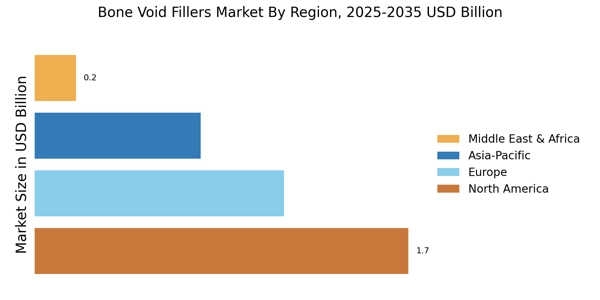
The Bone Void Fillers Market is poised for significant growth within various regions. In 2023, North America led with a valuation of 1.169 USD Billion, highlighting its dominance due to advanced healthcare infrastructure and increasing orthopedic procedures. Europe closely follows with a market valuation of 0.935 USD Billion, benefiting from robust research initiatives and a growing geriatric population. The Asia Pacific region, valued at 0.624 USD Billion in 2023, is emerging as a key player due to rising healthcare expenditure and an expanding patient base, making it a noteworthy segment to watch.
Middle East and Africa account for a moderate share with a valuation of 0.312 USD Billion, reflecting potential growth fueled by improved healthcare services. South America, at 0.39 USD Billion, exhibits steady growth driven by increasing awareness and demand for bone repair treatments. The fluctuation in market dynamics across these regions showcases varied growth drivers and challenges, with North America holding a majority share while the Asia Pacific presents substantial opportunities for future expansion, supported by escalating investments and technological advancements in the Bone Void Fillers Market industry.
The Bone Void Fillers Market is witnessing robust growth, driven by advancements in technology and increasing demand for orthopedic surgeries, particularly as the aging population enhances the need for effective surgical interventions. This market is characterized by a myriad of players offering diverse products that cater to different surgical needs and patient profiles. The competitive landscape is dynamic, with companies striving to innovate their product offerings and enhance their market share.Factors such as rising incidences of bone-related diseases, increased awareness regarding bone health, and the fashionable trend towards minimally invasive surgical procedures are key elements influencing competition in this market.
Market participants are also engaging in mergers, collaborations, and strategic alliances to strengthen their positions and improve product distribution networks, which intensifies the rivalry further.Etex Corporation stands out within the Bone Void Fillers Market with its commitment to research and development, leading to the creation of superior-quality bone void fillers designed to enhance patient outcomes. The company’s strengths lie in its extensive product portfolio that integrates advanced biomaterials, contributing to better healing processes and patient satisfaction. Etex Corporation benefits from a well-established presence, allowing it to leverage economies of scale in production and distribution. Their focus on sustainability and commitment to regulatory compliance provide an additional competitive edge, fostering trust and reliability among healthcare providers.
Through continuous innovation and quality enhancement, Etex Corporation has positioned itself prominently in the market, aligning with evolving surgical trends and effectively meeting clinicians' needs for superior grafting solutions.Stryker has firmly established its footprint in the Bone Void Fillers Market, leveraging its strong R&D capabilities and comprehensive product range. Known for its high-quality orthopedic products, Stryker continues to innovate with technologies that significantly improve surgical outcomes, thereby enhancing its competitive position.
The company benefits from a well-integrated supply chain, which facilitates timely product availability and responsive service to healthcare providers. Stryker's strength lies in its robust market presence, supported by significant investment in marketing and healthcare professional education, which enables it to effectively communicate the advantages of its bone void fillers products. This high level of engagement with the orthopedic community positions Stryker advantageously against competitors while fostering long-term relationships with key stakeholders. Their dedication to advancing medical technology and addressing unmet clinical needs further enhances their reputation and solidifies their standing in this competitive market landscape.
In September 2026, BONESUPPORT submitted its complete additional data package to the U.S. FDA for its CERAMENT V De Novo application, seeking regulatory clearance for its vancomycin-eluting bone void filler in the United States. (Source: bonesupport.com)
In September 2026, BONESUPPORT extended its U.S. commercial distribution agreement for CERAMENT BONE VOID FILLER, expanding hospital access and surgeon training for its injectable synthetic bioceramic bone graft substitute. (Source: bonesupport.com)
In May 2026, DePuy Synthes entered an exclusive distribution agreement with CGBIO across the U.S., Canada, and Australia for NOVOSIS, an advanced bone graft substitute containing recombinant human bone morphogenetic protein-2 (rhBMP-2) for orthopaedic bone void filling. (Source: jnj.com)
Se prevé que el mercado de rellenos óseos crezca de at a 5.18% CAGR de 2025 a 2035, impulsado por los avances tecnológicos, el aumento de los procedimientos ortopédicos y el aumento de las poblaciones geriátricas.
Nuevas oportunidades se encuentran en:
Para 2035, se espera que el mercado de rellenos de huecos óseos logre un crecimiento e innovación sustanciales.
| TAMAÑO DEL MERCADO 2024 | 3.794 (USD Billion) |
| TAMAÑO DEL MERCADO 2025 | 3.99 (USD Billion) |
| TAMAÑO DEL MERCADO 2035 | 6.613 (USD Billion) |
| TASA DE CRECIMIENTO ANUAL COMPUESTO (CAGR) | 5.18% (2025 - 2035) |
| COBERTURA DEL INFORME | Previsión de ingresos, panorama competitivo, factores de crecimiento y tendencias |
| AÑO BASE | 2024 |
| Período de previsión del mercado | 2025 - 2035 |
| Datos históricos | 2019 - 2024 |
| Unidades de previsión de mercado | USD Mil millones |
| Empresas clave perfiladas | DePuy Synthes (US), Stryker (US), Zimmer Biomet (US), Medtronic (US), Smith & Nephew (GB), MediTech (US), BoneSupport (SE), Osseon (US), Amedica (US) |
| Segmentos cubiertos | Tipo de material, aplicación, formulación, usuario final, regional |
| Oportunidades clave de mercado | Los avances in materiales biocompatibles mejoran la eficacia in del mercado de rellenos de huecos óseos. |
| Dinámica clave del mercado | La creciente demanda de biomateriales avanzados impulsa la innovación y la competencia in en el mercado de rellenos óseos. |
| Países cubiertos | Norteamérica, Europa, APAC, Sudamérica, MEA |
Se prevé que el mercado de rellenos óseos alcance una valoración de 6.613 USD Billion por 2035.
In 2024, la valoración de mercado de los rellenos óseos fue 3.794 USD Billion.
El CAGR esperado para el mercado de rellenos óseos durante el período de pronóstico 2025 - 2035 es 5.18%.
Se proyecta que el segmento de cerámica crecerá de 1.2 USD Billion in 2024 a 2.1 USD Billion por 2035.
Las aplicaciones clave incluyen cirugía ortopédica, que se espera que crezca de 1.5 USD Billion in 2024 a 2.5 USD Billion en 2035.
Se prevé que domine el tipo de formulación Putty, creciendo de 1.2 USD Billion in 2024 a 2.0 USD Billion por 2035.
Los segmentos de usuarios finales principales incluyen hospitales, que se prevé crecerán de 1.5 USD Billion in 2024 a 2.5 USD Billion en 2035.
Las empresas líderes in en el mercado de rellenos óseos incluyen DePuy Synthes, Stryker y Zimmer Biomet.
Se espera que el segmento de vidrio bioactivo crezca de 0.694 USD Billion in 2024 a 1.213 USD Billion en 2035.
Se proyecta que el segmento de centros de cirugía ambulatoria crecerá de 0.8 USD Billion in 2024 a 1.4 USD Billion por 2035, lo que indica un crecimiento diverso en los segmentos de usuarios finales.
Complete el formulario a continuación para recibir una muestra gratuita de este informe
“This is really good guys. Excellent work on a tight deadline. I will continue to use you going forward and recommend you to others. Nice job”
“Thanks for sending the report it gives us a good global view of the Betaïne market.”
“We found the report very insightful! we found your research firm very helpful. I'm sending this email to secure our future business.”
“I am very pleased with how market segments have been defined in a relevant way for my purposes (such as "Portable Freezers & refrigerators" and "last-mile"). In general the report is well structured. Thanks very much for your efforts.”
“We got the report in time, we really thank you for your support in this process. I also thank to all of your team as they did a great job.”
“The Automotive 48V ECU Components Procurement Intelligence Study” was a complex project, but the Market Research Future (MRFR) team handled it with quality, agility, and customer-centricity. They delivered all requested data on time and within the agreed scope. The team, including Shubhendra Anand and Rahul Gotadki, was always readily available to clarify questions and swiftly implement necessary adjustments, driving the project to a successful conclusion within a very demanding timeframe.
I would also like to specifically commend Akshay Agarwal for his responsiveness and support at every stage—from our initial inquiry on May 6th through to final delivery on June 18th. His dedication made the entire process seamless.”
“Thanks. It’s been a pleasure working with you, please use me as reference with any other Intel employees.”
“Thank you, this will be very helpful for OQS.”
“I have been reading the first document or the study, ,the Global HVAC and FP market report 2021 till 2026. Must say, good info! I have not gone in depth at all parts, but got a good indication of the data inside!”