Mercado de Hidróxido de Berilio Resumen del mercado
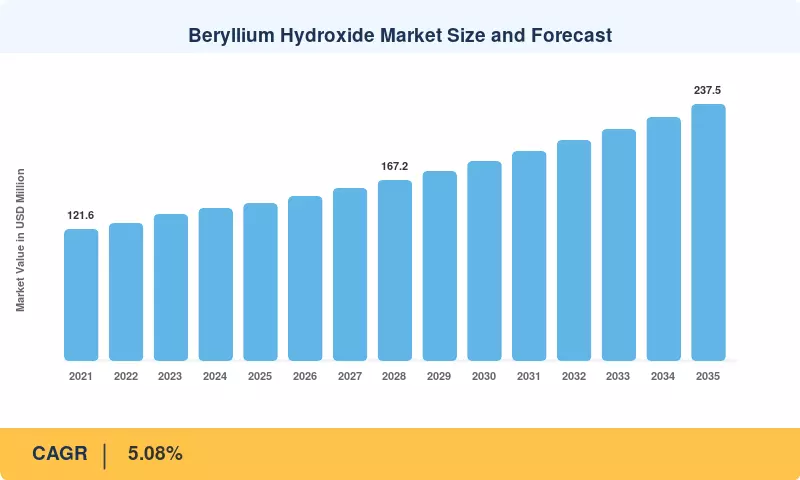
The beryllium hydroxide market was valued at USD 146.1 million in 2025 and is projected to reach USD 152.1 million in 2026, rising to USD 237.5 million by 2035 at a CAGR of 5.08% over 2026–2035. Two catalysts anchor that trajectory. Washington requested USD 849.8 billion for the Department of Defense in fiscal 2025, sustaining procurement of guidance systems, satellites and fighter aircraft that rely on beryllium-bearing alloys and metal [9]. Brussels, in parallel, kept beryllium on the EU critical raw materials list under the Critical Raw Materials Act, which sets 2030 benchmarks for domestic processing capacity [5].
Rather than in the final product, innovation is taking place within the plant itself in this industry. Closed, automated hydroxide precipitation lines using recycled-scrap feed are replacing traditional batch sulfate extraction methods, which require manual handling and use a lot of reagents. The act of regulation is what sets off the chain reaction: OSHA halved the allowable exposure limit for beryllium to 0.2 µg/m³ [3], and the European Union established a legally binding restriction at the same level, which will be fully enforced in July 2026 [4].
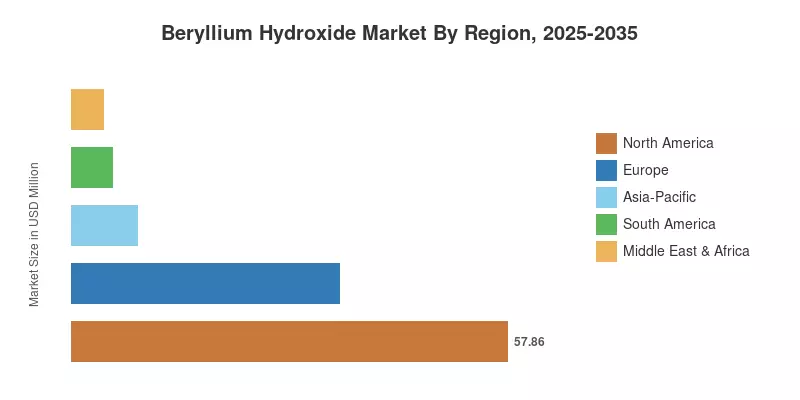
The sole major integrated bertrandite ore processing chain outside of Asia is located in North America, which accounts for 39.6% of the global beryllium hydroxide market [1]. Electronics and nuclear expansion in India and China are driving the Asia-Pacific region's 6.0% CAGR. Third place goes to Europe with a 24.3% share, driven mostly by demand for aerospace alloys. Who gets a cut over the next decade depends on secure processing capacity, not on the quantity of ore.
Key Report Takeaways
• By Grade
- Technical Grade held a 67.7% share of the beryllium hydroxide market in 2025, as it remains the standard feed for copper-beryllium master alloy production.
- High Purity Grade is forecast to expand at a 5.7% CAGR, the fastest among grades, on optics, guidance and reactor-reflector programs.
• By End-user Industry
- Aerospace and Defense accounted for 45.7% of the beryllium hydroxide market in 2025, the largest end-user position.
- Electrical and Electronics leads end-user growth with a 6.1% CAGR through 2035, driven by thermal-management substrates and spring contacts.
- Nuclear Energy contributed USD 17.5 million in 2025, tied to research-reactor reflectors and advanced reactor development.
• By Region
- North America leads with a 39.6% share, supported by integrated mine-to-metal capacity in Utah and Ohio.
- Asia-Pacific is the fastest-growing region at a 6.0% CAGR, led by China and India.
- Europe holds a 24.3% share, reliant on imported feedstock and aerospace alloy demand.
Market Size and Forecast (2021–2035)
Starting with producer shipment volumes, contained-beryllium unit values published by the U.S. Geological Survey [1][2], and company disclosures [11][17], Market Research Future built the beryllium hydroxide market series. Top-down validation was performed against downstream alloy, ceramic, and metal consumption. The numbers from the past are based on actual trade and pricing data. In contrast, the ones for the future are based on end-user demand models with scenario weighting applied to defense budgets, electronics production, and reactor development.




 Noah Malgeri
Co-Founder

 Peter Groot koerkamp
Account and Business Manager

 Younghwan Choi
Senior Retail Manager

 Mark Irwin
Management Consultant

 Akif Moroglu
Strategy & Business Development Director

 Guilherme Gomes Martins
Product Management Director

 Joseph Aguayo
Sales Operations & Pricing Manager

 La Terria Dodd
Program Support Specialist

 Rob Kooiker
Group Product Manager HVAC & Fire Protection GMA