Sensor de imagen de tiempo de vuelo 3D Resumen
Tendencias clave del mercado y aspectos destacados
Tamaño del mercado y previsión
| CAGR (2025 - 2035) | 30.17% |
| CAGR (2025 - 2035) | 30.17% |
The 3D Time of Flight Image Sensor Market is currently experiencing a notable evolution, driven by advancements in technology and increasing applications across various sectors. This market appears to be gaining traction due to the rising demand for enhanced imaging capabilities in consumer electronics, automotive, and industrial applications. The integration of these sensors into smartphones and tablets is particularly noteworthy, as manufacturers seek to improve user experience through features such as facial recognition and augmented reality. Furthermore, the automotive sector is likely to benefit from the adoption of these sensors for applications like driver assistance systems and autonomous vehicles, indicating a shift towards more sophisticated safety features. In addition to consumer electronics and automotive, the potential for growth in the healthcare sector is becoming increasingly apparent. 3D Time of Flight Image Sensors may play a crucial role in medical imaging and diagnostics, offering improved accuracy and efficiency. As industries continue to explore innovative uses for these sensors, the market is expected to expand further. The ongoing research and development efforts suggest that the future of the 3D Time of Flight Image Sensor Market holds promise, with new applications and technologies likely to emerge, thereby enhancing its overall value and relevance in the global landscape.
The incorporation of 3D Time of Flight Image Sensors in consumer electronics is on the rise, particularly in smartphones and tablets. This trend indicates a growing emphasis on enhancing user interaction through features like facial recognition and augmented reality, which could redefine user experiences.
The automotive industry is increasingly adopting 3D Time of Flight Image Sensors for advanced driver assistance systems. This trend suggests a shift towards improved safety measures, as these sensors facilitate features such as collision avoidance and pedestrian detection.
The potential applications of 3D Time of Flight Image Sensors in healthcare are becoming more evident. These sensors may enhance medical imaging and diagnostics, indicating a promising avenue for growth as the industry seeks to improve accuracy and efficiency in patient care.
The healthcare sector is increasingly adopting 3D Time of Flight Image Sensor Market technologies for various applications, including medical imaging and patient monitoring. These sensors facilitate non-invasive procedures, allowing for accurate depth measurements and improved diagnostics. The market for medical imaging is projected to expand significantly, with a notable increase in the use of 3D imaging techniques in surgical planning and rehabilitation. Furthermore, the ability to capture real-time data enhances patient care and monitoring, which is crucial in today's healthcare environment. As healthcare providers seek to improve outcomes and reduce costs, the integration of 3D sensors is likely to play a vital role in the evolution of medical technologies, thereby driving market growth.
Mobile Devices represent a dominant force in the 3D Time of Flight Image Sensor Market, primarily due to their extensive use in smartphones, which enhance functionalities like facial recognition and augmented reality applications. As manufacturers strive to differentiate their products, the integration of advanced imaging technologies becomes paramount. On the other hand, the Automotive segment is rapidly emerging, driven by innovation in vehicle technology and increased focus on safety features. As auto manufacturers invest in sensors for navigation and augmented reality displays, the demand for 3D Time of Flight sensors is poised for substantial growth, reflecting the changing dynamic and technology integration in modern vehicles.
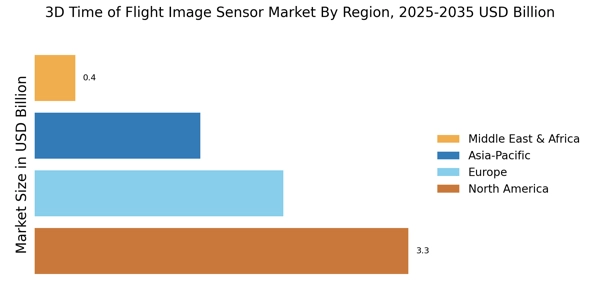
The 3D Time of Flight Image Sensor Market is segmented into North America, Europe, APAC, South America and MEA. North America is the largest regional market for 3D Time of Flight Image Sensors, with a revenue of $1.668 billion in 2023. The region is expected to grow at a CAGR of 32.1% from 2023 to 2032, reaching $17.818 billion by 2032. The growth in the region is attributed to the increasing adoption of 3D Time of Flight Image Sensors in various applications, such as facial recognition, gesture control, and augmented reality.
Europe is the second largest regional market for 3D Time of Flight Image Sensors, with a revenue of $1.251 billion in 2023.The region is expected to grow at a CAGR of 31.2% from 2023 to 2032, reaching $13.327 billion by 2032. The growth in the region is attributed to the increasing demand for 3D Time of Flight Image Sensors in the automotive and industrial sectors. APAC is the third largest regional market for 3D Time of Flight Image Sensors, with a revenue of $0.973 billion in 2023.
The region is expected to grow at a CAGR of 33.4% from 2023 to 2032, reaching $10.285 billion by 2032. The growth in the region is attributed to the increasing adoption of 3D Time of Flight Image Sensors in the consumer electronics and healthcare sectors.South America is the fourth largest regional market for 3D Time of Flight Image Sensors, with a revenue of $0.278 billion in 2023. The region is expected to grow at a CAGR of 34.3% from 2023 to 2032, reaching $3.042 billion by 2032.
The growth in the region is attributed to the increasing demand for 3D Time of Flight Image Sensors in the automotive and industrial sectors. MEA is the fifth largest regional market for 3D Time of Flight Image Sensors, with a revenue of $0.139 billion in 2023. The region is expected to grow at a CAGR of 35.1% from 2023 to 2032, reaching $1.738 billion by 2032. The growth in the region is attributed to the increasing adoption of 3D Time of Flight Image Sensors in the consumer electronics and healthcare sectors.
Figure 3 3D Time Of Flight Image Sensor Market By Regional Insights(2023-2032)






Q3 2026: Sony (JP) released the IMX479, a stacked SPAD depth sensor for automotive LiDAR using direct Time-of-Flight (dToF), achieving 520 dToF pixels with up to 20 fps frame rate, 5 cm distance resolution, and 37% photon detection efficiency for detecting objects up to 300 meters away
Q3 2026: STMicroelectronics (FR) launched the VL53L9 direct-ToF 3D LiDAR module with 2,268 sensing zones (54×42 array), 54×42° field of view, and ranging from below 5 cm to 9 meters, integrating emitter, receiver, processing, and power management in a 12.8×6.1×4.6 mm package for robotics and smart building applications
Q3 2026: Infineon (DE) signed a Memorandum of Understanding with Goertek Microelectronics to develop 3D Time-of-Flight camera products for industrial automation, targeting robotic depalletizing, pallet recognition, and perception for unmanned forklifts and AMRs
The global 3D Time-of-Flight (Tof) image sensor market is projected to reach USD 46.2 billion by 2032, exhibiting a CAGR of 30.17% from 2024 to 2032. Demand for 3D Tof image sensors is escalating due to their ability to provide real-time depth mapping and 3D imaging capabilities, facilitating advancements in applications such as facial recognition, augmented reality (AR), and autonomous vehicles. Key players in the market include Infineon Technologies, Sony Semiconductor Solutions, and STMicroelectronics.
Recent developments include the launch of the IRS2877C Tof sensor by Infineon, offering improved accuracy and longer range for industrial automation applications. Additionally, Qualcomm's acquisition of Arriver in 2023 strengthens its position in the automotive Tof sensor market. These developments indicate the growing adoption and innovation within the 3D Tof image sensor market, driven by increasing demand for depth sensing capabilities in various industries.
Se proyecta que el mercado de sensores de imagen 3D de tiempo de vuelo crecerá a una Tasa de Crecimiento Anual Compuesto (CAGR) del 30.17% desde 2024 hasta 2035, impulsado por los avances en electrónica de consumo, aplicaciones automotrices y automatización industrial.
Nuevas oportunidades se encuentran en:
Para 2035, se espera que el mercado logre un crecimiento sustancial, consolidando su papel en diversas industrias.
| MARKET SIZE 2024 | 7.301(USD Billion) |
| MARKET SIZE 2025 | 9.504(USD Billion) |
| MARKET SIZE 2035 | 132.76(USD Billion) |
| COMPOUND ANNUAL GROWTH RATE (CAGR) | 30.17% (2025 - 2035) |
| REPORT COVERAGE | Revenue Forecast, Competitive Landscape, Growth Factors, and Trends |
| BASE YEAR | 2024 |
| Market Forecast Period | 2025 - 2035 |
| Historical Data | 2019 - 2024 |
| Market Forecast Units | USD Billion |
| Key Companies Profiled | Sony (JP), STMicroelectronics (FR), Texas Instruments (US), Infineon Technologies (DE), ON Semiconductor (US), Microchip Technology (US), Melexis (BE), Cypress Semiconductor (US), Lumentum Operations (US) |
| Segments Covered | Application, Component, Technology, Wavelength, Regional |
| Key Market Opportunities | Integration of 3D Time of Flight Image Sensors in augmented reality applications enhances user experience and engagement. |
| Key Market Dynamics | Rising demand for advanced imaging solutions drives innovation and competition in the 3D Time of Flight Image Sensor market. |
| Countries Covered | North America, Europe, APAC, South America, MEA |
 Nirmit Biswas

 Aarti Dhapte
Complete el formulario a continuación para recibir una muestra gratuita de este informe

“This is really good guys. Excellent work on a tight deadline. I will continue to use you going forward and recommend you to others. Nice job”
 Noah Malgeri
Co-Founder

“Thanks for sending the report it gives us a good global view of the Betaïne market.”
 Peter Groot koerkamp
Account and Business Manager

“We found the report very insightful! we found your research firm very helpful. I'm sending this email to secure our future business.”
 Younghwan Choi
Senior Retail Manager

“I am very pleased with how market segments have been defined in a relevant way for my purposes (such as "Portable Freezers & refrigerators" and "last-mile"). In general the report is well structured. Thanks very much for your efforts.”
 Mark Irwin
Management Consultant

“We got the report in time, we really thank you for your support in this process. I also thank to all of your team as they did a great job.”
 Akif Moroglu
Strategy & Business Development Director

“The Automotive 48V ECU Components Procurement Intelligence Study” was a complex project, but the Market Research Future (MRFR) team handled it with quality, agility, and customer-centricity. They delivered all requested data on time and within the agreed scope. The team, including Shubhendra Anand and Rahul Gotadki, was always readily available to clarify questions and swiftly implement necessary adjustments, driving the project to a successful conclusion within a very demanding timeframe.
I would also like to specifically commend Akshay Agarwal for his responsiveness and support at every stage—from our initial inquiry on May 6th through to final delivery on June 18th. His dedication made the entire process seamless.”
 Guilherme Gomes Martins
Product Management Director

“Thanks. It’s been a pleasure working with you, please use me as reference with any other Intel employees.”
 Joseph Aguayo
Sales Operations & Pricing Manager

“Thank you, this will be very helpful for OQS.”
 La Terria Dodd
Program Support Specialist

“I have been reading the first document or the study, ,the Global HVAC and FP market report 2021 till 2026. Must say, good info! I have not gone in depth at all parts, but got a good indication of the data inside!”
 Rob Kooiker
Group Product Manager HVAC & Fire Protection GMA