Terrestrisches trunkiertes Radio-Markt Marktzusammenfassung
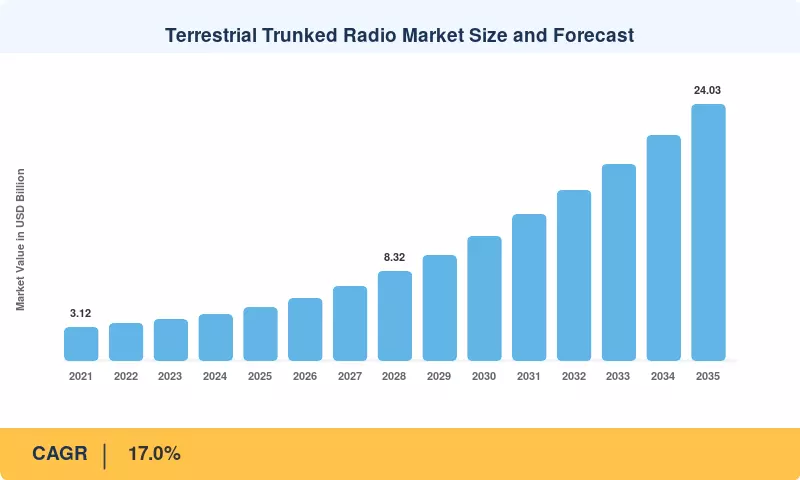
The Terrestrial Trunked Radio Market was valued at USD 4.93 billion in 2025 and is forecast to rise from USD 5.85 billion in 2026 to USD 24.03 billion by 2035, a CAGR of 17.0% over 2026–2035. Two catalysts carry most of that momentum. Governments are mandating the move from analog conventional radio to encrypted digital trunking, and smart-city and metro-rail budgets now treat secure narrowband voice as baseline infrastructure. Europe's 112-city Climate-Neutral and Smart Cities Mission and India's 100-city Smart Cities Mission both fund command-and-control centres that depend on resilient radio dispatch.
Analog VHF/UHF fleets and first-generation TETRA Release 1 installations are giving way to software-defined base stations, IP-based switching and hybrid handhelds that pair TETRA voice with LTE data. The UK's Emergency Services Network shows both the ambition and the friction: the National Audit Office puts the programme's cost at GBP 11.2 billion and pushes full transition beyond 2029 [3], which keeps the Airwave TETRA estate in service and funds interim upgrades. Spectrum refarming after 2G/3G switch-offs, tracked across more than 100 networks by GSMA [7], frees sub-1 GHz channels for private mission-critical communication systems.
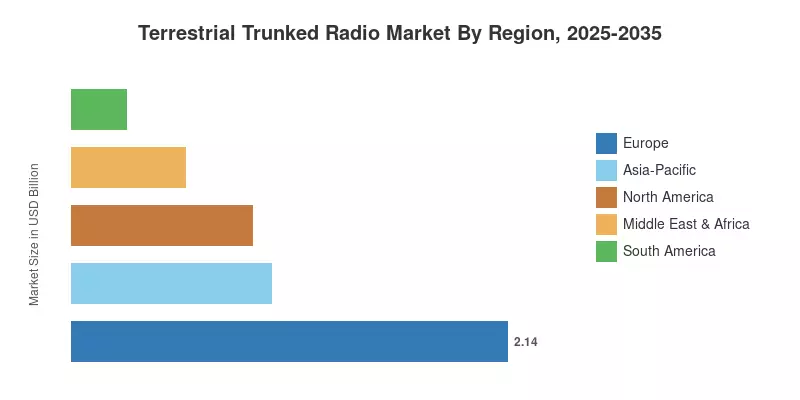
Europe holds a 43.5% revenue share, anchored by nationwide emergency networks in Germany, the UK and the Nordic Countries. Asia-Pacific is the fastest-growing region at a 19.8% CAGR and already ranks second by revenue, driven by metro rail, port and urban security projects in China, India and ASEAN. The Middle East & Africa follows as a high-value pocket where Gulf megaprojects specify TETRA for site-wide safety. Over the next decade, revenue will shift steadily from radio hardware toward hybrid integration, encryption upgrades and managed services.
Key Report Takeaways
• By Mode of Operation
- Trunked Mode Operation held a 66.8% share of the Terrestrial Trunked Radio Market in 2025, reflecting the efficiency of centrally managed talk groups for multi-agency dispatch.
- Direct Mode Operation is expected to expand at a 15.6% CAGR, sustained by disaster-recovery and military demand for network-independent calling.
• By Component
- Infrastructure captured 57.1% of 2025 revenue as base stations, switches and gateways continue to anchor capital budgets.
- Software and Services is projected to grow at an 18.6% CAGR, the fastest pace within the component dimension of the Terrestrial Trunked Radio Market.
• By Access Technology
- TETRA Release 1 retained a 65.5% share, supported by a vast installed base of interoperable terminals.
- Hybrid TETRA-LTE Systems are set to post an 18.8% CAGR as agencies add broadband data without abandoning narrowband voice.
• By Frequency Band
- The 380–410 MHz band accounted for a 48.9% share, reflecting its harmonized status for public protection.
- The 410–430 MHz band is forecast to grow at a 17.7% CAGR on the back of utility and transport licensing.
• By End User
- Public Safety and Emergency Services represented a 35.0% share of 2025 revenue.
- Industrial and Commercial users are expected to lead growth at a 17.5% CAGR.
• By Region
- Europe accounted for a 43.5% share of the Terrestrial Trunked Radio Market in 2025.
- Asia-Pacific is the fastest-growing region at a 19.8% CAGR.
- Middle East & Africa generated USD 0.56 billion in 2025, led by Gulf security and infrastructure programmes.
Market Size and Forecast (2021–2035)
Estimates for the Terrestrial Trunked Radio Market combine bottom-up tallies of base-station, terminal and software shipments with top-down validation against vendor disclosures, national network tenders and spectrum assignment records [1][12][14][15]. Historical values for 2021–2024 reflect reported contract awards and installed-base replacement rates, while the forecast incorporates announced migration timelines, hybrid deployment plans and regional infrastructure budgets.




 Noah Malgeri
Co-Founder

 Peter Groot koerkamp
Account and Business Manager

 Younghwan Choi
Senior Retail Manager

 Mark Irwin
Management Consultant

 Akif Moroglu
Strategy & Business Development Director

 Guilherme Gomes Martins
Product Management Director

 Joseph Aguayo
Sales Operations & Pricing Manager

 La Terria Dodd
Program Support Specialist

 Rob Kooiker
Group Product Manager HVAC & Fire Protection GMA



