Markt für Kappenverschlüsse Zusammenfassung
Wichtige Markttrends & Highlights
Marktgröße & Prognose
| CAGR (2025 - 2035) | 4.90% |
| CAGR (2025 - 2035) | 4.90% |
The Caps and Closures Market is currently experiencing a dynamic evolution, driven by various factors including consumer preferences, technological advancements, and sustainability initiatives. As the demand for convenience and product safety continues to rise, manufacturers are increasingly focusing on innovative designs and materials. This shift is evident in the growing popularity of tamper-evident and child-resistant closures, which enhance product integrity and consumer trust. Additionally, the market is witnessing a notable trend towards lightweight and recyclable materials, aligning with global sustainability goals. Companies are investing in research and development to create eco-friendly options that meet regulatory standards while appealing to environmentally conscious consumers. Moreover, the Caps and Closures Market is influenced by the expansion of the food and beverage sector, which requires efficient packaging solutions. The rise of e-commerce has further accelerated the need for secure and reliable closures that can withstand the rigors of shipping and handling. As brands strive to differentiate themselves in a competitive landscape, customization and branding opportunities through closures are becoming increasingly important. Overall, the market appears poised for continued growth, with innovation and sustainability at the forefront of strategic initiatives.
The Caps and Closures Market is increasingly prioritizing sustainability, with manufacturers exploring biodegradable and recyclable materials. This trend reflects a broader commitment to environmental responsibility, as companies seek to reduce their carbon footprint and meet consumer demand for eco-friendly products.
Innovations in manufacturing processes are reshaping the Caps and Closures Market. Automation and smart technologies are enhancing production efficiency and quality control, allowing for more precise and consistent closure designs that cater to diverse consumer needs.
As competition intensifies, brands are leveraging closures as a means of differentiation. Customization options, including unique shapes and colors, are becoming essential for attracting consumer attention and reinforcing brand identity in the Caps and Closures Market.
Das schnelle Wachstum des E-Commerce hat erhebliche Auswirkungen auf den Markt für Kappen und Verschlüsse. Da der Online-Einkauf immer weiter zunimmt, steigt die Nachfrage nach sicheren und zuverlässigen Verpackungslösungen. In 2025, it Es wird erwartet, dass der E-Commerce-Sektor innovative Kappen und Verschlüsse benötigt, die die Produktintegrität während des Transports gewährleisten. Dazu gehören Funktionen wie manipulationssichere Siegel und leicht zu öffnende Designs, die das Verbrauchererlebnis verbessern. Darüber hinaus erfordern die zunehmenden Direktvertriebskanäle in Verpackungen, die nicht nur Produkte schützen, sondern auch die Markenwerte widerspiegeln. Folglich dürften Hersteller, die ihre Angebote an die spezifischen Bedürfnisse des E-Commerce-Marktes anpassen, auf dem Markt für Kappen und Verschlüsse florieren und vom wachsenden Trend des Online-Handels profitieren.
Der Markt für Kappen und Verschlüsse wird zunehmend von Nachhaltigkeitsinitiativen beeinflusst. Verbraucher werden immer umweltbewusster, was Hersteller dazu veranlasst, umweltfreundliche Materialien und Produktionsprozesse einzusetzen. Dieser Wandel wird deutlich, wenn Unternehmen nach biologisch abbaubaren und recycelbaren Optionen für Kappen und Verschlüsse suchen. In 2025 wird die Nachfrage nach nachhaltigen Verpackungslösungen voraussichtlich steigen, wobei sich ein erheblicher Teil des Marktes auf die Reduzierung von Plastikmüll konzentriert. Dadurch werden Marken, die bei ihren Kappen und Verschlüssen Wert auf Nachhaltigkeit legen, wahrscheinlich einen Wettbewerbsvorteil erlangen und eine wachsende Bevölkerungsgruppe ansprechen, die Wert auf Umweltverantwortung legt. Darüber hinaus treibt auch der regulatorische Druck diesen Trend voran, da Regierungen strengere Richtlinien für Verpackungsabfälle einführen und so die Hersteller dazu zwingen, ihre Angebote auf dem Markt für Kappen und Verschlüsse zu erneuern und anzupassen.
Technologische Innovationen spielen eine entscheidende Rolle in bei der Gestaltung des Marktes für Kappen und Verschlüsse. Fortschritte in Fertigungstechnologien wie Spritzguss und Automatisierung haben die Produktionseffizienz verbessert und die Kosten gesenkt. In 2025 wird erwartet, dass der Markt einen Aufschwung erlebt in durch die Einführung intelligenter Verschlüsse, die Funktionen wie Originalitätssicherung und Kindersicherung umfassen. Diese Innovationen verbessern nicht nur die Produktsicherheit, sondern auch das Benutzererlebnis. Darüber hinaus ermöglicht die Integration digitaler Technologien in in die Design- und Produktionsprozesse eine stärkere Anpassung und schnelles Prototyping, sodass Marken schnell auf Marktanforderungen reagieren können. Infolgedessen werden Unternehmen, die diese technologischen Fortschritte nutzen, wahrscheinlich ihre Position auf dem Markt für Kappen und Verschlüsse stärken und auf die sich verändernden Bedürfnisse der Verbraucher eingehen.
Die Einhaltung gesetzlicher Vorschriften ist ein entscheidender Faktor für den Markt für Kappen und Verschlüsse. Da Regierungen weltweit strengere Vorschriften zu Verpackungsmaterialien und Sicherheitsstandards einführen, müssen sich Hersteller anpassen, um wettbewerbsfähig zu bleiben. In 2025, die Einhaltung dieser Vorschriften wird voraussichtlich erhebliche Auswirkungen auf die Materialauswahl und die Designprozesse haben. Dazu gehört die Einhaltung von Richtlinien zur Lebensmittelsicherheit, Recyclingfähigkeit und zum chemischen Inhalt der in-Verpackung. Unternehmen, die proaktiv in-Compliance-Maßnahmen ergreifen, werden wahrscheinlich ihren Ruf verbessern und das Vertrauen der Verbraucher stärken. Darüber hinaus drängt die Betonung der Nachhaltigkeit in regulatorischen Rahmenbedingungen die Hersteller zu Innovationen und der Entwicklung umweltfreundlicher Kappen und Verschlüsse. Daher wird die Fähigkeit, sich effektiv in der Regulierungslandschaft zurechtzufinden, ein entscheidender Faktor für den Erfolg des Marktes für Kappen und Verschlüsse sein.
Anpassungs- und Branding-Möglichkeiten werden für den Markt für Kappen und Verschlüsse immer wichtiger. Da sich der Wettbewerb verschärft, suchen Marken nach einzigartigen Verpackungslösungen, die ihre Produkte in den Regalen hervorheben. In 2025, der Markt wird voraussichtlich wachsen. in personalisierte Kappen und Verschlüsse, die es Unternehmen ermöglichen, eine eindeutige Identität zu schaffen. Besonders ausgeprägt ist dieser Trend in Sektoren wie Getränken und Kosmetika, in denen die Verpackung eine entscheidende Rolle spielt in Verbraucherwahrnehmung. Darüber hinaus erhöht die Möglichkeit, Markenlogos und -farben in Verschlüsse zu integrieren, die Markenbekanntheit und -treue. Da sich die Verbraucher zu Produkten hingezogen fühlen, die ihren persönlichen Vorlieben entsprechen, dürfte die Nachfrage nach maßgeschneiderten Kappen und Verschlüssen steigen, was den Herstellern des Marktes für Kappen und Verschlüsse lukrative Möglichkeiten bietet.
In the caps and closures market, the material type segment is predominantly led by plastic, which has carved out the largest market share due to its lightweight, cost-effective, and versatile nature. Plastics are widely utilized across various industries, from beverages to personal care, contributing to their significant prevalence. Conversely, metal closures, particularly aluminum and tinplate, are seeing a surge in popularity, capturing attention with their robustness and recycled properties, indicating a shift towards sustainability in consumer preferences.
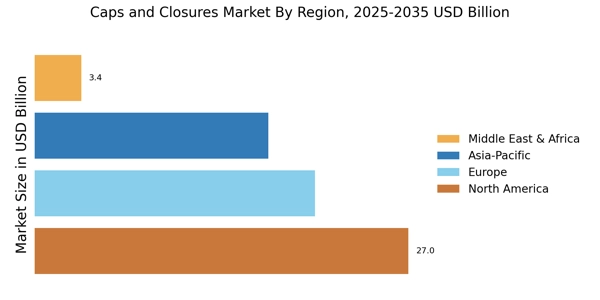
North America is the largest market for caps and closures, holding approximately 40% of the global market share. The region's growth is driven by increasing demand for sustainable packaging solutions and stringent regulations promoting eco-friendly materials. The U.S. leads in innovation, with a focus on advanced manufacturing technologies and consumer preferences shifting towards convenience and recyclability. Key players like Crown Holdings and Ball Corporation dominate the landscape, supported by a robust supply chain and significant investments in R&D. The U.S. and Canada are the primary contributors, with a competitive environment fostering collaboration among manufacturers. The presence of major companies ensures a steady supply of innovative products, catering to diverse industries such as food and beverage, pharmaceuticals, and personal care.
Europe is the second-largest market for caps and closures, accounting for around 30% of the global share. The region's growth is significantly influenced by stringent regulations aimed at reducing plastic waste and promoting recycling. The European Union's directives on single-use plastics are driving manufacturers to innovate and adopt sustainable practices, enhancing market dynamics. Leading countries include Germany, France, and the UK, where companies like Mondi Group and Alpla are at the forefront of sustainable packaging solutions. The competitive landscape is characterized by a mix of established players and emerging startups, all striving to meet the evolving consumer demands for eco-friendly products. The focus on circular economy principles is reshaping the market, encouraging collaboration across the supply chain.
Asia-Pacific is witnessing rapid growth in the caps and closures market, holding approximately 25% of the global share. The region's expansion is driven by increasing urbanization, rising disposable incomes, and a growing demand for packaged goods. Countries like China and India are leading this growth, supported by favorable government policies and investments in manufacturing capabilities. China is the largest market, with significant contributions from local manufacturers and multinational companies. The competitive landscape is evolving, with key players like Amcor and Berry Global expanding their presence. The region's diverse consumer base is pushing for innovative packaging solutions, creating opportunities for companies to introduce new products tailored to local preferences and sustainability goals.
The Middle East and Africa region is emerging as a significant player in the caps and closures market, holding about 5% of the global share. The growth is driven by increasing consumer demand for packaged products, particularly in the food and beverage sector. Additionally, government initiatives aimed at boosting local manufacturing are creating a favorable environment for market expansion. Countries like South Africa and the UAE are leading the charge, with a growing number of local manufacturers entering the market. The competitive landscape is characterized by a mix of established companies and new entrants, all vying for market share. The presence of key players such as Graham Packaging and AptarGroup is enhancing the region's capabilities, fostering innovation and meeting the rising demand for diverse packaging solutions.
The Caps and Closures Market is currently characterized by a dynamic competitive landscape, driven by innovation, sustainability, and strategic partnerships. Major players such as Crown Holdings (US), Ball Corporation (US), and Amcor (AU) are actively shaping the market through their distinct operational focuses. Crown Holdings (US) emphasizes innovation in packaging solutions, particularly in the beverage sector, while Ball Corporation (US) is leveraging its extensive experience in aluminum packaging to enhance sustainability initiatives. Amcor (AU) is also prioritizing sustainable practices, focusing on developing recyclable and biodegradable materials. Collectively, these strategies not only enhance their market positioning but also contribute to a more sustainable future for the industry.
In terms of business tactics, companies are increasingly localizing manufacturing to reduce lead times and optimize supply chains. This approach appears to be a response to the growing demand for efficiency and responsiveness in the market. The Caps and Closures Market is moderately fragmented, with key players exerting considerable influence. The collective actions of these companies suggest a trend towards consolidation, as they seek to enhance their competitive edge through strategic collaborations and acquisitions.
In August 2025, Crown Holdings (US) announced a partnership with a leading beverage manufacturer to develop a new line of eco-friendly caps. This collaboration is significant as it aligns with the growing consumer demand for sustainable packaging solutions, potentially positioning Crown as a leader in environmentally responsible practices within the sector. The partnership not only enhances Crown's product offerings but also strengthens its market presence in the beverage industry.
In September 2025, Ball Corporation (US) unveiled its latest initiative aimed at reducing carbon emissions across its production facilities. This strategic move underscores Ball's commitment to sustainability and reflects a broader industry trend towards environmental responsibility. By investing in cleaner technologies, Ball Corporation (US) is likely to enhance its operational efficiency while appealing to environmentally conscious consumers.
In July 2025, Amcor (AU) launched a new range of closures designed specifically for the food and beverage sector, focusing on enhancing product freshness and shelf life. This innovation is crucial as it addresses the increasing consumer preference for longer-lasting products. Amcor's proactive approach in developing advanced closure solutions may provide a competitive advantage, particularly in markets where product quality is paramount.
As of October 2025, the Caps and Closures Market is witnessing a shift towards digitalization, with companies increasingly integrating AI and data analytics into their operations. This trend is indicative of a broader movement towards efficiency and innovation. Strategic alliances are becoming more prevalent, as companies recognize the value of collaboration in navigating the complexities of the market. Looking ahead, competitive differentiation is likely to evolve, with a pronounced shift from price-based competition to a focus on innovation, technology, and supply chain reliability. This evolution suggests that companies that prioritize these aspects will be better positioned to thrive in the increasingly competitive landscape.
May 2026: Reliable Caps partnered with PureCycle Technologies to introduce closures made with up to 75% certified post-consumer recycled (PCR) polypropylene using PureCycle’s PureFive® resin. The closures are available through Reliable Caps’ distribution network across most of its product portfolio. The development addresses demand for recycled-content packaging in food, beverage, personal care and household applications while aiming to maintain product appearance, processing consistency and performance.
March 2026: Amcor announced a collaboration with Vöslauer Mineralwasser to supply a customized tethered closure for the Austrian mineral-water brand’s bottles. The cap remains attached to the bottle after opening, helping reduce litter and support collection and recycling. Its design allows the cap to open widely and stay away from the consumer’s face, combining ease of use with packaging sustainability objectives.
February 2026: Origin Materials partnered with Matrix Bottling Group to support the commercial adoption of recyclable PET bottle caps. Under the agreement, Matrix will provide bottling and capping services for beverages using Origin’s PET closures. Following a joint bottling trial in the fourth quarter of 2025, the companies planned customer qualification trials and product runs throughout 2026. The collaboration supports the shift toward mono-material PET packaging, designed to improve the recyclability of bottles and their caps together.
January 2026: Amcor introduced a lightweight, ergonomically designed tethered cap for Wattwiller, a French natural mineral-water brand owned by Spadel. Manufactured from HDPE and designed for recycling with PET bottles, the closure uses a smaller 26 mm bottle neck to reduce material use and weight compared with the previous design. Its flower-shaped surface combines smooth and ribbed sections to improve grip and make opening easier for consumers with limited dexterity.
June 2026: Blue Ocean Closures launched Paper-Plug™, a fiber-based opening and dispensing concept integrating a fiber screw closure directly into carton and corrugated-board packaging. The design aims to offer an alternative to conventional plastic fitments and complex opening assemblies for food, home-care and other packaged products. This development expands fiber-based packaging innovation into caps, closures and dispensing systems.
The Caps and Closures Market is projected to grow bei einer CAGR von 4.1% CAGR from 2024 to 2035, driven by innovations in sustainable materials and increasing demand in the beverage sector.
Neue Möglichkeiten liegen in:
Bis 2035 wird erwartet, dass der Markt für Kappen und Verschlüsse ein robustes Wachstum erzielen wird, das von Innovation und Nachhaltigkeit getragen wird.
| MARKET SIZE 2024 | 67.42(USD Billion) |
| MARKET SIZE 2025 | 70.19(USD Billion) |
| MARKET SIZE 2035 | 104.92(USD Billion) |
| COMPOUND ANNUAL GROWTH RATE (CAGR) | 4.1% (2024 - 2035) |
| REPORT COVERAGE | Revenue Forecast, Competitive Landscape, Growth Factors, and Trends |
| BASE YEAR | 2024 |
| Market Forecast Period | 2025 - 2035 |
| Historical Data | 2019 - 2024 |
| Market Forecast Units | USD Billion |
| Key Companies Profiled | Market analysis in progress |
| Segments Covered | Market segmentation analysis in progress |
| Key Market Opportunities | Adoption of sustainable materials in the Caps and Closures Market enhances eco-friendly packaging solutions. |
| Key Market Dynamics | Rising demand for sustainable packaging drives innovation in caps and closures, influencing competitive dynamics and consumer preferences. |
| Countries Covered | North America, Europe, APAC, South America, MEA |
Der Markt für Kappen und Verschlüsse wurde mit at 75.0 USD Billion in 2024 bewertet.
Der Markt wird voraussichtlich 110.0 USD Billion bis 2035 erreichen.
Der erwartete CAGR für den Markt für Kappen und Verschlüsse während 2025 - 2035 beträgt 3.54%.
Es wird erwartet, dass das Getränkesegment mit einer Bewertungsspanne von 30.0 bis 45.0 USD Billion dominieren wird.
Zu den Hauptmaterialien gehören Kunststoff, Metall, Glas, Holz und Papier, wobei der Wert von Kunststoff zwischen 30.0 und 45.0 USD Billion liegt.
Es wird erwartet, dass Schraubverschlüsse mit einer Bewertungsspanne von 20.0 bis 30.0 USD Billion den Markt anführen werden.
Zu den Hauptakteuren zählen Crown Holdings, Ball Corporation, Amcor, Silgan Holdings und Berry Global.
Für das Endverbrauchssegment Lebensmittel und Getränke wird eine Bewertung zwischen 30.0 und 45.0 USD Billion prognostiziert.
Das Pharmasegment wird zwischen 10.0 und 15.0 USD Billion bewertet, was im Vergleich zu anderen auf einen moderaten Anteil hinweist.
Zu den Trends gehört die steigende Nachfrage nach nachhaltigen Materialien und innovativen Verschlussdesigns, angetrieben durch Verbraucherpräferenzen.
The secondary research process involved comprehensive analysis of regulatory databases, industry standards, trade publications, and authoritative packaging organizations. Key sources included the US Food and Drug Administration (FDA) – Center for Food Safety and Applied Nutrition (CFSAN) for food contact substance regulations and 21 CFR Part 177 compliance data; European Food Safety Authority (EFSA) for plastic materials and articles intended to come into contact with food (EU Regulation 10/2011); US Environmental Protection Agency (EPA) for guidelines on recycled plastics and sustainable packaging materials; ASTM International standards (ASTM D3198, ASTM D3475 for child-resistant packaging); International Organization for Standardization (ISO) – ISO 8317 (child-resistant closures), ISO 9001 quality management systems; Plastics Industry Association (PLASTICS); Packaging Machinery Manufacturers Institute (PMMI); National Sanitation Foundation (NSF); US Census Bureau – Annual Survey of Manufactures (ASM) for NAICS Code 326160 (Plastics Bottle Manufacturing); Eurostat – Packaging Waste Statistics and Circular Economy indicators; United Nations Environment Programme (UNEP) for global plastic pollution treaties and Extended Producer Responsibility (EPR) frameworks; World Health Organization (WHO) – Good Manufacturing Practices (GMP) for pharmaceutical packaging; US Department of Agriculture (USDA) – bio-based packaging certifications; European Commission – Single Use Plastics Directive (SUPD); China National Center for Food Safety Risk Assessment (CFSA); Japan Ministry of Health, Labour and Welfare (MHLW) – Food Sanitation Law compliance data; and National Bureau of Statistics of China for manufacturing output metrics.
Production statistics, material safety studies, regulatory compliance data, recycling infrastructure analysis, and trade flow patterns for closure technologies involving polyethylene (PE), polypropylene (PP), high-density polyethylene (HDPE), low-density polyethylene (LDPE), polyethylene terephthalate (PET), aluminum, and steel were gathered from these sources.
To gather both qualitative and quantitative insights, supply-side and demand-side stakeholders were interviewed during the primary research process. CEOs, VPs of manufacturing, leaders of global innovation, officers in charge of regulatory compliance, and commercial directors from companies that make rigid packaging, injection molding, and raw material resin were among the supply-side sources. Demand-side sources included quality assurance leads from food processing companies (Mondelez, Danone), supply chain executives from personal care brands (Unilever, Procter & Gamble), pharmaceutical packaging managers (Pfizer, Johnson & Johnson), and procurement directors from multinational beverage corporations (Coca-Cola, PepsiCo, Nestlé).
Primary research confirmed sustainability transition timelines (shift to 30-50% rPET content), validated market segmentation across screw closures, dispensing caps, tethered caps, and crown closures, and collected information on automated capping line investments, lightweighting strategies, tamper-evident technology adoption, and raw material price volatility management.
Primary Respondent Breakdown:
By Designation: C-level Primaries (32%), Director Level (30%), Others (38%)
By Region: North America (33%), Europe (25%), Asia-Pacific (32%), Rest of World (10%)
Production volume analysis and revenue triangulation were used to get the global market valuation. The following were part of the methodology:
Finding more than fifty important manufacturers in the Middle East and Africa, Asia-Pacific, Latin America, Europe, and North America
Product mapping for rubber (butyl rubber, bromobutyl), metal (aluminum, steel), plastic (PP, HDPE, LDPE, PET, PS), and new bioplastic materials (PLA, bio-PE)
Technology segmentation encompassing post-mold tamper-evident band applications, compression molding, and injection molding
Examination of projected and reported yearly sales for caps and closures portfolios, omitting revenues from flexible packaging and container bodies
Coverage of producers who will account for 75–80% of the world market in 2024
To determine segment-specific valuations for food and beverage (carbonated drinks, bottled water, alcoholic beverages), pharmaceutical (OTC medications, prescription drugs, vaccines), personal care (cosmetics, toiletries), and household cleaning applications, extrapolation using top-down (manufacturer revenue validation) and bottom-up (production volume × Average Selling Price by material type and region) approaches is used.
Bitte füllen Sie das folgende Formular aus, um ein kostenloses Muster dieses Berichts zu erhalten
“This is really good guys. Excellent work on a tight deadline. I will continue to use you going forward and recommend you to others. Nice job”
“Thanks for sending the report it gives us a good global view of the Betaïne market.”
“We found the report very insightful! we found your research firm very helpful. I'm sending this email to secure our future business.”
“I am very pleased with how market segments have been defined in a relevant way for my purposes (such as "Portable Freezers & refrigerators" and "last-mile"). In general the report is well structured. Thanks very much for your efforts.”
“We got the report in time, we really thank you for your support in this process. I also thank to all of your team as they did a great job.”
“The Automotive 48V ECU Components Procurement Intelligence Study” was a complex project, but the Market Research Future (MRFR) team handled it with quality, agility, and customer-centricity. They delivered all requested data on time and within the agreed scope. The team, including Shubhendra Anand and Rahul Gotadki, was always readily available to clarify questions and swiftly implement necessary adjustments, driving the project to a successful conclusion within a very demanding timeframe.
I would also like to specifically commend Akshay Agarwal for his responsiveness and support at every stage—from our initial inquiry on May 6th through to final delivery on June 18th. His dedication made the entire process seamless.”
“Thanks. It’s been a pleasure working with you, please use me as reference with any other Intel employees.”
“Thank you, this will be very helpful for OQS.”
“I have been reading the first document or the study, ,the Global HVAC and FP market report 2021 till 2026. Must say, good info! I have not gone in depth at all parts, but got a good indication of the data inside!”