Bopp-Dielektrikum-Film-Markt Zusammenfassung
Wichtige Markttrends & Highlights
Marktgröße & Prognose
| CAGR (2025 - 2035) | 3.74% |
The Bopp Dielectric Film Market is currently experiencing a notable transformation, driven by advancements in technology and increasing demand across various sectors. This film, known for its excellent electrical insulation properties, is widely utilized in the production of capacitors, which are essential components in electronic devices. As industries continue to evolve, the need for efficient and reliable materials has become paramount. Consequently, manufacturers are focusing on enhancing the performance characteristics of Bopp dielectric films, which may lead to innovations in product formulations and applications. Furthermore, the growing emphasis on sustainability is prompting companies to explore eco-friendly alternatives, potentially reshaping the competitive landscape of the market. In addition to technological advancements, the Bopp Dielectric Film Market is influenced by shifting consumer preferences and regulatory frameworks. As the electronics sector expands, there is a corresponding rise in the demand for high-quality dielectric films that can withstand rigorous operational conditions. This trend suggests that manufacturers must remain agile, adapting to the evolving needs of their clients while ensuring compliance with environmental standards. The interplay between innovation, sustainability, and regulatory compliance appears to be a defining factor in the market's trajectory, indicating a dynamic future for Bopp dielectric films.
The Bopp Dielectric Film Market is witnessing a surge in technological innovations, which are enhancing the performance and efficiency of dielectric films. Manufacturers are investing in research and development to create films with superior electrical insulation properties, thereby expanding their applications in various electronic devices.
There is a growing trend towards sustainability within the Bopp Dielectric Film Market, as companies seek to develop eco-friendly alternatives. This shift is driven by increasing consumer awareness and regulatory pressures, prompting manufacturers to adopt greener practices in their production processes.
The demand for Bopp dielectric films is on the rise, particularly in the electronics sector. As electronic devices become more prevalent, the need for high-quality dielectric films that can endure demanding conditions is becoming increasingly critical, influencing market dynamics.
Nachhaltigkeitsinitiativen werden zu einem entscheidenden Treiber im Bopp-Dielektrikum-Filmmarkt. Mit dem zunehmenden Bewusstsein für Umweltprobleme konzentrieren sich die Hersteller auf die Produktion umweltfreundlicher Dielektrikfilme. Dazu gehört die Entwicklung von recycelbaren und biologisch abbaubaren Bopp-Filmen, die mit den globalen Nachhaltigkeitszielen übereinstimmen. Der Wandel zu nachhaltigen Materialien ist nicht nur eine Reaktion auf regulatorische Druck, sondern spiegelt auch die sich ändernden Verbraucherpräferenzen wider. Infolgedessen werden Unternehmen, die Nachhaltigkeit priorisieren, voraussichtlich einen Wettbewerbsvorteil auf dem Markt erlangen. Die Nachfrage nach nachhaltigen Dielektrikfilmen wird voraussichtlich wachsen, was möglicherweise den Marktanteil für diejenigen erhöht, die in diesem Bereich innovativ sind.
Der Bopp-Dielektrikum-Film-Markt erlebt einen Anstieg technologischer Fortschritte, die die Leistung und Effizienz von Dielektrikfilmen verbessern. Innovationen in den Herstellungsverfahren, wie verbesserte Extrusionstechniken und fortschrittliche Beschichtungsmethoden, führen zu hochwertigeren Filmen mit besseren dielektrischen Eigenschaften. Diese Fortschritte verbessern nicht nur die elektrischen Isolationsfähigkeiten von Bopp-Filmen, sondern tragen auch zu deren Haltbarkeit und Langlebigkeit bei. Infolgedessen nehmen die Hersteller diese Technologien zunehmend an, um den wachsenden Anforderungen verschiedener Anwendungen, einschließlich Kondensatoren und Isoliermaterialien, gerecht zu werden. Der Markt wird voraussichtlich in den nächsten Jahren eine durchschnittliche jährliche Wachstumsrate (CAGR) von etwa 5 % verzeichnen, die durch diese technologischen Verbesserungen vorangetrieben wird.
Der Automobilsektor wird zunehmend zu einem wichtigen Treiber für den Bopp-Dielektrikum-Film-Markt. Mit dem Anstieg von Elektrofahrzeugen (EVs) und fortschrittlichen Fahrerassistenzsystemen (ADAS) steigt die Nachfrage nach hochwertigen Dielektrikum-Materialien. Bopp-Dielektrikum-Filme sind entscheidend für die Isolierung in verschiedenen Automobilkomponenten, einschließlich Batterien und elektronischen Steuergeräten. Da sich die Automobilindustrie weiterhin entwickelt, wird erwartet, dass der Bedarf an zuverlässigen und effizienten Dielektrikum-Filmen wächst. Marktforscher prognostizieren, dass die Anwendungen von Bopp-Dielektrikum-Filmen im Automobilbereich eine jährliche Nachfragesteigerung von etwa 5 % verzeichnen könnten, was den Wandel der Branche hin zu anspruchsvolleren und elektrifizierten Fahrzeugtechnologien widerspiegelt.
Der Bopp-Dielektrikum-Film-Markt verzeichnet ein Wachstum, das durch die zunehmende Einführung erneuerbarer Energietechnologien vorangetrieben wird. Während die Welt sich auf nachhaltige Energiequellen umstellt, steigt die Nachfrage nach effizienten Isoliermaterialien in Solarpanelen und Windturbinen. Bopp-Dielektrikum-Filme werden in verschiedenen Anwendungen der erneuerbaren Energien aufgrund ihrer überlegenen dielektrischen Festigkeit und thermischen Stabilität eingesetzt. Dieser Trend wird voraussichtlich anhalten, da der Sektor der erneuerbaren Energien erheblich wachsen soll, was möglicherweise zu einem Anstieg der Nachfrage nach Bopp-Dielektrikum-Filmen um 7 % in den nächsten Jahren führen wird. Die Ausrichtung der Bopp-Filme auf Initiativen im Bereich erneuerbare Energien positioniert sie als einen entscheidenden Bestandteil des Übergangs zu nachhaltigen Energielösungen.
Der Elektroniksektor ist ein bedeutender Treiber für den Bopp-Dielektrikum-Film-Markt, da die Nachfrage nach hochleistungsfähigen Dielektrikum-Materialien weiterhin steigt. Mit der Verbreitung elektronischer Geräte, einschließlich Smartphones, Tablets und Elektrofahrzeugen, ist der Bedarf an zuverlässigen Isoliermaterialien von größter Bedeutung. Bopp-Dielektrikum-Filme werden aufgrund ihrer hervorragenden elektrischen Eigenschaften bevorzugt, was sie ideal für Kondensatoren und andere elektronische Komponenten macht. Der Markt für Bopp-Dielektrikum-Filme im Elektroniksektor wird voraussichtlich wachsen, wobei Prognosen auf einen potenziellen Anstieg der Nachfrage um über 6 % jährlich hinweisen. Dieser Trend unterstreicht die entscheidende Rolle, die Bopp-Filme beim Wachstum der Elektronikindustrie spielen.
In the Bopp Dielectric Film Market, the substrate segment is primarily dominated by Polypropylene (PP), which holds the largest market share due to its excellent characteristics such as high clarity, gloss, and moisture resistance. Following PP, Polyethylene (PE) is gaining traction as a significant contender, characterized by its ease of processing and versatility, making up a notable portion of the market. Polyethylene terephthalate (PET) and Polyimide (PI) are also integral to the segment, serving specific applications where enhanced thermal stability and electrical insulation properties are required. Growth trends in the Bopp Dielectric Film Market are driven by the increasing demand for packaging solutions, especially in food and consumer goods industries. The emphasis on sustainable materials has led to innovations in the use of PE films, contributing to its status as the fastest-growing substrate. Additionally, the demand for energy-efficient solutions and miniaturization in electronic components underscores the importance of advanced materials like PI, propelling growth across the substrate segment.
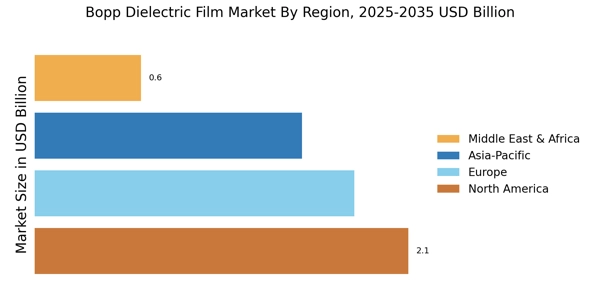
The North American BOPP dielectric film market is driven by increasing demand for sustainable packaging solutions and advancements in technology. The region holds approximately 35% of the global market share, making it the largest market. Regulatory support for eco-friendly materials and innovations in film production processes are key growth catalysts. The demand for high-performance films in electronics and automotive sectors further fuels this growth. Leading countries in this region include the United States and Canada, with the U.S. being the dominant player. Major companies such as DuPont Teijin Films and 3M are at the forefront, leveraging their technological expertise to enhance product offerings. The competitive landscape is characterized by continuous innovation and strategic partnerships, ensuring a robust supply chain and market presence.
Europe is witnessing significant growth in the BOPP dielectric film market, driven by stringent regulations promoting sustainable packaging and energy-efficient solutions. The region accounts for approximately 30% of the global market share, making it the second-largest market. The European Union's Green Deal and various national initiatives are pivotal in shaping market dynamics, encouraging investments in eco-friendly technologies and materials. Germany, France, and the UK are the leading countries in this market, with Germany being the largest producer of BOPP films. Key players like Mitsubishi Polyester Film and Toray Industries are actively expanding their operations in Europe, focusing on innovation and sustainability. The competitive landscape is marked by collaborations and mergers aimed at enhancing product portfolios and market reach, ensuring a strong foothold in the region.
The Asia-Pacific region is emerging as a powerhouse in the BOPP dielectric film market, driven by rapid industrialization and increasing consumer demand for packaged goods. This region holds approximately 25% of the global market share, with countries like India and China leading the charge. The growing electronics and automotive sectors are significant contributors to market growth, supported by favorable government policies and investments in manufacturing capabilities. India and China are the leading countries in this market, with a strong presence of local manufacturers such as Jindal Poly Films and Polyplex Corporation. The competitive landscape is characterized by a mix of established players and new entrants, focusing on cost-effective production and innovation. The region's market dynamics are further influenced by the increasing adoption of advanced technologies and sustainable practices in film production.
The Middle East and Africa (MEA) region presents significant growth opportunities in the BOPP dielectric film market, driven by increasing demand for packaging solutions in various industries. The region holds approximately 10% of the global market share, with countries like South Africa and Saudi Arabia leading the market. The growth is supported by investments in infrastructure and manufacturing capabilities, along with a rising consumer base seeking quality packaging solutions. South Africa and Saudi Arabia are the key players in this market, with local companies like SABIC and Uflex Limited making substantial contributions. The competitive landscape is evolving, with a focus on enhancing production efficiency and sustainability. As the region continues to develop, the presence of international players is expected to increase, further driving market growth and innovation.
The Bopp Dielectric Film Market is characterized by a dynamic competitive landscape, driven by increasing demand for high-performance films in various applications, including electronics, packaging, and automotive sectors. Key players such as Mitsubishi Polyester Film (Japan), Toray Industries (Japan), and Jindal Poly Films (India) are strategically positioned to leverage innovation and regional expansion to enhance their market presence. Mitsubishi Polyester Film (Japan) focuses on developing advanced film technologies, while Toray Industries (Japan) emphasizes sustainability in its production processes. Jindal Poly Films (India) is actively pursuing partnerships to broaden its product offerings, thereby shaping a competitive environment that is increasingly focused on technological advancements and sustainability initiatives.In terms of business tactics, companies are localizing manufacturing to reduce lead times and optimize supply chains, which is particularly crucial in a moderately fragmented market. The competitive structure is influenced by the collective actions of these key players, who are not only enhancing their operational efficiencies but also responding to the evolving demands of end-users. This localized approach allows for greater flexibility and responsiveness to market changes, which is essential in maintaining a competitive edge.
In August Mitsubishi Polyester Film (Japan) announced the launch of a new line of eco-friendly Bopp dielectric films designed for electronic applications. This strategic move underscores the company's commitment to sustainability and positions it favorably in a market increasingly driven by environmental considerations. The introduction of these films is expected to attract environmentally conscious consumers and businesses, thereby enhancing Mitsubishi's market share.
In September Toray Industries (Japan) expanded its production capacity for Bopp films in response to rising global demand. This expansion is indicative of Toray's proactive approach to scaling operations and meeting customer needs. By increasing its production capabilities, Toray aims to solidify its position as a leading supplier in the dielectric film sector, which could potentially lead to improved economies of scale and reduced production costs.
In July Jindal Poly Films (India) entered into a strategic partnership with a leading electronics manufacturer to co-develop specialized Bopp dielectric films tailored for high-performance applications. This collaboration not only enhances Jindal's product portfolio but also allows for shared expertise and resources, which could accelerate innovation and market penetration. Such partnerships are becoming increasingly vital in a competitive landscape where technological advancements are paramount.
As of October the Bopp Dielectric Film Market is witnessing trends that emphasize digitalization, sustainability, and the integration of advanced technologies such as AI. Strategic alliances are playing a crucial role in shaping the competitive landscape, enabling companies to pool resources and expertise. The shift from price-based competition to a focus on innovation, technology, and supply chain reliability is evident, suggesting that future competitive differentiation will hinge on the ability to adapt to these emerging trends.

Der Bopp-Dielektrikum-Film-Markt wird voraussichtlich von 2024 bis 2035 mit einer durchschnittlichen jährlichen Wachstumsrate (CAGR) von 3,74 % wachsen, angetrieben durch die steigende Nachfrage in den Bereichen Elektronik und Verpackung.
Neue Möglichkeiten liegen in:
Bis 2035 wird erwartet, dass der Markt seine Position als wichtiger Akteur in der globalen Materialindustrie festigt.
| MARKET SIZE 2024 | 6.107(USD Billion) |
| MARKET SIZE 2025 | 6.336(USD Billion) |
| MARKET SIZE 2035 | 9.149(USD Billion) |
| COMPOUND ANNUAL GROWTH RATE (CAGR) | 3.74% (2025 - 2035) |
| REPORT COVERAGE | Revenue Forecast, Competitive Landscape, Growth Factors, and Trends |
| BASE YEAR | 2024 |
| Market Forecast Period | 2025 - 2035 |
| Historical Data | 2019 - 2024 |
| Market Forecast Units | USD Billion |
| Key Companies Profiled | Mitsubishi Polyester Film (JP), Toray Industries (JP), BOPP Film (IN), Jindal Poly Films (IN), SABIC (SA), Polyplex Corporation (IN), Uflex Limited (IN), DuPont Teijin Films (US), 3M (US) |
| Segments Covered | Application, Substrate, Coating, Capacitance, End-use Industry, Regional |
| Key Market Opportunities | Growing demand for energy-efficient solutions drives innovation in the Bopp Dielectric Film Market. |
| Key Market Dynamics | Rising demand for energy-efficient solutions drives innovation and competition in the Bopp Dielectric Film market. |
| Countries Covered | North America, Europe, APAC, South America, MEA |
 Priya Nagrale

Bitte füllen Sie das folgende Formular aus, um ein kostenloses Muster dieses Berichts zu erhalten

“This is really good guys. Excellent work on a tight deadline. I will continue to use you going forward and recommend you to others. Nice job”
 Noah Malgeri
Co-Founder

“Thanks for sending the report it gives us a good global view of the Betaïne market.”
 Peter Groot koerkamp
Account and Business Manager

“We found the report very insightful! we found your research firm very helpful. I'm sending this email to secure our future business.”
 Younghwan Choi
Senior Retail Manager

“I am very pleased with how market segments have been defined in a relevant way for my purposes (such as "Portable Freezers & refrigerators" and "last-mile"). In general the report is well structured. Thanks very much for your efforts.”
 Mark Irwin
Management Consultant

“We got the report in time, we really thank you for your support in this process. I also thank to all of your team as they did a great job.”
 Akif Moroglu
Strategy & Business Development Director

“The Automotive 48V ECU Components Procurement Intelligence Study” was a complex project, but the Market Research Future (MRFR) team handled it with quality, agility, and customer-centricity. They delivered all requested data on time and within the agreed scope. The team, including Shubhendra Anand and Rahul Gotadki, was always readily available to clarify questions and swiftly implement necessary adjustments, driving the project to a successful conclusion within a very demanding timeframe.
I would also like to specifically commend Akshay Agarwal for his responsiveness and support at every stage—from our initial inquiry on May 6th through to final delivery on June 18th. His dedication made the entire process seamless.”
 Guilherme Gomes Martins
Product Management Director

“Thanks. It’s been a pleasure working with you, please use me as reference with any other Intel employees.”
 Joseph Aguayo
Sales Operations & Pricing Manager

“Thank you, this will be very helpful for OQS.”
 La Terria Dodd
Program Support Specialist

“I have been reading the first document or the study, ,the Global HVAC and FP market report 2021 till 2026. Must say, good info! I have not gone in depth at all parts, but got a good indication of the data inside!”
 Rob Kooiker
Group Product Manager HVAC & Fire Protection GMA